Grand Tetons in Teton County, Wyoming — The American West (Mountains)
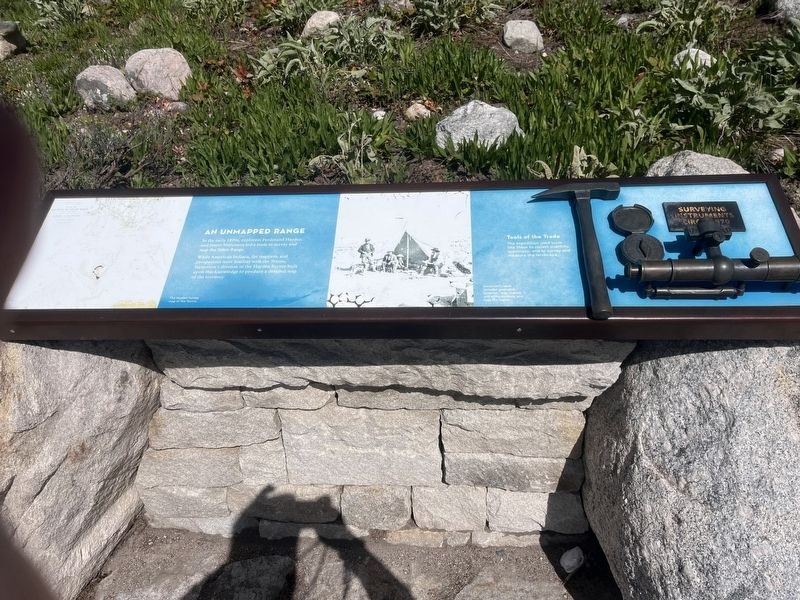
An Unmapped Range
Photographed by Thomas Smith, May 22, 2026
1. An Unmapped Range Marker
Inscription. In the early 1870s explorers Ferdinand Hayden and James Stevensonled a team to survey and map the Teton Range.
While American Indians, fur trappers ,and prospectors were familiar with the Tetons, Stevenson 's division of the Hayden Survey built upon this knowledge to produce a detailed map of the territory.
(caption:) The expedition used tools like these to collect scientific specimens, and to survey and measure the landscape.
Topics. This historical marker is listed in this topic list: Exploration.
Location. 43° 45.103′ N, 110° 43.515′ W. Marker is in Grand Tetons, Wyoming, in Teton County. It is at the intersection of S Jenny Lake Walkway and S. Jenny Lake Parking Lot Walkway on S Jenny Lake Walkway. Touch for map. Touch for directions.
Regionally, this marker is in Wyoming’s Colorado River Valley, specifically in Flagstaff & High Country, on the Mogollon Rim, in the Prescott Area, in Verde Valley, in the White Mountains, in The Valley (the San Fernando Valley), in the Inland Empire, in Silicon Valley, in the Coachella Valley, in the Colorado
Click or scan to see this page online
Desert, in the Gold Country, in the High Desert, in the Mojave Desert, in the San Bernardino Mountains, in the San Luis Valley, in the Berkshire Foothills, in the Connecticut River Valley, on the Connecticut Shoreline, on the Gold Coast, in Greater Bridgeport, in Greater Hartford, in Greater New Haven, in Greater New London, in the Knowledge Corridor, in the Litchfield Hills, in Mystic and the Eastern Shore, in the Quiet Corner, in the Thames River Valley, on Delaware’s Beaches, in Southern New Castle County, in the Everglades, on the Florida Keys, on Hilo and East Hawaii, on the Kona Coast, on North Shore Oahu, on Pearl Harbor and Historic West Oahu, in Upcountry Maui, in Lahaina and West Maui, on Windward Oahu, in the Quad Cities, on the Indiana Dunes and Lake Michigan Shore, in the Calumet Region, in the Spirit Lake Nation, in the Mandan, Hidatsa, and Arikara Nation, in the Turtle Mountain Band of Chippewa, on the Oglala Lakota Pine Ridge Reservation, in the Rosebud Sioux Tribe, in the Standing Rock Sioux Tribe, on the Cheyenne River Reservation, in the Crow Creek Sioux Tribe, on the Coeur d'Alene Reservation, in the Lower Brule Sioux Tribe, on the Kootenai Reservation, in the Sisseton-Wahpeton Oyate, on the Wind River Indian Reservation, on the Shoshone–Paiute Duck Valley Reservation, on the Southern Ute Indian Reservation, in the Yankton Sioux Tribe, in the Navajo Nation, on the Shoshone-Bannock Fort Hall Reservation, on the Ute Mountain Ute Indian Reservation, on Nez Perce Tribal Land, in the Blackfeet Nation, in the Crow Nation, in the Flathead Nation, in the Fort Belknap Indian Reservation, on the Fort Peck Indian Reservation, in the Northern Cheyenne Nation, on the Rocky Boy’s Reservation, in the Tohono O’odham Nation, in the White Mountain Apache Nation, in the Yavapai-Apache Nation, in the Amana Colonies, on Mount Desert Island, in the Kennebec Valley, in the Maine Highlands, in Midcoast Maine, on Penobscot Bay, on Southern Maine Coast, in the Western Maine Lakes and Mountains Region, in Greater Bangor, in Greater Portland, in the Baltimore Metro Region, in Central Maryland, in Historic Boston, on Cape Ann, on the North Shore, in the South Coast, on the South Shore, in Greater Boston, on the Straits of Mackinac, on the Boundary Waters Canoe Area Wilderness, in Greater Duluth — The Twin Ports, in Greater Billings, in the Lakes Region, in the Merrimack Valley, in North Jersey, in Central Jersey, on the Jersey Shore, in the Pine Barrens, in Piedmont Triad, on the Cape Fear Coast, on the Crystal Coast, in Greater Asheville, in Greater Charlotte, on the Outer Banks, in the Research Triangle, on the Oregon Coast, in the Blackstone Valley, in Greater Providence, on Narragansett Bay, in Newport and Aquidneck Island, in Historic Charleston, on the Grand Strand, on the Sea Islands, on Waccamaw Neck, in the Ashepoo, Combahee and Edisto Basin, in the Foothills, in Congaree Country, in Greater Burlington, in the Mid-Ohio Valley, in the Jackson Hole Area, and in Greater Yellowstone. It is also in the American Mountain West, in the Ohio River Valley, on the Colorado Plateau, in the Black Hills, in the Chesapeake Bay Region, and on the Eastern Seaboard. Globally, it is in the North Atlantic Region, North America, the Great North Woods, the Rocky Mountains, the Western Hemisphere, the Western World, and the Anglosphere. Historically, it finds itself in what was once Fairfield County, Hartford County, Litchfield County, Middlesex County, New Haven County, New London County, Tolland County, Windham County, the Viceroyalty of New France, and Acadia.
More about this marker. Behind Jenny Lake Visitor Center
Credits. This page was last revised on June 18, 2026. It was originally submitted on June 8, 2026, by Thomas Smith of Waterloo, Ill. This page has been viewed 16 times since then. Photo1. submitted on June 8, 2026, by Thomas Smith of Waterloo, Ill. • Andrew Ruppenstein was the editor who published this page.