Bare Cove Park in Hingham in Plymouth County, Massachusetts — The American Northeast (New England)
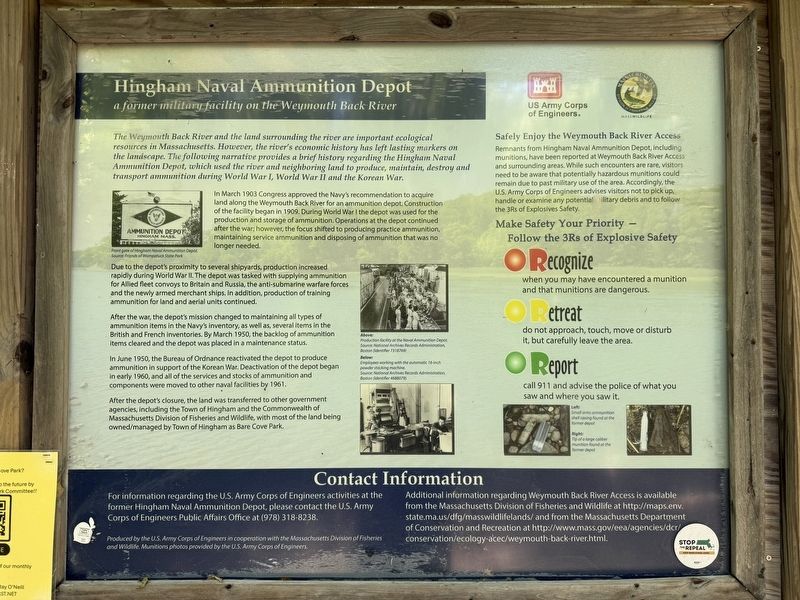
Hingham Naval Ammunition Depot
a former military facility on the Weymouth Back River
Photographed by G.W.Bartlett, June 3, 2026
1. Hingham Naval Ammunition Depot Marker
The Weymouth Back River and the land surrounding the river are important ecological resources in Massachusetts. However, the river's economic history has left lasting markers on the landscape. The following narrative provides a brief history regarding the Hingham Naval Ammunition Depot, which used the river and neighboring land to produce, maintain, destroy and transport ammunition during World War I, World War II and the Korean War.
In March 1903 Congress approved the Navy's recommendation to acquire land along the Weymouth Back River for an ammunition depot. Construction of the facility began in 1909. During World War I the depot was used for the production and storage of ammunition. Operations at the depot continued after the war; however, the focus shifted to producing practice ammunition, maintaining service ammunition and disposing of ammunition that was no longer needed.
Due to the depot's proximity to several shipyards, production increased rapidly during World War II. The depot was tasked with supplying ammunition for Allied fleet convoys to Britain and Russia, the anti-submarine warfare forces and the newly
this page online
After the war, the depot's mission changed to maintaining all types of ammunition items in the Navy's inventory, as well as, several items in the British and French Inventories. By March 1950, the backlog of ammunition items cleared and the depot was placed in a maintenance status.
In June 1950, the Bureau of Ordinance reactivated the depot to produce ammunition in support of the Korean War. Deactivation of the depot began in early 1960, and all of the services and stocks of ammunition and components were moved to other naval facilities by 1961.
After the depot's closure, the land was transferred to other government agencies, including the Town of Hingham and the Commonwealth of Massachusetts Division of Fisheries and Wildlife, with most of the land being owned/managed by Town of Hingham as Bare Cove Park.
Safely Enjoy the Weymouth Back River Access
Remnants from the Hingham Naval Ammunition Depot, including munitions have been reported at Weymouth Back River Accessand surrounding areas. While such encounters are rare,
Photographed by G.W.Bartlett, June 3, 2026
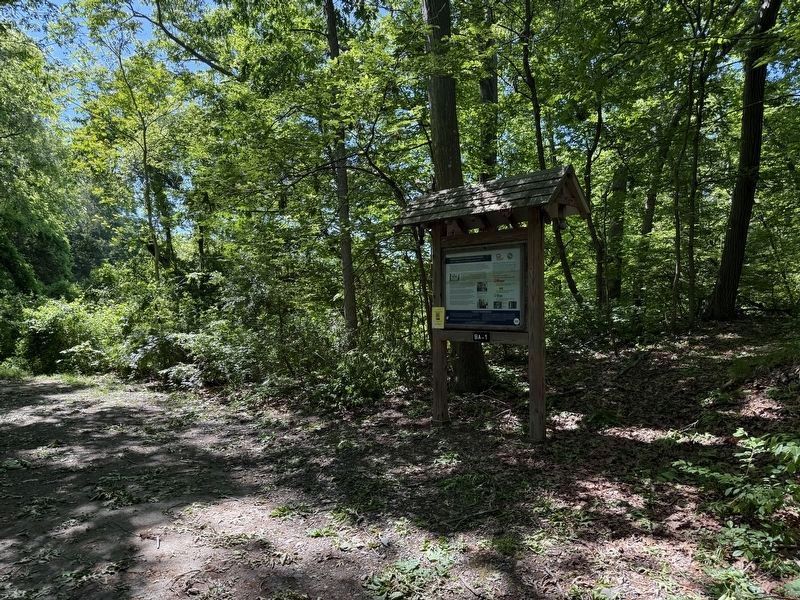
2. Hingham Naval Ammunition Depot Marker
Make Safety Your Priority — Follow the 3Rs of Explosive Safety Recognize when you may have encountered a munition and that munitions are dangerous.
Retreat do not approach, touch, move or disturb it, but carefully leave the area.
Report call 911and advise the police of what you saw and where you saw it.
( photo captions )
— Front gate of Hingham Naval Ammunition Depot. Source: Friends of Wompatuck State Park
— Production facility at the Naval Ammunition Depot. Source: National Archives Records Administration, Boston (Identifier 7318769)
— Employees working with the automatic 16-inch powder stacking machine. Source: National Archives Records Administration, Boston (Identifier 4688079)
— Small arms ammunition shell casing found at the former depot.
— Tip of a large caliber munition found at the former depot.
Contact Information
For information regarding the U.S. Army Corps of Engineers activities at the former Hingham Naval Ammunition Depot, please contact the U.S. Army Corps of Engineers Public Affairs Office at (redacted).
Additional information regarding Weymouth Back River Access is available from the Massachusetts Division of Fisheries and Wildlife at https://www.mass.gov/how-to/masswildlife-lands-viewer and from the Massachusetts Department of Conservation and Recreation at https://www.mass.gov/orgs/executive-office-of-energy-and-environmental-affairs .
Produced by the U.S. Army Corps of Engineers in cooperation with the Massachusetts Division of Fisheries and Wildlife. Munitions photos provided by the U.S. Army Corps of Engineers.
Erected by U.S. Army Corps of Engineers.
Topics. This memorial is listed in these topic lists: Industry & Commerce • War, Korean • War, World I • War, World II.
Location. 42° 14.75′ N, 70° 55.717′ W. Memorial is in Hingham, Massachusetts, in Plymouth County. It is in Bare Cove Park. It is at the intersection of Beal Street and Massachusetts Route 3A, on the left when traveling north on Beal Street. Located on the Bunker Alley Path in the Back River Wildlife Sanctuary and Reservation, part of Bare Cove Park. Touch for map. Memorial is in this post office area: Hingham MA 02043, United States of America. Touch for directions.

Regionally, this memorial is on the South Shore. It is also in the American Northeast, in New England, and on the Eastern Seaboard. Globally, it is in the North Atlantic Region, North America, the Western Hemisphere, the Western World, and the Anglosphere. Historically, it finds itself in what was once one of the original Thirteen Colonies.
Other nearby markers. At least 8 other markers are within walking distance of this marker: Third Almshouse (approx. ¼ mile away); Great Esker Park (approx. ¼ mile away); Hingham "Town Farm" (approx. 0.3 miles away); Almshouse (approx. 0.3 miles away); Abigail Adams to John Adams, March-April 1776 (approx. 0.3 miles away); Abigail Smith Adams (approx. 0.3 miles away); Abigail Adams to John Adams, May 18, 1778 (approx. 0.3 miles away); Abigail Adams to John Adams, August 5, 1777 (approx. 0.3 miles away). Touch for a list and map of all markers in Hingham.
Also see . . .
1. Bare Cove Park - Town of Hingham. Bare Cove Park is not a "Dog Park" - Required to walk dogs here...
Bare Cove Park Map Opens in new window... Bare Cove Park consists of 484 acres located along the banks of the Weymouth Back River in the town of Hingham, Massachusetts. Set aside as a wildlife sanctuary and a place for public recreation, the park is an exceptional area of river shoreline, wetland, open fields, dense woods, and diverse animal and plant life. (Submitted on June 3, 2026, by G.W.Bartlett of Hingham, Massachusetts.)
2. Massachusetts Division of Fisheries and Wildlife.
The Viewer helps you find and learn about Wildlife Management Areas, Wildlife Conservation Easements, and other open space in Massachusetts. MassWildlife's WMAs and WCEs are all open to fishing, hunting, hiking, bird watching, and more!(Submitted on June 11, 2026, by G.W.Bartlett of Hingham, Massachusetts.)
3. Massachusetts Department of Conservation and Recreation.
EEA seeks to protect, preserve, and enhance the Commonwealth’s environmental resources while ensuring a clean energy future for the state’s residents. Through the stewardship of open space, protection of environmental resources, and enhancement of clean energy, the Executive Office of Energy and Environmental Affairs works tirelessly to make Massachusetts a wonderful place to live, work, and raise a family.(Submitted on June 11, 2026, by G.W.Bartlett of Hingham, Massachusetts.)
Credits. This page was last revised on June 11, 2026. It was originally submitted on June 3, 2026, by G.W.Bartlett of Hingham, Massachusetts. This page has been viewed 26 times since then. Last updated on June 11, 2026, by G.W.Bartlett of Hingham, Massachusetts. Photos: 1, 2. submitted on June 3, 2026, by G.W.Bartlett of Hingham, Massachusetts. • Devry Becker Jones was the editor who published this page.
