Near Deerwalk in Wood County, West Virginia — The American South (Appalachia)
The Endless Cable System

Photographed by Bradley Owen, May 29, 2026
1. The Endless Cable System Marker
This schematic is of George West's endless cable system. It was the last system to operate in the Volcano oil fields. It operated through 1972.
The red arrows show the endless cable entering and leaving the engine house. Though primitive by today's technological advances, it is far from being a simple process.
Once the endless cable left the engine house it was routed to the well site as pictured above. A single engine house could pump as many as 40 wells simultaneously. At times, the only sound at the well site would be creaking of the wheels as the cable wound around it and moved to the next well.
Power is built up as the canvas belt moves around the larger wooden wheels on either side of the engine. The engine is left of center between the identical flywheels as noted by white arrows.
In the background are the wooden wheels guiding the cable to and from the well sites. NOTE: these wheels are nearly at ceiling height.
The wheel on the left is receiving the cable. It is routed around the wheel in the middle and
this page online
This is the single cylinder, 40 horsepower, engine that powered Mr. West's endless cable system. The engine was noted for power and not speed. Starting it could be dangerous as one turned the flywheel backwards and the kickback when it started could break an arm or leg. The "spark plug" was a pilot light.
The larger wheel is anchored via a concrete base. The white arrow on the left points to the next well on the "loop."
In hot weather the endless cable would expand and in times of colder weather it would contract, thus hampering operations. A simple solution was having a wheel installed on a window assembly. Open or close the window to keep proper tension on the cable.
Erected by The Friends of Mountwood Park.
Topics. This historical marker is listed in this topic list: Industry & Commerce. A significant historical year for this entry is 1972.
Location. 39° 14.595′ N, 81° 18.068′ W. Marker is near

Photographed by Bradley Owen, May 29, 2026
2. The Endless Cable System Marker

Regionally, this marker is in West Virginia’s Mid-Ohio Valley. It is also in the American South, specifically in the Upper South, in the Ohio River Valley, in Appalachia, and specifically in Northern Appalachia. Globally, it is in North America, the Western Hemisphere, the Western World, and the Anglosphere. Historically, it finds itself in what was once the Viceroyalty of New France and also the territory of the Mississippian Culture.
Other nearby markers. At least 8 other markers are within walking distance of this marker: Sixteen Horsepower Gas Engine (here, next to this marker); Oil Pump (here, next to this marker); Wheels Of The Endless Cable (here, next to this marker); Laurel Fork & Sand Hill Railroad (a few steps from this marker); Volcano's Schools
Photographed by Bradley Owen, May 29, 2026
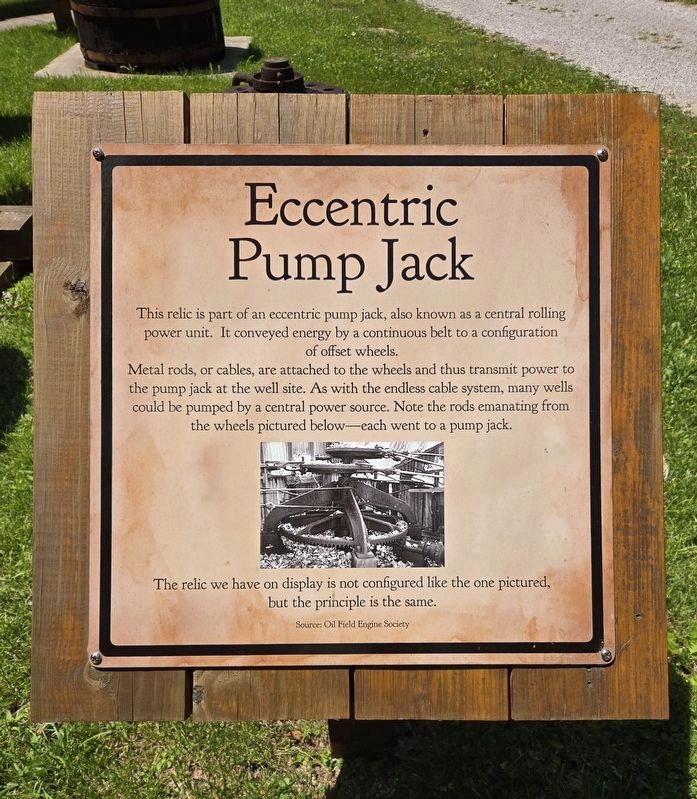
3. Eccentric Pump Jack Marker
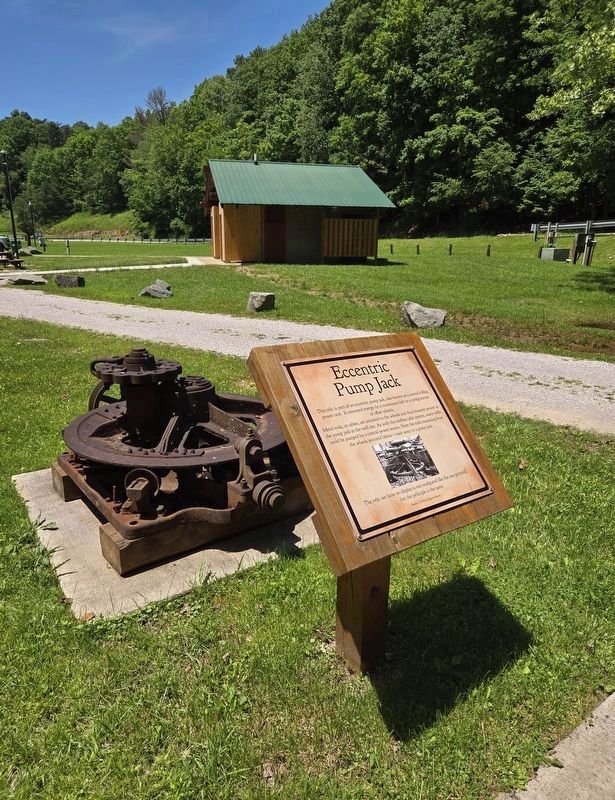
This relic is part of an eccentric pump jack, also known as a central rolling power unit. It conveyed energy by a continuous belt to a configuration of offset wheels.
Metal rods, or cables, are attached to the wheels and thus transmit power to the pump jack at the well site. As with the endless cable system, many wells could be pumped by a central power source. Note the rods emanating from the wheels pictured below - each went to a pump jack.
The relic we have on display is not configured like the one pictured, but the principle is the same.
Source: Oil Field Engine Society
Photographed by Bradley Owen, May 29, 2026
4. Eccentric Pump Jack and Marker
Located on the grounds of the Volcano Museum.
Photographed by Bradley Owen, May 29, 2026
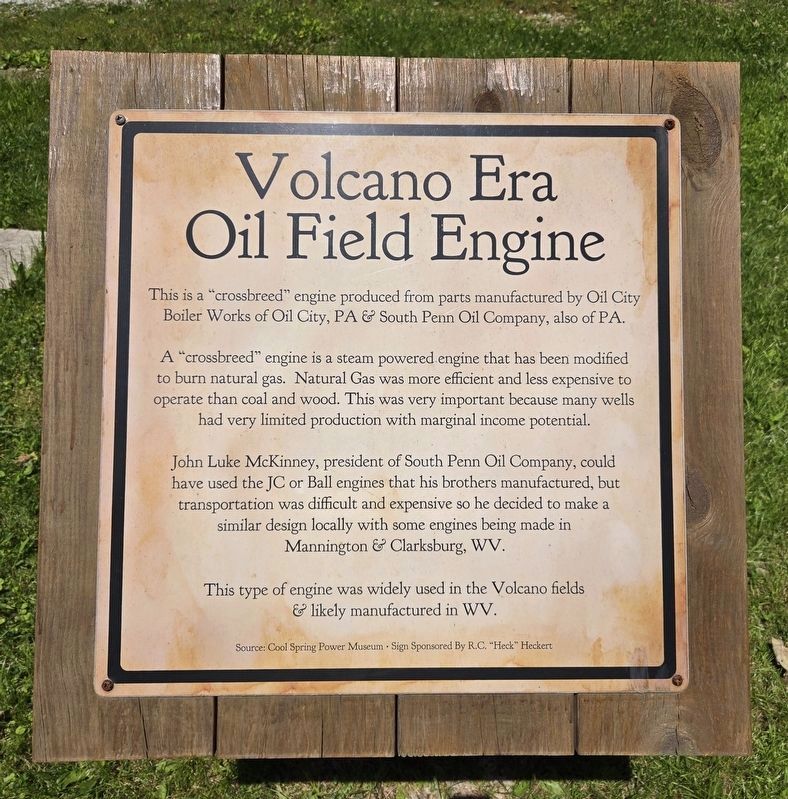
5. Volcano Era Oil Field Engine Marker
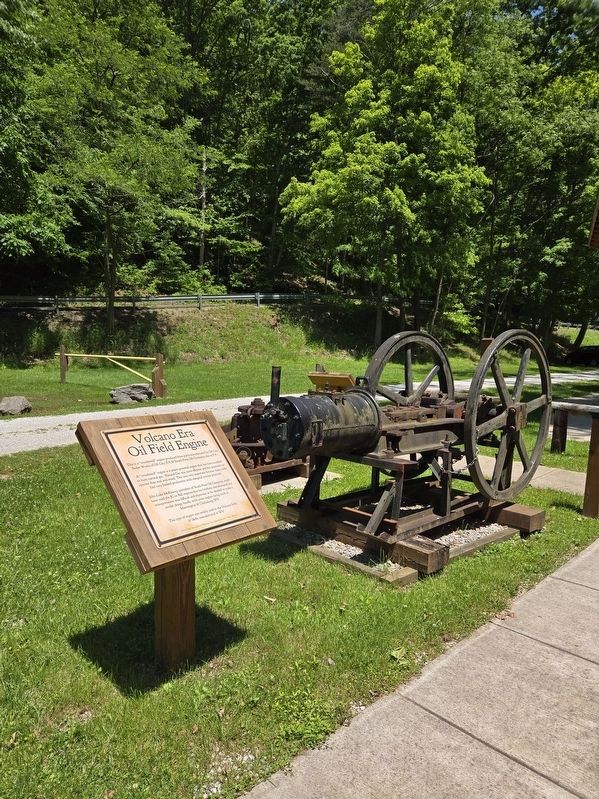
This is a "crossbreed" engine produced from parts manufactured by Oil City Boiler Works of Oil City, PA & South Penn Oil Company, also of PA.
A "crossbreed" engine is a steam powered engine that has been modified to burn natural gas. Natural Gas was more efficient and less expensive to operate than coal and wood. This was very important because many wells had very limited production with marginal income potential.
John Luke McKinney, president of South Penn Oil Company, could have used the JC or Ball engines that his brothers manufactured, but transportation was difficult and expensive so he decided to make a similar design locally with some engines being made in Mannington & Clarksburg, WV.
This type of engine was widely used in the Volcano fields & likely manufactured in WV.
Source: Cool Spring Power Museum • Sign Sponsored By R.C. "Heck" Heckert
Photographed by Bradley Owen, May 29, 2026
6. Volcano Era Oil Field Engine and Marker
Credits. This page was last revised on June 15, 2026. It was originally submitted on June 12, 2026, by Bradley Owen of Morgantown, West Virginia. This page has been viewed 14 times since then. Photos: 1, 2. submitted on June 12, 2026, by Bradley Owen of Morgantown, West Virginia. 3, 4, 5, 6. submitted on June 15, 2026, by Bradley Owen of Morgantown, West Virginia.
