
Residence Park in Dayton in Montgomery County, Ohio — The American Midwest (Great Lakes)
Infantry Massachusetts 1st Cavalry
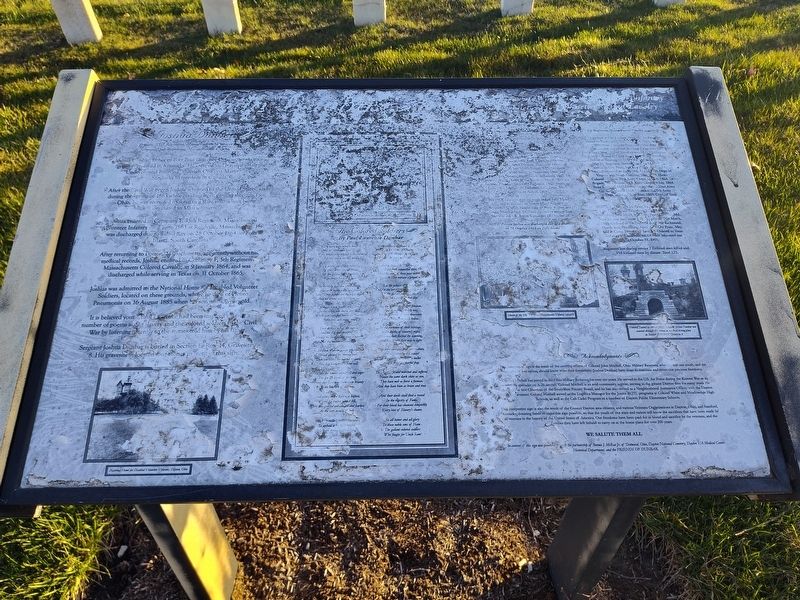
Photographed by Craig Doda, March 21, 2026
1. Infantry Massachusetts 1st Cavalry Marker
Joshua Dunbar
Private, 55th Regiment, Massachusetts Volunteer Infantry
Sergeant, 5th Regiment, Massachusetts Colored Cavalry
Joshua Dunbar, father of Poet Paul Laurence Dunbar, was born and grew up enslaved in Kentucky. He escaped and traveled along the "Underground Railroad" through Ohio via Marysville and Sandusky to freedom in Canada.
After the Civil War began Joshua returned to the United States, and during the spring of 1863 while residing in or passing through Troy, Ohio, he was recruited to serve in a state militia unit being organized in Massachusetts.
Joshua enlisted in Company F, 55th Regiment, Massachusetts Volunteer Infantry on 2 June 1863 at Readville, Massachusetts. He was discharged due to a disability on 28 October 1863 on Folly Island, South Carolina.
After returning to Boston, Massachusetts, apparently without his medical records, Joshua enlisted in Company F, 5th Regiment, Massachusetts Colored Cavalry on 9 January 1864, and was discharged while serving in Texas on 31 October 1865.
Joshua was admitted to the National Home for Disabled Volunteer Soldiers, located on these grounds, where
this page online
It is believed young Paul Laurence had been inspired to write a number of poems about slavery and the colored soldiers in the Civil War by listening intently to the stories told him by his father.
Sergeant Joshua Dunbar is buried in Section E, Row 14, Gravesite 8. His gravesite is located four stones in front of this sign.
The Colored Soldiers
By Paul Laurence Dunbar
If the muse were mine to tempt it
And my feeble voice were strong,
If my tongue were trained to measures,
I would sing a stirring song.
I would sing a song heroic
Of those noble sons of Ham,
Of the gallant colored soldiers
Who fought for Uncle Sam.
In the early days you scorned them,
And with many a flip and flount
Said "These battles are the white man's
And the whites will fight them out."
Up the hills you fought and faltered,
In the vales you strove and bled,
While your ears still heard the thunder
Of the foes' advancing tread.
Then distress fell on the nation,
And the flag was drooping low;
Should the dust pollute your banner?
No! the nation shouted, No!
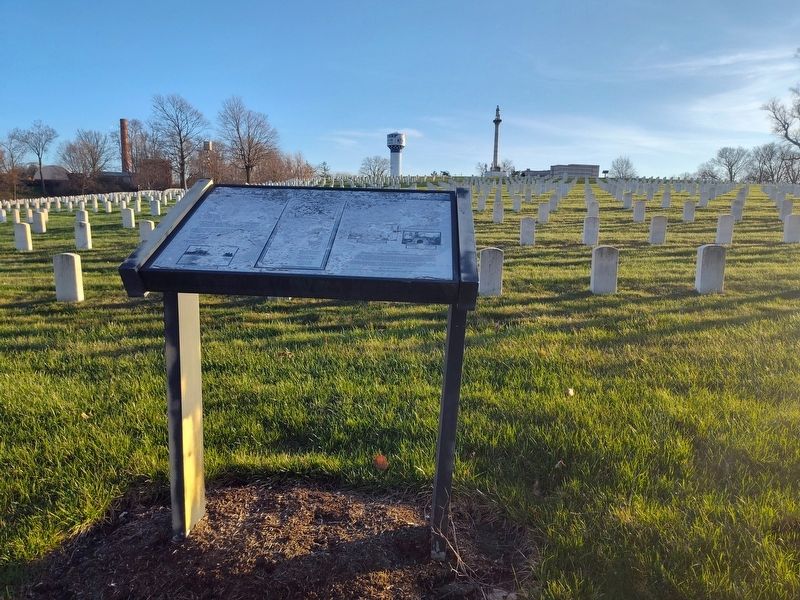
So whenWar, in savage triumphPhotographed by Craig Doda, March 21, 20262. Infantry Massachusetts 1st Cavalry Marker
Spread abroad his funeral pall -
Then you called the colored soldiers,
And they answered to your call.
And like the hounds unleashed and eager
For the life blood of the prey,
Sprung they forth and bore them bravely
In the thickest of the fray.
And where'er the fight was hottest,
Where the bullets fastest fell,
There they pressed unblanched and fearless
At the very mouth of hell.
Ah, they rallied to the standard
To uphold it by their might;
None were stronger in the labor,
None were braver in the fight.
From the blazing breach of Wagner,
To the plains of Olustee,
They were foremost in the fight
Of the battles of the free.
And at Pillow! God have mercy
On the deeds committed there,
And the souls of those poor victims
Sent to Thee without a prayer.
Let the fullness of Thy pity
O'er the hot wrought spirits
Of the gallant colored soldiers
Who fell fighting on that day!
Yes, the Blacks enjoy their freedom,
And they won it dearly too;
For the lifeblood of their thousands
Did the southern fields bedew.
In the darkness of their bondage,
In the depths of slavery's night,
Their muskets flashed the dawning,
And they fought their way to light.
They were comrades then and brothers,
Are they more or less today?
They were good to stop a bullet
And to front the fearful fray.
They have slept and marched and suffered
Neath the same dark skies as you,
They have met as fierce a foeman,
And they have been as brave and true.
And their deeds shall find a record
In the registry of Fame;
For their blood has cleansed completely
Every blot of Slavery's shame.
So all honor and all glory
To those noble sons of Ham -
The gallant colored soldiers
Who fought for Uncle Sam!
5th Regiment, Massachusetts Cavalry (Colored)
Organized at Camp Meigs, Readville. 1st Battalion moved to Washington, D.C., May 8, 1864. At Camp Stoneman, Giesboro Point, Md., May 8-12. Dismounted and moved to Camp Casey, near Fort Albany, May 12. 2nd Battalion moved to Washington May 6-8, and to Camp Casey May 9. 3rd Battalion moved to Washington May 11, and to Camp Casey May 11. Regiment moved to Fort Monroe, Va., thence to City Point, Va., May 16. Attached to Rand's Provisional Brigade, 18th Army Corps, Dept. of Virginia and North Carolina, May, 1864. Hink's Colored Division, 18th Army Corps, to June, 1864. 1st Brigade, 3rd Division, 18th Army Corps to July, 1864. Point Lookout, Md., District of St. Mary's, 22nd Army Corps to March, 1865; Unattached, 25th Army Corps, Dept. of Virginia, to June, 1865. Dept. of Texas to October, 1865.
SERVICE - Duty at City Point, Va., as infantry till June 16, 1864. Before Petersburg June 16-19. Siege of Petersburg June 16-28. Moved to Point Lookout, Md., June 30, and duty there guarding prisoners till March, 1865. Ordered to the field and duty near Richmond, March; near Petersburg, April; near City Point, May, and at Camp Lincoln till June 16. Ordered to Texas and duty at Clarksville till October. Mustered out October 31, 1865.
Regiment lost during service 7 Enlisted men killed and 116 Enlisted men by disease. Total 123.
Acknowledgments
This interpretive sign is the result of the untiring efforts of Colonel John Mitchell, Ohio Military Reserves, who felt that our youth, and the peoples of our nation, should know what their forefathers (Joshua Dunbar) have done to maintain and retain our precious freedoms.
Colonel Mitchell has served in the Ohio Military Reserves for over ten years. He served in the U.S. Air Force during the Korean War as an armament specialist on A-26 aircraft. Colonel Mitchell is an avid community activist, serving in the greater Dayton area for many years. He served as the first Chairman of the SouthWest Priority Board, and he has also served as a Neighborhood Assistance Officer with the Dayton Police Department. Colonel Mitchell served as the Logistics Manager for the Junior ROTC programs at Colonel White and Meadowdale High Schools, as well as the Cub Cadet Program in a number of Dayton Public Elementary Schools.
This interpretive sign is also the result of the Greater Dayton area citizens, and various Veterans Organizations in Dayton, Ohio, and Stanford, Kentucky, donating funds to make this sign possible, so that the youth of our state and nation will know the sacrifices that have been made by all veterans in the history of the United States of America. Our freedoms have been paid for in blood and sacrifice by the veterans, and the families they have left behind to carry on at the home place for over 200 years.
We Salute Them All
The content of this sign was provided through the partnership of Bennie J. McRae Jr. of Trotwood, Ohio, Dayton National Cemetery, Dayton VA Medical Center Historical Department, and the Friends of Dunbar.
Erected by Bennie J. McRae Jr.; Dayton National Cemetery; Dayton VA Medical Center Historical Department; Friends of Dunbar.
Topics. This historical marker is listed in these topic lists: African Americans • Air & Space • Arts, Letters, Music • Military. A significant historical date for this entry is January 9, 1864.
Location. 39° 44.874′ N, 84° 15.574′ W. Marker has been reported damaged. Marker is in Dayton, Ohio, in Montgomery County. It is in Residence Park. It is at the intersection of McMahon Avenue and Wisconsin Avenue, on the right when traveling east on McMahon Avenue. Touch for map. Marker is at or near this postal address: 4397 W Third St, Dayton OH 45417, United States of America. Touch for directions.

Regionally, this marker is in Ohio’s Miami Valley. It is also in the American Midwest and in the Corn Belt. Globally, it is in North America, the Western Hemisphere, the Western World, and the Anglosphere. Historically, it finds itself in what was once the Haudenosaunee (Iroquois) Confederacy, the territory of the Mississippian Culture, and the Northwest Territory.
Other nearby markers. At least 8 other markers are within walking distance of this location: Dayton National Cemetery Civil War Memorial (about 400 feet away, measured in a direct line); A National Cemetery System (about 400 feet away); AMVETS Carillon (about 400 feet away); Memorial (about 500 feet away); Veterans Memorial (about 500 feet away); "A Promise Made - A Commitment Kept" (about 700 feet away); Navy Seabees (approx. 0.2 miles away); Freemasons of Ohio (approx. 0.2 miles away). Touch for a list and map of all markers in Dayton.
Credits. This page was last revised on June 15, 2026. It was originally submitted on June 12, 2026, by Craig Doda of Napoleon, Ohio. This page has been viewed 14 times since then. Photos: 1, 2. submitted on June 12, 2026, by Craig Doda of Napoleon, Ohio. • Devry Becker Jones was the editor who published this page.
