Mitte in Leipzig, Saxony, Germany — Central Europe
Solidarność
⎯⎯⎯
Solidarität
⎯⎯⎯
Solidarity
Photographed by James Hulse, March 11, 2026
1. Solidarność / Solidarität / Solidarity Marker

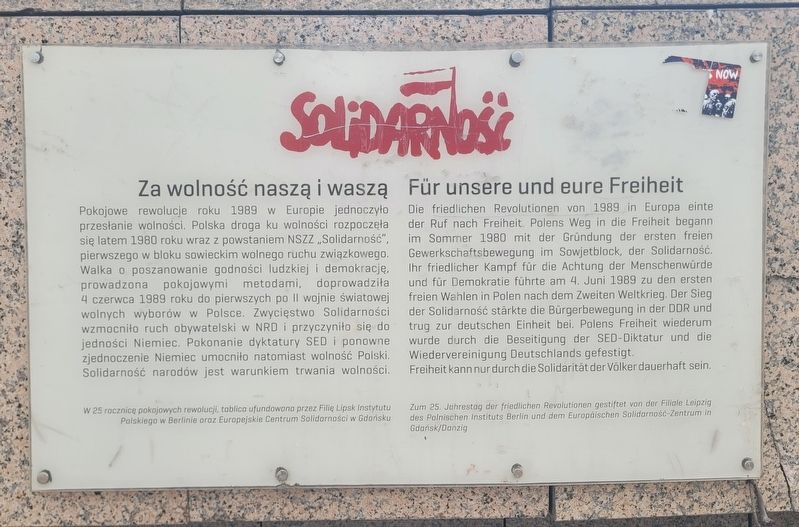
Za wolność naszą i waszą
Pokojowe rewolucje roku 1989 w Europie jednoczyło przesłanie wolności. Polska droga ku wolności rozpoczęła się latem 1980 roku wraz z powstaniem NSZZ „Solidarność”, pierwszego w bloku sowieckim wolnego ruchu związkowego. Walka o poszanowanie godności ludzkiej i demokrację, prowadzona pokojowymi metodami, doprowadziła 4 czerwca 1989 roku do pierwszych po II wojnie światowej wolnych wyborów w Polsce. Zwycięstwo Solidarności wzmocniło ruch obywatelski w NRD i przyczyniło się do jedności Niemiec. Pokonanie dyktatury SED i ponowne zjednoczenie Niemiec umocniło natomiast wolność Polski. Solidarność narodów jest warunkiem trwania wolności.
W 25. rocznicę pokojowych rewolucji, tablica ufundowana przez Filię Lipsk Instytutu Polskiego w Berlinie oraz Europejskie Centrum Solidarności w Gdańsku.
Für unsere und eure Freiheit
Die friedlichen Revolutionen von 1989 in Europa einte der Ruf nach Freiheit. Polens Weg
this page online
Zum 25. Jahrestag der friedlichen Revolutionen gestiftet von der Filiale Leipzig des Polnischen Instituts Berlin und dem Europäischen Solidarność-Zentrum in Gdańsk/Danzig.
For Our Freedom and Yours
The peaceful revolutions of 1989 in Europe were united by the ideal of freedom. Poland's road to freedom began in the summer of 1980 with the founding of the Independent Self-Governing Trade Union “Solidarity” (NSZZ Solidarność), the first free trade union movement in the Soviet bloc. The struggle for
Photographed by James Hulse, March 11, 2026
2. Solidarność / Solidarität / Solidarity Marker
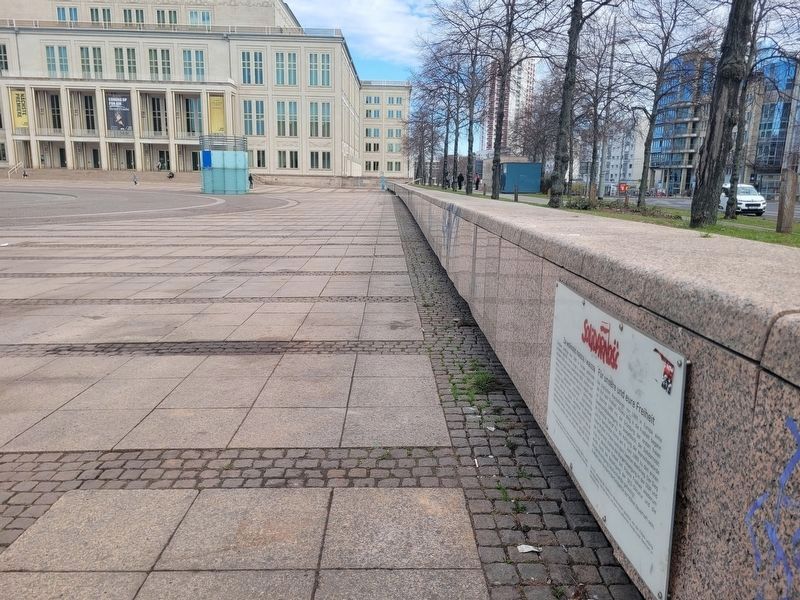
The view of the marker with the Leipzig Opera in the background.
On the 25th anniversary of the peaceful revolutions, this plaque was donated by the Leipzig Branch of the Polish Institute in Berlin and the European Solidarity Centre in Gdańsk.
Erected 2014 by Leipzig Branch of the Polish Institute in Berlin and the European Solidarity Centre in Gdańsk.
Topics. This historical marker is listed in this topic list: Government & Politics. A significant historical date for this entry is June 4, 1989.
Location. 51° 20.344′ N, 12° 22.894′ E. Marker is in Leipzig, Sachsen (Saxony). It is in Mitte. It is at the intersection of Augustusplatz and Grimmaischer Steinweg, on the right when traveling west on Augustusplatz. Touch for map. Marker is at

Photographed by James Hulse, March 11, 2026
3. Solidarność / Solidarität / Solidarity Marker
The view of the marker along the street. The marker is located to the left side of the bus on the wall.

Regionally, this marker is in Central Germany. Globally, it is in Europe, the European Union, Atlantic Europe, Central Europe, the Schengen Area, Western Europe, and the Western World. Historically, it finds itself in what was once the Holy Roman Empire and also the former East Germany.
Other nearby markers. At least 8 other markers are within walking distance of this marker: Der Tag der Entscheidung / The day of decision (here, next to this marker); Oper Leipzig / Leipzig Opera House (about 90 meters away, measured in a direct line); Neues Gewandhaus / New Gewandhaus (about 120 meters away); Zum Gedenken an die Familie Bamberger / In Memory of the Bamberger Family (about 120 meters away); Freie Wahlen / Free Elections (about 120 meters away); Universitätskirche St. Pauli / St. Paul's University Church (about 120 meters away); Paulinum - Aula und Universitätskirche St. Pauli (about 120 meters away); Tympanon-Fries des Leipziger Neuen Theaters / Tympanum Frieze of Leipzig's New Theater (about 150 meters away). Touch for a list and map of all markers in Leipzig.
Credits. This page was last revised on June 16, 2026. It was originally submitted on June 15, 2026, by James Hulse of Medina, Texas. This page has been viewed 15 times since then. Photos: 1, 2, 3. submitted on June 16, 2026, by James Hulse of Medina, Texas.
