Tooele in Tooele County, Utah — The American Mountains (Southwest)
The Powerhouse
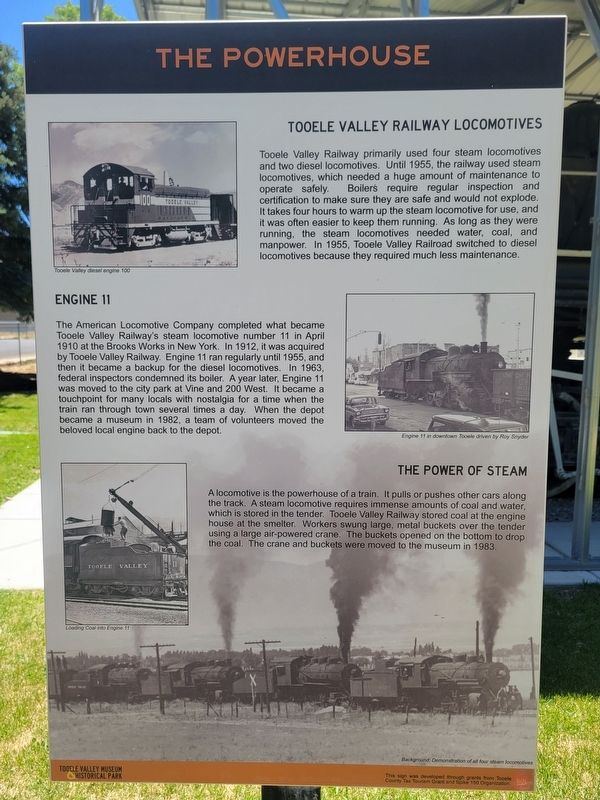
Photographed by Jeremy Snow, June 12, 2026
1. The Powerhouse Marker
Tooele Valley Railway Locomotives
Tooele Valley Railway primarily used four steam locomotives and two diesel locomotives. Until 1955, the railway used steam locomotives, which needed a huge amount of maintenance to operate safely. Boilers require regular inspection and certification to make sure they are safe and would not explode. It takes four hours to warm up the steam locomotive for use, and it was often easier to keep them running. As long as they were running, the steam locomotives needed water, coal, and manpower. In 1955, Tooele Valley Railroad switched to diesel locomotives because they required much less maintenance.
Engine 11
The American Locomotive Company completed what became Tooele Valley Railway's steam locomotive number 11 in April 1910 at the Brooks Works in New York. In 1912, it was acquired by Tooele Valley Railway. Engine 11 ran regularly until 1955, and then it became a backup for the diesel locomotives. In 1963, federal inspectors condemned its boiler. A year later, Engine 11 was moved to the city park at Vine and 200 West. It became a touchpoint for many locals with nostalgia
this page online
The Power of Steam
A locomotive is the powerhouse of a train. It pulls or pushes other cars along the track. A steam locomotive requires immense amounts of coal and water, which is stored in the tender. Tooele Valley Railway stored coal at the engine. house at the smelter. Workers swung large, metal buckets over the tender using a large air-powered crane. The buckets opened on the bottom to drop the coal. The crane and buckets were moved to the museum in 1983.
Topics. This historical marker is listed in this topic list: Railroads & Streetcars. A significant historical year for this entry is 1912.
Location. 40° 31.862′ N, 112° 17.298′ W. Marker is in Tooele, Utah, in Tooele County. It can be reached from the intersection of North Broadway Street and E. Vine Street, on the left when traveling north. Marker located inside the Tooele Valley Museum Historical Park. Touch for map. Marker is at or near this postal address: 35 N Broadway Street, Tooele UT 84074,
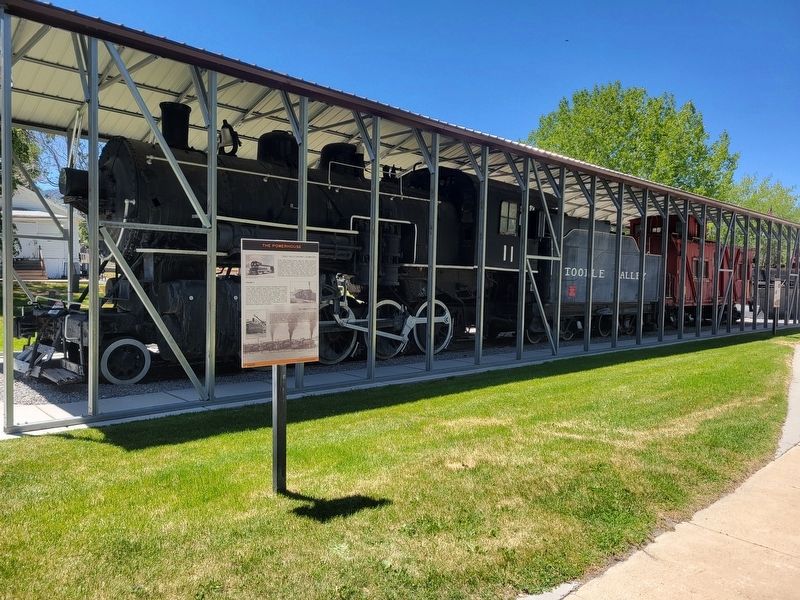
Photographed by Jeremy Snow, June 12, 2026
2. The Powerhouse Marker

Regionally, this marker is in the Wasatch Front, in the West Desert, and in Greater Salt Lake. It is also in the American Mountain West and on the Colorado Plateau. Globally, it is in North America, the Rocky Mountains, the Western Hemisphere, the Western World, and the Anglosphere. Historically, it finds itself in what was once New Spain and also Mexico’s Alta California.
Other nearby markers. At least 8 other markers are within walking distance of this marker: Tooele Valley Railway Depot (a few steps from this marker); The Caboose (a few steps from this marker); Tooele Valley Railroad Complex (within shouting distance of this marker); The Military in Tooele (within shouting distance of this marker); Working on the Railway (within shouting distance of this marker); Railroads in Tooele County (within shouting distance of this marker); Mining in Tooele (about 300 feet away, measured in a direct line); Tooele Carnegie Free Public Library (approx. half a mile away). Touch for a list and map of all markers in Tooele.
Credits. This page was last revised on June 16, 2026. It was originally submitted on June 15, 2026, by Jeremy Snow of Cedar City, Utah. This page has been viewed 11 times since then. Photos: 1, 2. submitted on June 15, 2026, by Jeremy Snow of Cedar City, Utah. • Andrew Ruppenstein was the editor who published this page.
