Broek in Waterland in Waterland, North Holland, Netherlands — Northwestern Europe
Zicht op Havenrak
⎯⎯⎯
View of Havenrak
| — | Waterlands Raboroute | — |
Photographed by Andrew Ruppenstein, June 2, 2026
1. Zicht op Havenrak / View of Havenrak Marker

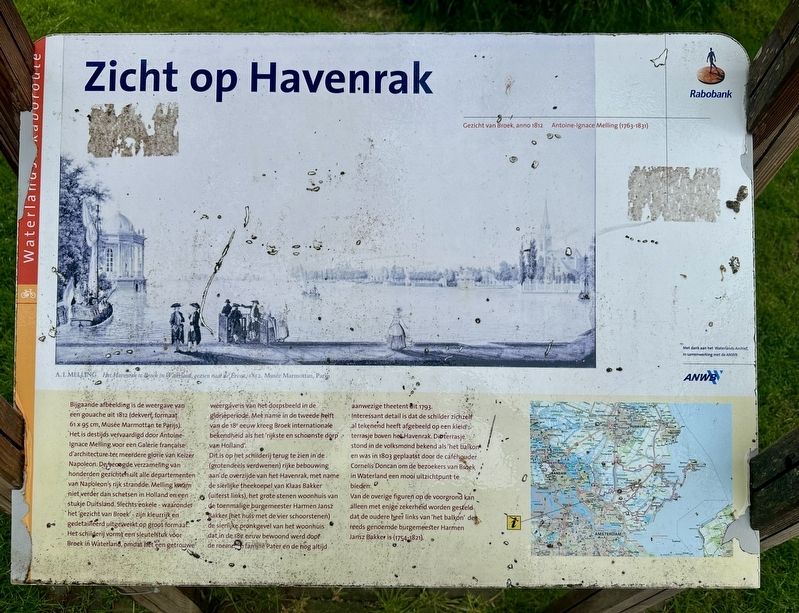
Bijgaande afbeelding is de weergave van een gouache uit 1812 (dekvert, formaat 61 x 95 cm, Musée Marmottan te Parijs). Het is destijds vervaardigd door Antoine-Ignace Melling voor een Galerie française d'architecture ter meerdere glorie van Keizer Napoleon. Debeoogde verzameling van honderden gezichten uit alle departementen van Napoleon's rijk strandde. Melling kwam niet verder dan schetsen in Holland en een stukje Duitsland. Slechts enkele - waaronder het ‘gezicht van Broek’ - zijn kleurrijk en gedetailleerd uitgewerkt op groot formaat. Het schilderij vormt een sleutelstuk voor Broek in Waterland, omdat het een getrouwe weergave is van het dorpsbeeld in de glorieperiode. Met name in de tweede helft van de 18e eeuw kreeg Broek internationale bekendheid als het ‘rijkste en schoonste dorp van Holland’.
Dit is op het schilderij terug te zien in de (grotendeels verdwenen) rijke bebouwing aan de overzijde van het Havenrak, met name de sierlijke theekoepel van Klaas Bakker (uiterst links), het grote stenen woonhuis van de toenmalige burgemeester Harmen Jansz Bakker (het huis met de vier schoorstenen) de
this page online
Interessant detail is dat de schilder zichzelf al tekenend heeft afgebeeld op een klein terrasje boven het Havenrak. Dit terrasje stond in de volksmond bekend als ‘het balkon’ en was in 1803 geplaatst door de caféhouder Cornelis Doncan om de bezoekers van Broek in Waterland een mooi uitzichtpunt te bieden.
Van de overige figuren op de voorgrond kan alleen met enige zekerheid worden gesteld dat de oudere heer links van 'het balkón' de reeds genoemde burgemeester Harmen Jansz Bakker is (1754-1821).
View of Havenrak
The accompanying image shows a gouache from 1812 (gouache on paper, measuring 61 x 95 cm; Musée Marmottan, Paris). It was created at the time by Antoine-Ignace Melling for a Galerie française d'architecture intended to glorify Emperor Napoleon. The planned collection—comprising hundreds of views from across the departments of Napoleon's empire—never came to fruition; Melling got no further than making sketches in Holland and parts of Germany.
Photographed by Andrew Ruppenstein, June 2, 2026
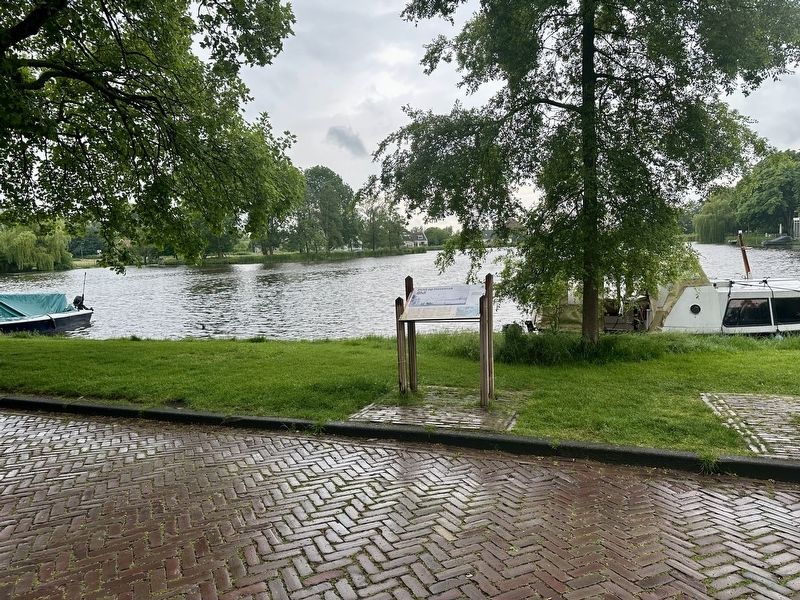
2. Zicht op Havenrak / View of Havenrak Marker - wide view
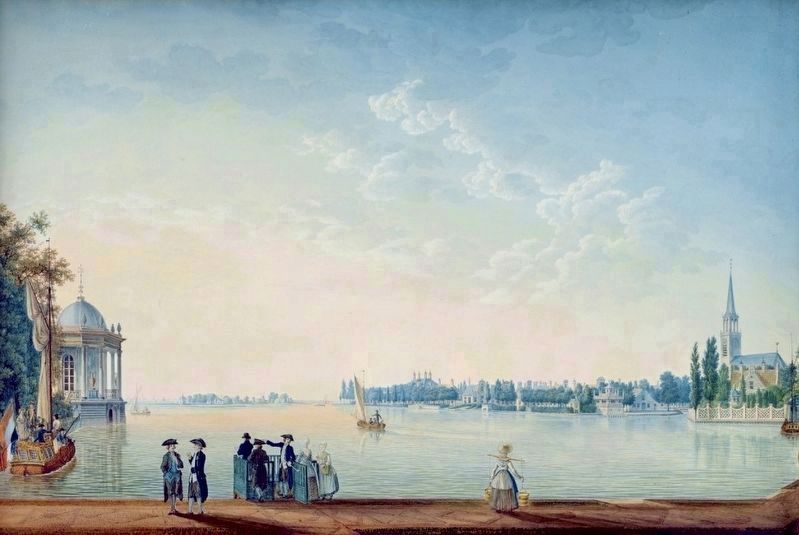
This is reflected in the painting by the (largely vanished) substantial buildings on the far side of the Havenrak—notably the elegant tea pavilion belonging to Klaas Bakker (far left), the large stone residence of the then-mayor Harmen Jansz Bakker (the house with the four chimneys), the ornate show façade of the home occupied in the 18th century by the prominent Pater family, and the tea pavilion from 1793 that still stands today. An interesting detail is that the artist has depicted himself sketching on a small terrace overlooking the Havenrak. Locally known as ‘the balcony,’ this terrace had been installed in 1803 by café owner Cornelis Doncan to offer visitors to Broek in Waterland a fine vantage point. Regarding the other figures in
Anton Ignace Melling (courtesy Musée Marmottan via Meisterdrucke), circa 1812
3. Het Havenrak te Broek in Waterland…
This image is the same as provided on the marker. The original can be found in the Musée Marmottan in Paris. The view is, in the most general sense, a view across the body of water (Het Havenrak).
Erected by Rabobank, ANWB.
Topics. This historical marker is listed in this topic list: Arts, Letters, Music. A significant historical year for this entry is 1812.
Location. 52° 26.115′ N, 4° 59.676′ E. Marker is in Broek in Waterland, Noord-Holland (North Holland), in Waterland. It is on Havenrak, on the right when traveling south. Touch for map. Marker is at or near this postal address: Havenrak 15, Broek in Waterland, Noord-Holland 1151, Netherlands. Touch for directions.

Regionally, it is in Europe, the European Union, Atlantic Europe, the Benelux Low Countries, the Schengen Area, Western Europe, and the Western World. Historically, it finds itself in what was once the Holy Roman Empire.
Other nearby markers. At least 8 other markers are within 5 kilometers of this marker, measured as the crow flies: Nederlandse Hervormde Kerk / Dutch Reformed Church (about 120 meters away, measured in a direct line); Kanon / Cannon (approx. 3.4 kilometers away); Toren / Tower (approx. 3.5 kilometers away); Het Kerkhof / The Church Cemetery (approx. 3.6 kilometers away); Het Zonnepad (approx. 3.6 kilometers away); Watersnood 1916 / Flood of 1916 (approx. 3.6 kilometers away); Leo Hordijk Memorial (approx. 3.7 kilometers away); Weezenland 17 (approx. 3.7 kilometers away).
Credits. This page was last revised on June 16, 2026. It was originally submitted on June 16, 2026, by Andrew Ruppenstein of Lamorinda, California. This page has been viewed 8 times since then. Photos: 1, 2, 3. submitted on June 16, 2026, by Andrew Ruppenstein of Lamorinda, California.
