Mitte in Leipzig, Saxony, Germany — Central Europe
Planung und Bau
⎯⎯⎯
Planning and Construction
Photographed by James Hulse, March 11, 2026
1. Planung und Bau / Planning and Construction Marker

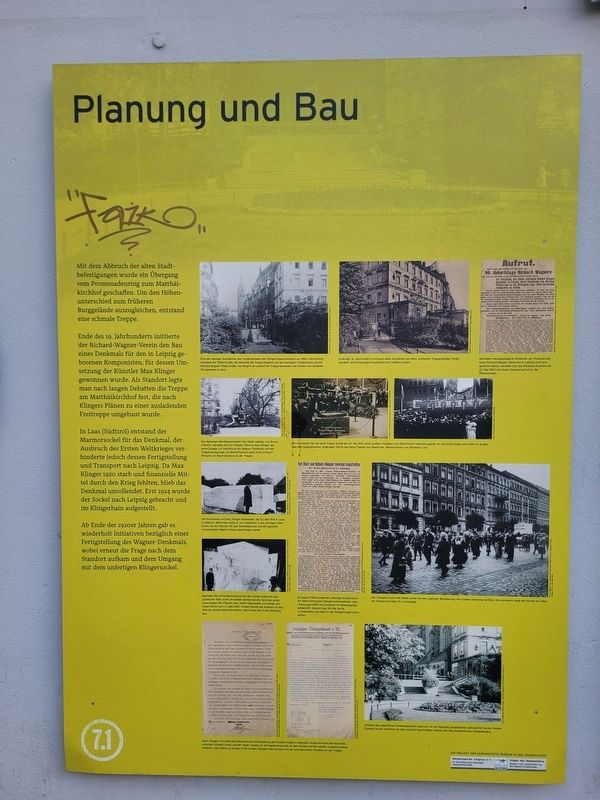
Mit dem Abbruch der alten Stadtbefestigungen wurde ein Übergang vom Promenadenring zum Matthäikirchhof geschaffen. Um den Höhenunterschied zum früheren Burggelände auszugleichen, entstand eine schmale Treppe.
Ende des 19. Jahrhunderts initiierte der Richard-Wagner-Verein den Bau eines Denkmals für den in Leipzig geborenen Komponisten, für dessen Umsetzung der Künstler Max Klinger gewonnen wurde. Als Standort legte man nach langen Debatten die Treppe am Matthäikirchhof fest, die nach Klingers Plänen zu einer ausladenden Freitreppe umgebaut wurde.
In Laas (Südtirol) entstand der Marmorsockel für das Denkmal, der Ausbruch des Ersten Weltkrieges verhinderte jedoch dessen Fertigstellung und Transport nach Leipzig. Da Max Klinger 1920 starb und finanzielle Mittel durch den Krieg fehlten, blieb das Denkmal unvollendet. Erst 1924 wurde der Sockel nach Leipzig gebracht und im Klingerhain aufgestellt.
Ab Ende der 1920er Jahre gab es wiederholt Initiativen bezüglich einer Fertigstellung des Wagner-Denkmals, wobei erneut die Frage nach dem Standort aufkam und nach dem Umgang mit dem unfertigen Klingersockel.
Bildunterschriften:
Eine der wenigen Aufnahmen des Vorgängerbaus der Klingertreppe entstand um 1890. Gleichzeitig entstand die Töpferstraße, die oberhalb der Treppe beginnt und am damaligen Theaterplatz (heute Richard-Wagner-Platz) endet. Von Beginn an scheint die Treppe besonders bei Kindern ein beliebter Ort gewesen zu sein.
Der damalige Oberbürgermeister der Stadt Leipzig, Carl Bruno Tröndlin, wandte sich im Frühjahr 1904 an Max Klinger, der seine Zusage zur Gestaltung des Wagner-Denkmals und der Treppenanlage gab. Die Bleistiftskizze zeigt einen Entwurf Klingers zur Raumsituation an der Treppe.
Die Aufnahmen mit Max Klinger entstanden am 20. Mai 1914 in Laas in Südtirol. Mehrmals reiste er zur Inspektion in den dortigen Steinbruch, wo der Marmor für den Denkmalsockel und die geplante monumentale Wagner-Statue geschlagen wurde.
Nachdem der erste Marmorblock für den Sockel aufgrund einer schwarzen Ader nicht verwendet werden konnte, fand das grobe Ausschlagen der Figuren nach einem Gipsmodell von Klinger am neuen Block noch in Laas statt. Klinger konnte die Arbeiten im Mai 1914 ein letztes Mal kontrollieren, dann brach der Erste Weltkrieg aus.
Ende des 19. Jahrhunderts entstand diese Aufnahme der alten, einfachen Treppenanlage. Direkt daneben am Promenadenring befand sich „Müllers Hotel“.
Nachdem vorangegangene Initiativen zur Finanzierung eines Richard-Wagner-Denkmals in Leipzig nicht ausgereicht hatten, wandte sich das Denkmal-Komitee am 22. Mai 1903 mit einem Spendenaufruf an die Öffentlichkeit.
Der Grundstein für die neue Treppe wurde am 22. Mai 1913 unter großem medialen und öffentlichen Interesse gelegt. Im Anschluss folgte eine Feier im großen Saal des Gewandhauses. Außerdem führte das Neue Theater am Abend „Die Meistersinger von Nürnberg“ auf.
Im August 1924 wurde der unfertige Sockel durch ein österreichisches Transportunternehmen nach Leipzig geschafft und zunächst im Palmengarten aufgestellt. Geplant war, ihn hier fertig zu bearbeiten und dann in der Klingertreppe einzusetzen.
Der Transport durch die Stadt wurde von der Leipziger Bevölkerung mit großem Interesse verfolgt. Die Aufnahme zeigt den Sockel auf Höhe der Könneritzstraße 23 in Schleußig.
Nach Klingers Tod blieb die bildhauerische Fertigstellung des Sockels fraglich, besonders aufgrund eines Rechtsstreits zwischen Klingers Erben und der Stadt Leipzig um die Eigentumsrechte an dem Sockel und den bereits vorgenommenen Arbeiten. Dies führte zu einiger Kritik an dem Standort des Sockels und der provisorischen Situation an der Treppe.
Anstelle des eigentlichen Denkmalsockels stand ein nur als Übergang angedachter, gemauerter Sockel. Dessen Zustand wurde mehrfach als sehr schlecht beschrieben, ebenso der des provisorischen Holzgeländers.
With
this page online
At the end of the 19th century, the Richard Wagner Society initiated the construction of a monument to the composer born in Leipzig. The artist Max Klinger was selected to carry out the project. After lengthy debates, the staircase at Matthäikirchhof was chosen as the location, and it was redesigned according to Klinger's plans as a broad ceremonial staircase.
In Laas (South Tyrol), the marble pedestal for the monument was created. However, the outbreak of the First World War prevented its completion and transport to Leipzig. Since Max Klinger died in 1920 and financial resources were lacking after the war, the monument remained unfinished. The pedestal was not brought to Leipzig and erected in the Klinger Grove until 1924.
Beginning in the late 1920s, there were repeated initiatives to complete the Wagner Monument. Once again, debates arose concerning its location and how to deal with the unfinished Klinger pedestal.
Captions:
One of the few photographs of the predecessor of the Klinger Staircase was taken around 1890. At the same time, Töpferstraße was laid out, beginning above the staircase and ending at the then Theater Square (today Richard Wagner Square). From the beginning, the staircase appears to have been a popular gathering place, especially for children.
The mayor of Leipzig at the time, Carl Bruno Tröndlin, approached Max Klinger in the spring of 1904. Klinger agreed to design both the Wagner Monument and the staircase. The pencil sketch shows one of Klinger's concepts for the spatial arrangement of the site.
The photographs of Max Klinger were taken on May 20, 1914, in Laas, South Tyrol. He traveled there several times to inspect the quarry where the marble for the monument pedestal and the planned monumental Wagner statue was being cut.
After the first marble block for the pedestal proved unusable because of a black vein in the stone, the rough carving of the figures based on a plaster model by Klinger was begun on a new block in Laas. Klinger was able to inspect the work one final time in May 1914 before the First World War broke out.
This photograph of the old, simple staircase dates from the end of the 19th century. Directly beside it on the Promenade Ring stood “Müller's Hotel.”
After earlier fundraising efforts for a Richard Wagner Monument in Leipzig had failed to raise sufficient funds, the monument committee issued a public appeal for donations on May 22, 1903.
The cornerstone for the new staircase was laid on May 22, 1913, amid considerable public and media attention. A celebration followed in the Great Hall of the Gewandhaus. That evening, the New Theater presented “The Mastersingers of Nuremberg.”
In August 1924, the unfinished pedestal was transported to Leipzig by an Austrian transport company and initially placed in the Palmengarten. The plan was to complete the carving there and then install it at the Klinger Staircase.
The transport through the city attracted great interest from the people of Leipzig. The photograph shows the pedestal passing Könneritzstraße 23 in the district of Schleußig.
After Klinger's death, completion of the sculptural work on the pedestal remained uncertain, particularly because of a legal dispute between Klinger's heirs and the City of Leipzig over ownership rights to the pedestal and the work already completed. This led to criticism of both the location of the pedestal and the temporary condition of the staircase.
Instead of the intended monument pedestal, a temporary masonry pedestal stood on the site. Its condition was repeatedly described as very poor, as was that of the provisional wooden railing.
Erected by Leipzig

Photographed by James Hulse, March 11, 2026
2. Planung und Bau / Planning and Construction Marker
Topics. This historical marker is listed in this topic list: Notable Places. A significant historical year for this entry is 1920.
Location. 51° 20.544′ N, 12° 22.228′ E. Marker is in Leipzig, Sachsen (Saxony). It is in Mitte. It is on Goerdelerring just north of Dittrichring, on the right when traveling north. Touch for map. Marker is at or near this postal address: Goerdelerring 20, Leipzig SN 04109, Germany. Touch for directions.

Regionally, this marker is in Central Germany. Globally, it is in Europe, the European Union, Atlantic Europe, Central Europe, the Schengen Area, Western Europe, and the Western World. Historically, it finds itself in what was once the Holy Roman Empire and also the former East Germany.
Other nearby markers. At least 8 other markers are within walking distance of this marker: Abbruch der Treppe / Demolition of the Staircase (here, next to this marker); Die Klingertreppe / The Klinger Staircase (here, next to this marker); Wiederaufbau und Richard-Wagner-Denkmal / Reconstruction and the Richard Wagner Monument (here, next to this marker); Bezirksverwaltung für Staatssicherheit Leipzig / Leipzig District Administration for State Security

Photographed by James Hulse, March 11, 2026
3. Planung und Bau / Planning and Construction Marker
The view of the markers at the top of the stairs.

Photographed by James Hulse, March 11, 2026
4. Planung und Bau / Planning and Construction Marker
The view of the Richard Wagner statue on the stairs.
Credits. This page was last revised on July 3, 2026. It was originally submitted on June 17, 2026, by James Hulse of Medina, Texas. This page has been viewed 18 times since then. Photos: 1, 2, 3, 4. submitted on June 28, 2026, by James Hulse of Medina, Texas.
