Wm. H. Holcomb House
526 North Seventh Street
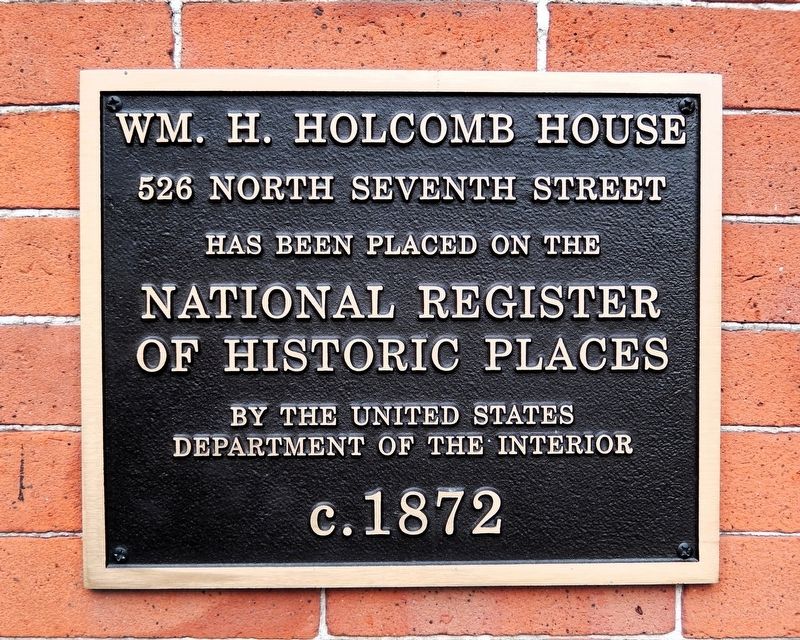
National Register of Historic Places
by the United States Department of the Interior
c. 1872
Topics and series. This historical marker is listed in these topic lists: Architecture • Notable Buildings. In addition, it is included in the National Register of Historic Places (NRHP) series list. A significant historical year for this entry is 1872.
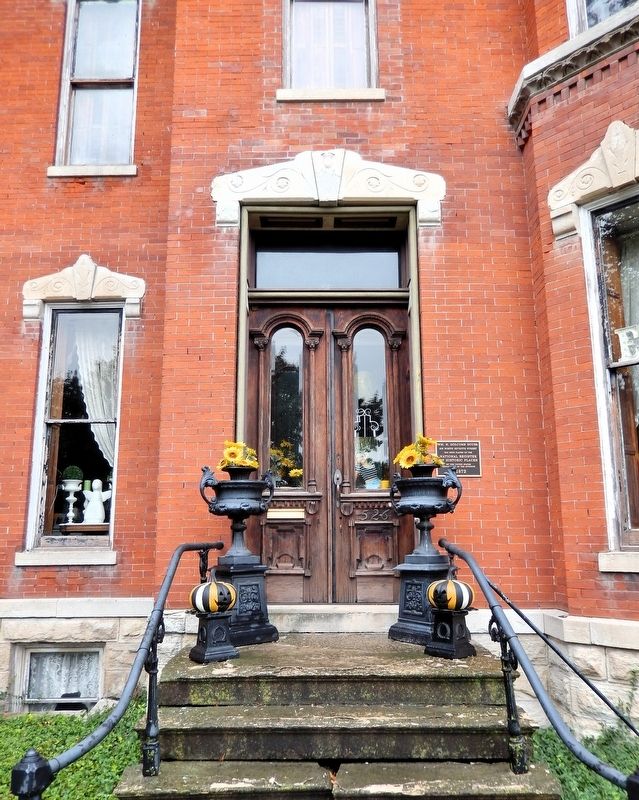
Location. 41° 55.482′ N, 89° 4.144′ W. Marker is in Rochelle, Illinois, in Ogle County. It is at the intersection of North 7th Street (Illinois Route 38/251) and 6th Avenue, on the left when traveling north on North 7th Street. The marker is mounted directly on the east/front facade of the house, on the right side of the entrance. Touch for map. Marker is at or near this postal address: 526 North 7th Street, Rochelle IL 61068, United States of America. Touch for directions.

Regionally, this marker is in the American Midwest and in the Corn Belt. Globally, it is in North America, the Western Hemisphere, the Western World, and the Anglosphere. Historically, it finds itself in what was once the Viceroyalty of New France, the territory of the Mississippian
this page online
Other nearby markers. At least 8 other markers are within 6 miles of this marker, measured as the crow flies: 1884 City and Town Hall (approx. 0.2 miles away); City of Rochelle (approx. 0.3 miles away); The Lincoln Highway - The nation's first coast-to-coast highway! (approx. 0.3 miles away); Better Roads for a Bright Future (approx. 0.3 miles away); "Fill 'er up!" (approx. 0.3 miles away); The History of Headons (approx. 5.4 miles away); The Water Fountain and Mile Marker Below (approx. 5.4 miles away); Creston (approx. 5.4 miles away). Touch for a list and map of all markers in Rochelle.
Regarding Wm. H. Holcomb House. National Register of Historic Places № 73000714.
From the National Register Nomination prepared by Susan Karr Sorell, 8/7/1973:
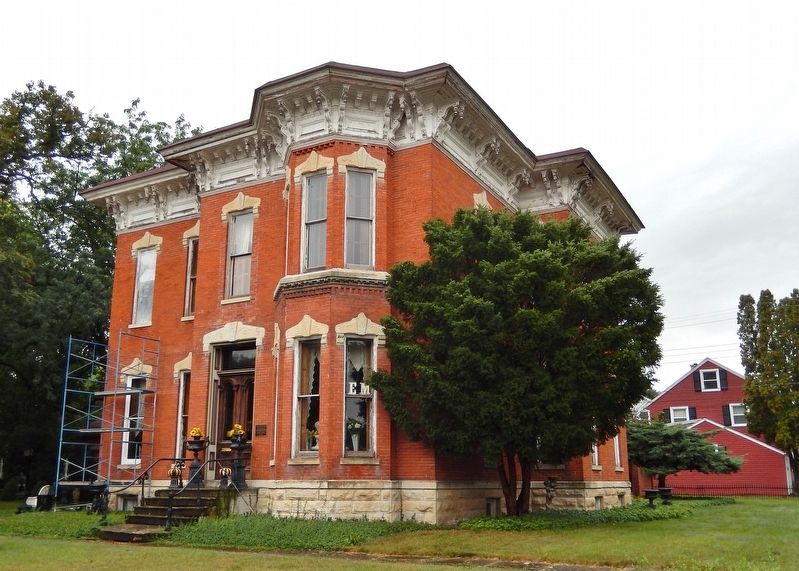
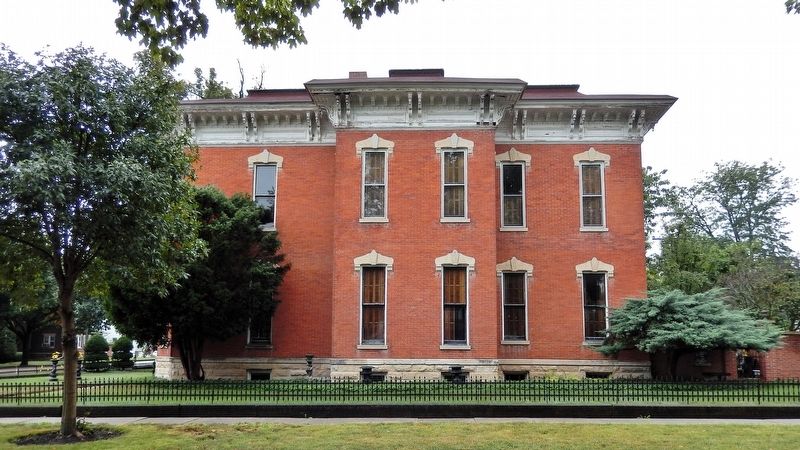
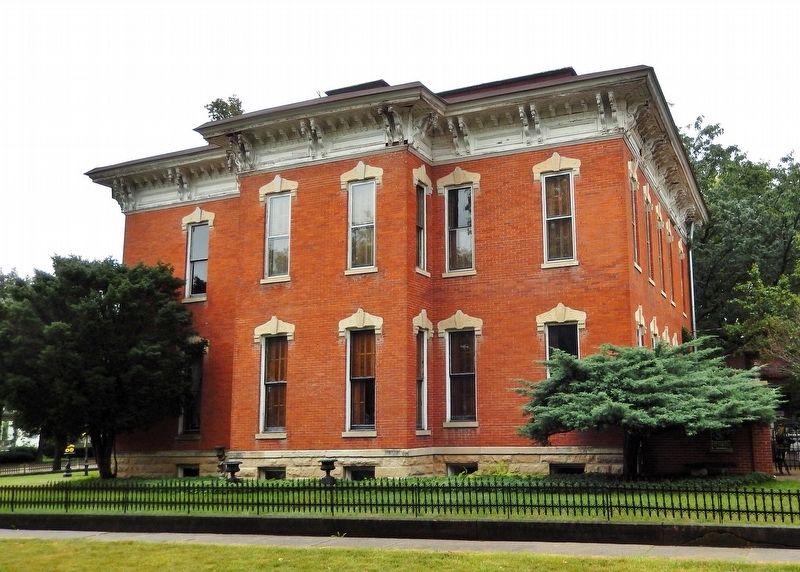
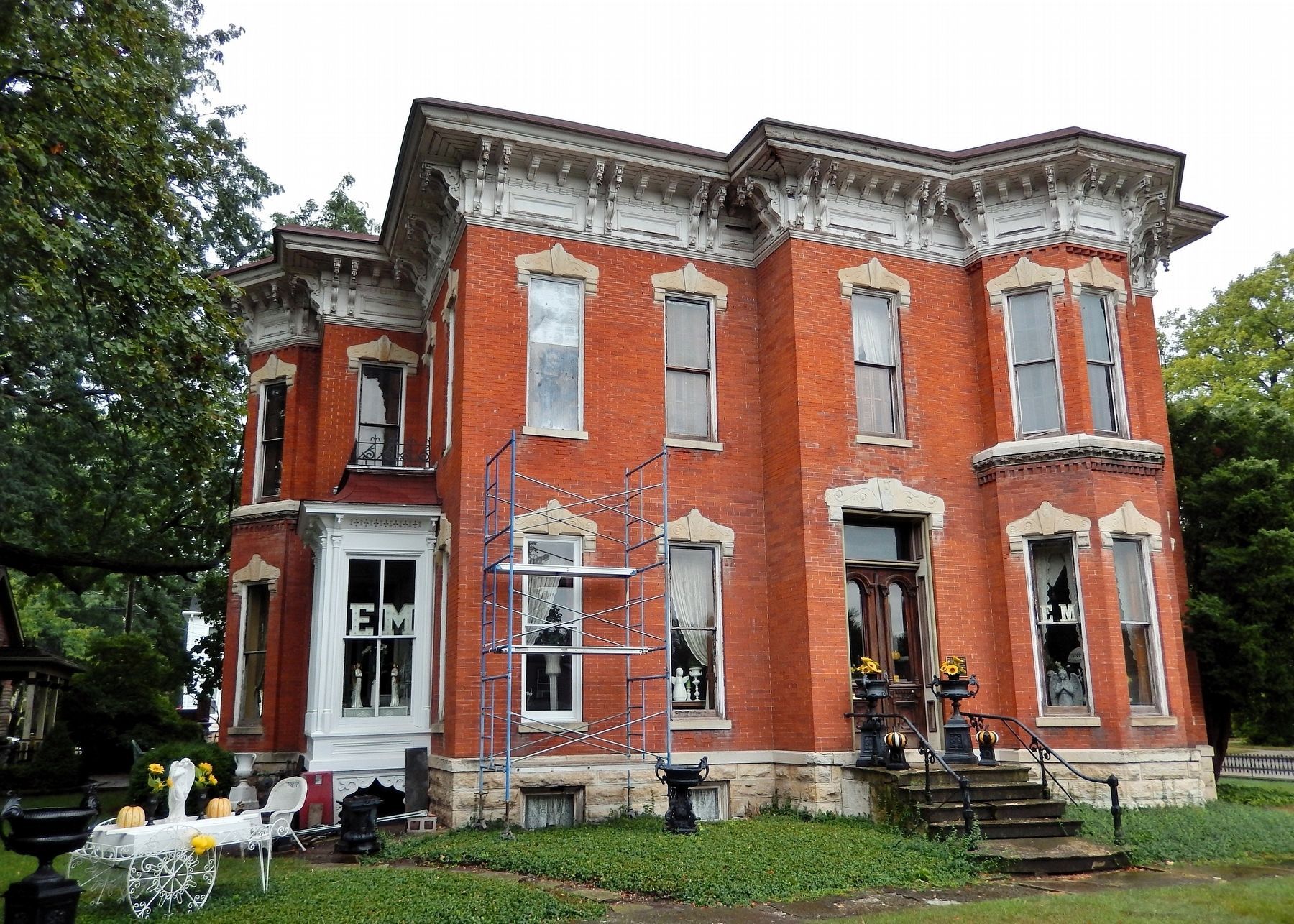
The Holcomb house is two stories high of locally made brick with limestone trim and is topped by a large wooden cornice. Its widely projecting eaves are supported by ornate brackets. The cornice, the wide eaves with supporting brackets, and the general proportions of the house are typical of the Victorian Italianate style.The house, arranged
in a formal plan, has a central hall featuring at one end a spectacular oval, spiraling staircase lit by an oval skylight. At the entry, a delicate design is etched in the glass of the richly carved front doors. To the right of the hall is the parlor, accented by a carved marble fireplace with a decorative, gold-leafed wood overmantle containing a mirrored backing. Behind the parlor and also opening off the hall is the dining room. It has a modeled, papier mache wall covering giving a leather-like appearance. Behind the dining room at the rear of the house is the kitchen. At the front of the house to the left of the hall is the living room. It, like other rooms opening off the hall has carved, wood grained sliding doors. The library is accessible from both the adjoining living room and the central hall. Of particular interest on the library mantle are the gold leafed goddesses of earth and sea holding torches from which a gas flame originally burned. A small glassed-in porch opens off the library and behind the library is a bedroom. Six more bedrooms are on the second floor. The Holcomb house is situated on a corner lot surrounded byPhotographed by Cosmos Mariner, September 11, 20232. Wm. H. Holcomb House MarkerThe marker is mounted on the right side of the east/front entrance.a wrought iron fence of the same date as the house. There are wrought iron hitching posts on the Sixth Avenue side.Photographed by Cosmos Mariner, September 11, 20233. Wm. H. Holcomb House (northeast elevation)The William H. Holcomb House is significant both for its architecture and elaborate interiors, and for the local historical importance of the man who built it. Architecturally, it offers an excellent example of a handsome 1870's design. The interiors illustrate the architectural ornamentation of that period. The elaborate woodwork, parquet floors, etched glass, and ornate fireplaces and overmantles are seldom seen in the more elegant houses of this period.
The original owner, William Horace Hoicomb, was born in Knoxville, Illinois in 1840, He was educated at Knox College. From 1861-1865 Holcomb served in the Civil War. Holcomb came to Rochelle in 1871 as a freight agent for the Chicago and Iowa Railroad. The section of that railroad between Aurora and Forreston and the Rockford branch were being built by his cousin, F.E. Hinckley. Holcomb moved his family to Rochelle shortly after 1871. In 1877 he was appointed receiver for the railroad. Holcomb was also an alderman in Rochelle from 1874-77 and between 1878-80 he served
as Rochelle's third mayor. In addition, he served on the school board. W. H. Holcomb's career was very important to the development of railway transportation in the United States. He was superintendent of four railroad lines.Photographed by Cosmos Mariner, September 11, 20234. Wm. H. Holcomb House (north elevation)
Also see . . . William H. Holcomb House (Wikipedia).
Excerpt: The William H. Holcomb House, also known as the Carl Vandre House, is a wood-frame brick house on a limestone foundation. The house was built in 1872 and is a significant example of Italianate style. The house was listed on the National Register of Historic Places on October 25, 1973, for its significance in the area of architecture.(Submitted on June 17, 2026, by Cosmos Mariner of Cape Canaveral, Florida.)William H. Holcomb (c. 1839–1908) was the general superintendent of the Chicago & Iowa Railroad and subsequently held the same position with the Chicago, Burlington & Northern Railway (part of the Chicago, Burlington and Quincy Railroad). In the 1880s he served as General Manager of the Oregon Railway and Navigation Company, and in 1893 was the General Manager of Transportation for the World's Columbian Exposition, in Chicago. He was also a vice-president and general manager with the Union Pacific Railroad.
Photographed by Cosmos Mariner, September 11, 20235. Wm. H. Holcomb House (northwest elevation)
Credits. This page was last revised on June 17, 2026. It was originally submitted on June 17, 2026, by Cosmos Mariner of Cape Canaveral, Florida. This page has been viewed 22 times since then. Photos: 1, 2, 3, 4, 5, 6. submitted on June 17, 2026, by Cosmos Mariner of Cape Canaveral, Florida.
