Dungarvan in County Waterford, Munster, Ireland — Irish South-West ((Éire) North Atlantic Ocean)
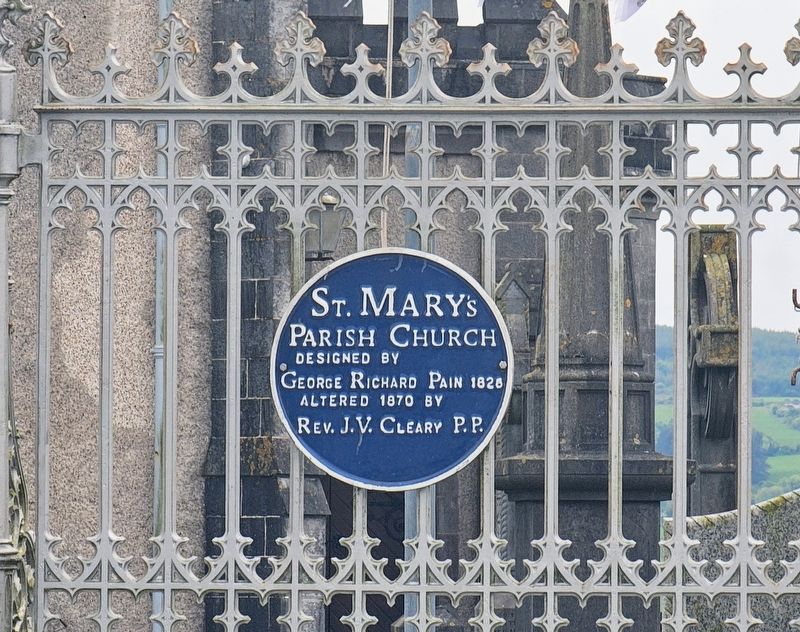
St. Mary's Parish Church
Photographed by Ian Lefkowitz, May 16, 2026
1. St. Mary's Parish Church Marker
St. Mary’s Parish Church
Designed by
George Richard Pain 1826
Altered 1870 by
Rev. J.V. Cleary P.P.
Topics. This historical marker is listed in this topic list: Religion & Religious Structures. A significant historical year for this entry is 1826.
Location. 52° 5.269′ N, 7° 37.291′ W. Marker is in Dungarvan, Munster, in County Waterford. It is at the intersection of Emmet Street and Saint Mary Street, on the left when traveling west on Emmet Street. Touch for map. Marker is at or near this postal address: 1 Emmet St, Dungarvan, Munster X35 KD56, Ireland. Touch for directions.

Regionally, this marker is in the Ancient East. Globally, it is on the Atlantic Ocean, in the North Atlantic Region, in Europe, on the Island of Ireland, on the Celtic Fringe, in the European Union, in Atlantic Europe, on one of the British Isles, in the Western World, and in the Anglosphere.
Other nearby markers. At least 8 other markers are within walking distance of this marker: Mai O'Higgins (about 90 meters away, measured in a direct line); Seán Norris (about 120 meters away); Tadhg Gaelach Ó Súilleabháin (about 150 meters away); John and James Mulcahy
this page online
Also see . . .
1. St. Mary’s Parish Church Dungarvan. (Submitted on June 17, 2026, by Ian Lefkowitz of New York, New York.)
2. Saint Mary's Catholic Church, Emmet Street, New Chapel Street, Dungarvan (Buildings of Ireland).
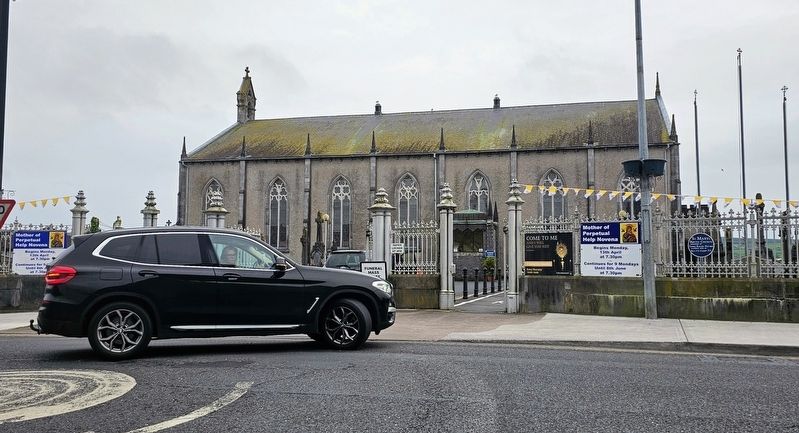
An imposing Gothic-style Catholic church, designed by George Richard Paine (1793 - 1838), and built on a site sponsored by the sixth Duke of Devonshire (1790 - 1858), forming a landmark in the townscape of Dungarvan. Very well maintained, the church retains most of its original form and character with important salient features and materials intact. The reserved treatment of the exterior, which relies on subtle cut-stone dressings for ornamentation, belies the decorative treatment of the interior, which is particularly noteworthy, and which incorporates numerous features of artistic design significance - ranging from the stained(Submitted on June 17, 2026, by Ian Lefkowitz of New York, New York.)glass panels, decorative plasterwork, and the carved furniture to the altar (also including a carved ‘Pieta’ by P. Scannell (fl. 1870), of Cork) – together with features of technical importance, most notably the construction of the arcade and vaulted roof. A collection of cut-stone markers to the attendant graveyard enhance the artistic importance of the site, while the gateway and railings fronting directly on to Emmett Street are a pleasing feature in the streetscape.Photographed by Ian Lefkowitz, May 16, 20262. St. Mary's Parish Church MarkerThe marker is located outside the northern entrance to the church.
Additional keywords. blue plaque
Credits. This page was last revised on June 18, 2026. It was originally submitted on June 17, 2026, by Ian Lefkowitz of New York, New York. This page has been viewed 11 times since then. Photos: 1, 2. submitted on June 17, 2026, by Ian Lefkowitz of New York, New York. • Andrew Ruppenstein was the editor who published this page.
