Canterbury in Kent, England, United Kingdom — Northwestern Europe (the British Isles)
The Westgate
Photographed by Ray Gurganus, April 1, 2026
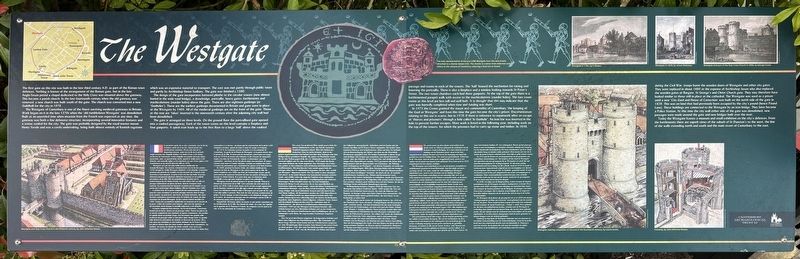
1. The Westgate Marker
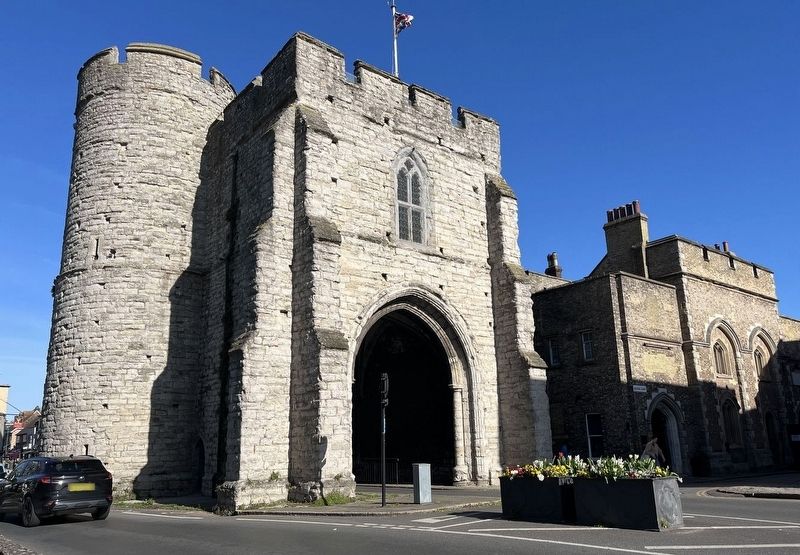
The Westgate of Canterbury is one of the finest surviving medieval gateways in Britain. Work began on it in the late 1370s when the ‘old tumbledown Westgate’ was demolished. Built at an unsettled time when invasion from the French was expected at any time, the gateway was both a fine defensive structure, incorporating several innovative features and a status symbol for the city. The gate was probably designed by the royal master mason Henry Yevele and was a costly undertaking, being built almost entirely of Kentish ragstone which was an expensive material to transport. The cost was met partly through public taxes and partly by Archbishop Simon Sudbury. The gate was finished c.1380.
The design of the gate incorporates battered plinths to the circular towers (now almost buried in the wide road bridge), a drawbridge,
this page online
The gate is arranged on three levels. On the ground floor the portcullised gate opened into a vaulted passageway. Each of the tower rooms on this level contains a fireplace and four gunports. A spiral stair leads up to the first floor to a large 'hall' above the vaulted passage and rooms in each of the towers. The 'hall' housed the mechanism for raising and lowering the portcullis. There is also a fireplace and a window looking towards St Peter's Street. The two tower chambers each had three gunports. At the top of the gate there is a battlemented parapet walk with access to the machicolations (murder holes). The two tower rooms at this level are less tall and well built. It is thought that this may indicate that the gate was hurredly completed when time and funding was short.
In 1473 the Crown granted the mayor and commonality of Canterbury 'the keeping of the Gaol at Westgate'
Photographed by Ray Gurganus, March 29, 2025
2. The Westgate
Today the Westgate houses a museum and small exhibition on the city's defences.
circa 1930
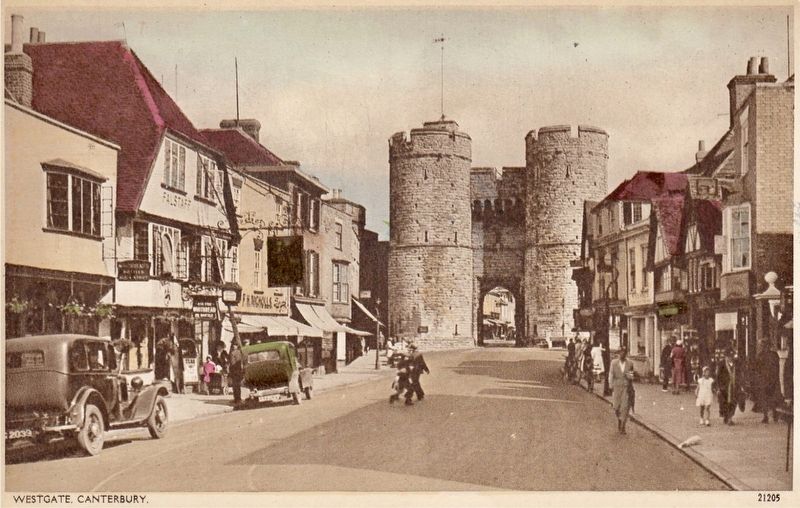
3. View of Westgate from the east
(French, German, Dutch text not transcribed)
Topics. This historical marker is listed in this topic list: Forts and Castles. A significant historical year for this entry is 1370.
Location. 51° 16.901′ N, 1° 4.542′ E. Marker is in Canterbury, England, in Kent. It is at the intersection of St Dunstans St and North Lane, on the left when traveling east on St Dunstans St. Touch for map. Marker is in this post office area: Canterbury, England CT2 8AE, United Kingdom. Touch for directions.

Regionally, this marker is in the Greater South East. Globally, it is on the Atlantic Ocean, in the North Atlantic Region, in Europe, in Atlantic Europe, on one of the British Isles, in the Western World, and in the Anglosphere. Historically, it finds itself in what was once the Roman Empire.
Other nearby markers. At least 8 other markers are within walking distance of this marker: A different marker also named Westgate (within shouting distance of this marker); Ian Dury (about 90 meters away, measured in a direct line); Mary Tourtel (about 120 meters away); Christopher Marlowe (about 210 meters away); Canterbury West Station (approx. 0.3 kilometers away); James Simmons (approx. 0.3 kilometers away); High Street Bridge (approx. 0.3 kilometers away); Aphra Behn (approx. 0.3 kilometers away). Touch for a list and map of all markers in Canterbury.
Credits. This page was last revised on June 24, 2026. It was originally submitted on June 19, 2026, by Ray Gurganus of Washington, District of Columbia. This page has been viewed 14 times since then. Photos: 1, 2. submitted on June 19, 2026, by Ray Gurganus of Washington, District of Columbia. 3. submitted on June 24, 2026. • Andrew Ruppenstein was the editor who published this page.
