Waterford in County Waterford, Munster, Ireland — Irish South-West ((Éire) North Atlantic Ocean)
Edmund Rice
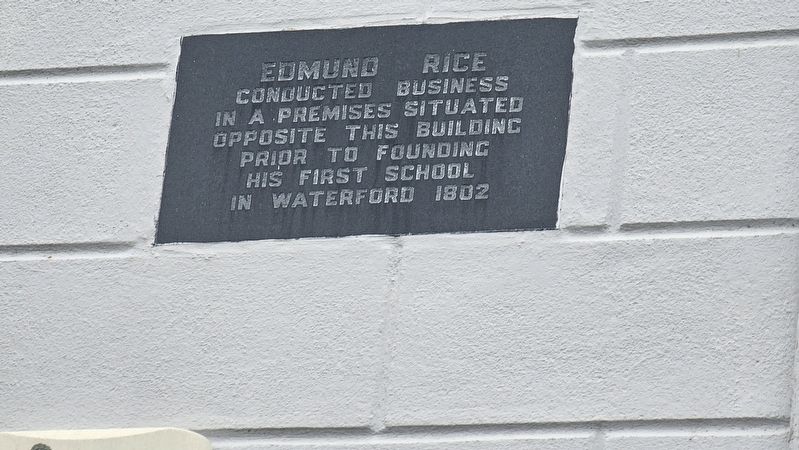
Photographed by Ian Lefkowitz, May 16, 2026
1. Edmund Rice Marker
conducted business in a premises situated opposite this building prior to founding his first school in Waterford 1802
Topics. This historical marker is listed in this topic list: Education. A significant historical year for this entry is 1802.
Location. 52° 15.674′ N, 7° 6.715′ W. Marker is in Waterford, Munster, in County Waterford. It is at the intersection of Great George's Street and Barronstrand St, on the left when traveling east on Great George's Street. Touch for map. Marker is at or near this postal address: 25 Great George's St, Waterford, Munster, Ireland. Touch for directions.

Regionally, this marker is in the Ancient East. Globally, it is on the Atlantic Ocean, in the North Atlantic Region, in Europe, on the Island of Ireland, on the Celtic Fringe, in the European Union, in Atlantic Europe, on one of the British Isles, in the Western World, and in the Anglosphere.
Other nearby markers. At least 8 other markers are within walking distance of this marker: Honest John's Last Work (within shouting distance of this marker); Tadhg Gaelach Ó Súilleabháin (within shouting distance of this marker);
this page online
Also see . . . The Story of Edmund Rice (Edmund Rice Schools Trust).
So, as a 40-year old widower and a successful businessman in Waterford on Ireland’s southeast coast, Edmund Rice changed course radically. He was a rich merchant living in comfortable circumstances, but he was conscious of the hardship suffered by poorer people. Realising the effects deprivation had, especially on the young people of the city, he responded to their needs. He sold off his business interests and started a school for poor boys in a converted stable. He and his assistants lived in some rooms above the makeshift classrooms. In 1802 Edmund was joined by two companions, Thomas Grosvener(Submitted on June 20, 2026, by Ian Lefkowitz of New York, New York.)and Patrick Finn, and the three began to live a form of community life in rooms over the Stable School in New Street.Photographed by Ian Lefkowitz, May 16, 20262. Edmund Rice MarkerThe marker faces John Roberts Square in downtown Waterford.

Credits. This page was last revised on June 23, 2026. It was originally submitted on June 20, 2026, by Ian Lefkowitz of New York, New York. This page has been viewed 13 times since then. Photos: 1, 2. submitted on June 20, 2026, by Ian Lefkowitz of New York, New York. • Andrew Ruppenstein was the editor who published this page.
