The Viking Triangle in Waterford in County Waterford, Munster, Ireland — Irish South-West ((Éire) North Atlantic Ocean)
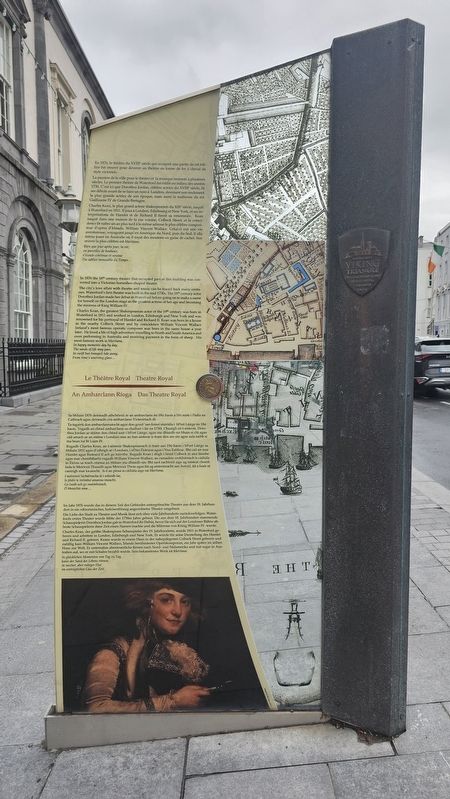
Theatre Royal
⎯⎯⎯
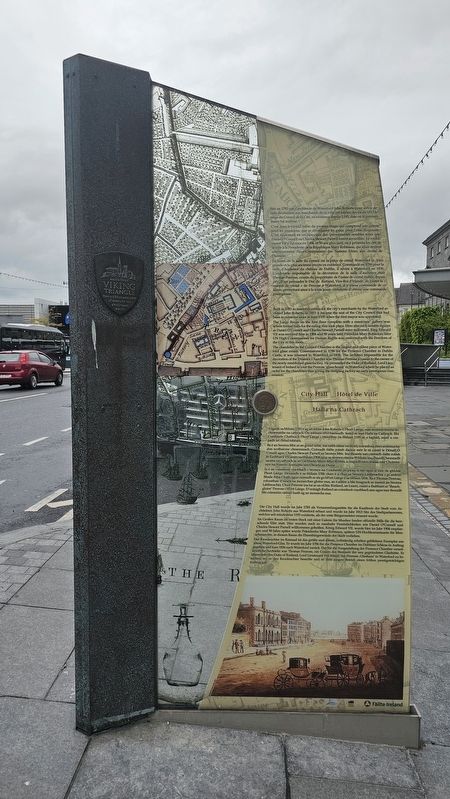
City Hall
Photographed by Ian Lefkowitz, May 16, 2026
1. Theatre Royal side of marker
 Le Théâtre Royal / Theatre Royal
En 1876, le théâtre du XVIIIe siècle qui occupait une partie de cet édifice fut rénové pour devenir un théâtre en forme de fer à cheval de style victorien.
La passion de la ville pour le théâtre et la musique remonte à plusieurs siècles. Le premier théâtre de Waterford fut édifié au milieu des années 1730. C’est ici que Dorothea Jordan, célèbre actrice du XVIIIe siècle, fit ses débuts avant de se faire un nom à Londres, devenant non seulement la plus grande actrice de son époque, mais aussi la maîtresse du roi Guillaume IV de Grande-Bretagne.
Charles Kean, le plus grand acteur shakespearien du XIXe siècle, naquit à Waterford en 1811. Il joua à Londres, Edinbourg et New York, et ses interprétations de Hamlet et de Richard II firent sa renommée. Kean naquit dans une maison de la rue voisine, Colbeck Street, et la coïncidence fit naître un an plus tard à la même adresse le plus célèbre compositeur d’opéra d’Irlande, William Vincent Wallace. Celui-ci eut une vie aventureuse, voyageant jusqu’en Amérique du Nord, puis du Sud, il alla même jouer en Australie où il reçut des moutons en guise de cachet. Son œuvre la plus célèbre est Maritana,
Bien que jour après jour, la vie,
en parcelles de bonheur,
s’écoule continue et sereine
Du sablier immuable du Temps…
In 1876 the 18th century theatre that occupied part of this building was converted into a Victorian horseshoe-shaped theatre.
The city’s love affair with theatre and music can be traced back many centuries. Waterford’s first theatre was built in the mid 1730s. The 18th century actor Dorothea Jordan made her debut in Waterford before going on to make a name for herself on the London stage as the greatest actress of her age and becoming the mistress of King William IV.
Charles Kean, the greatest Shakespearean actor
this page online
In happy moments day by day,
The sands of life may pass,
In swift but tranquil tide away,
From time’s unerring glass…
An Amharclann Ríoga / Das Theatre Royal
Sa bhliain 1876 deineadh athchóiriú ar an amharclann ón 18ú haois a bhí suite i Halla na Cathrach agus deineadh crú-amharclann Victeoiriach di.
Ta tagairtí don amharclannaíocht agus don gceol ’san foinsí stairiúla i bPort Láirge ón 18ú haois. Tógadh an chéad amharclann sa chathair i lár na 1730í. Chuaigh an t-aisteoir, Dorothea Jordan ar stáitse don chéad uair i bPort Láirge, agus ina dhiaidh sin bhain sí clú agus cáil amach ar an stáitse i Londain mar an ban-aisteoir
Photographed by Ian Lefkowitz, May 16, 2026
2. City Hall side of marker
Rugadh Charles Kean, an t-aisteoir Shakespearach is fearr san 19ú haois i bPort Láirge sa bhliain 1811 agus d’oibrigh sé i Londain, i nDún Éideann agus i Nua Eabhrac. Bhí cáil air mar Hamlet agus Risteard II ach go háirithe. Rugadh Kean i dtigh i Sráid Colbeck in aice láimhe agus mar chomhtharlú rugadh William Vincent Wallace, an cumadóir ceoldrámach is cáiliúla in Éirinn sa teach céanna an bhliain ina dhiaidh sin. Bhí saol eachtrúil aige ag taisteal chomh fada le Meiriceá Thuaidh agus Meiriceá Theas agus fiú ag aisteoireacht san Astráil, áit a fuair sé caoirigh mar íocaíocht. Is é an píosa is cáiliúla aige ná Maritana,
I móimintí lúcháireacha lá i ndiaidh lae,
Is féidir le tréimhsí amanna imeacht,
Go luath ach go suaimhneach,
Ó bheaichte ama…
Im Jahr 1876 wurde das in diesem Teil des Gebäudes untergebrachte Theater aus dem 18. Jahrhundert in ein viktorianisches, hufeisenförmig angeordnetes Theater umgebaut. Die Liebe der Stadt zu Theater und Musik lässt sich über viele Jahrhunderte zurückverfolgen. Waterfords erstes Theater wurde Mitte der 1730er Jahre gebaut. Die aus dem 18. Jahrhundert stammende Schauspielerin Dorothea Jordan gab in Waterford ihr Debüt, bevor Sie sich auf der Londoner Bühne als beste Schauspielerin ihrer Zeit einen Namen machte und die Mätresse von König William IV. wurde. Charles Kean, der größte Shakespeare-Schauspieler des 19. Jahrhunderts, wurde 1811 in Waterford geboren und arbeitete in London, Edinburgh und New York. Er wurde für seine Darstellung des Hamlet und Richard II. gefeiert. Keane wurde in einem Haus in der nahegelegenen Colbeck Street geboren und zufällig kam William Vincent Wallace, Irlands berühmtester Opernkomponist, ein Jahr später im selben Haus zur Welt. Er unternahm abenteuerliche Reisen nach Nord- und Südamerika
Photographed by Ian Lefkowitz, May 16, 2026
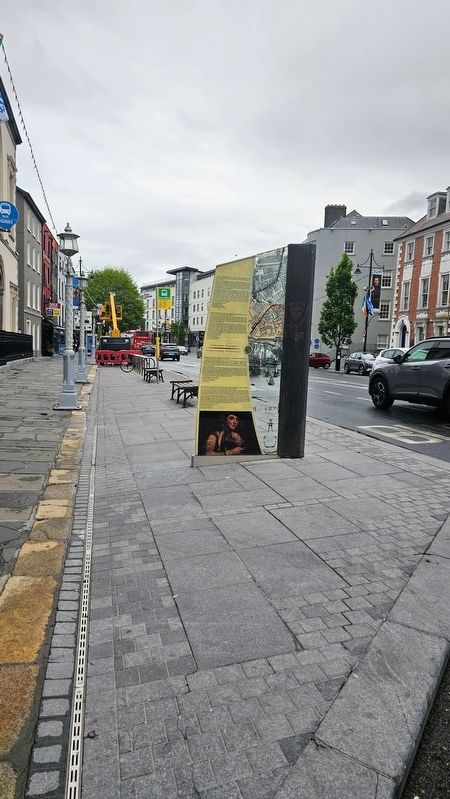
3. Theatre Royal / City Hall Marker
This double-sided marker is found in front of the Theatre Royal on the Mall.
In glücklichen Momenten von Tag zu Tag,
kann der Sand des Lebens rinnen,
in rascher, aber ruhiger Flut
im untrüglichen Glas der Zeit.
City Hall / Hôtel de Ville
Bâti en 1783 par l’architecte de Waterford John Roberts pour servir de salle de réunion aux marchands de la ville, cet édifice devint en 1813 le siège du Conseil de la Cité, en existence depuis 1195, date où le premier maire fut nommé.
C’est dans le Grand Salon du premier étage, qui comprend une galerie pour les musiciens, que se déroulaient les galas pour l’élite dirigeante. C’est également en ces lieux que des personnalités notables telles que Daniel O’Connell ou Charles Stewart Parnell furent accueillies. Le roi Édouard VII y fut reçu en 1904, et 90 ans plus tard, on y présenta les clés de la ville à la Présidente de la République Mary Robinson, qui allait devenir ultérieurement Haut-Commissaire des Nations Unies aux droits de l’homme.
Le lustre de la salle du conseil est la pièce de cristal Waterford la plus grande et la plus ancienne encore en existence. Commandé en 1786 pour la Salle d’Audience du château de Dublin, il revint à Waterford en 1836. L’architecte responsable de la décoration de la salle d’audience était Thomas Penrose, cousin du propriétaire de l’usine de cristal établie depuis peu. Il sut persuader le Duc de Rutland, Vice-Roi d’Irlande, de visiter la « maison de cristal » de Penrose à Waterford, il y passa commande de ce lustre, permettant ainsi à la toute jeune cristallerie d’obtenir une commande prestigieuse.
Built in 1783 as assembly rooms for the city’s merchants by the Waterford architect John Roberts, in 1813 it became the seat of the City Council that had been in existence since at least 1195 when the first mayor was appointed.
The Large Room on the first floor complete with a musicians’ gallery was where formal balls for the ruling élite took place. Here also such notable figures as Daniel O’Connell and Charles Stewart Parnell were welcomed. King Edward VII was received here in 1904 and 90 years later President Mary Robinson, later UN High Commissioner for Human Rights, was conferred with the Freedom of the City in this room.
The chandelier in the Council Chamber is the largest and oldest piece of Waterford glass extant. Commissioned in 1786 for the Presence Chamber in Dublin Castle, it was returned to Waterford in 1836. The architect responsible for the decoration of the Presence Chamber was Thomas Penrose a cousin to the owner of the newly established glass factory. He persuaded the Duke of Rutland, Lord Lieutenant of Ireland to visit the Penrose ‘glass-house’ in Waterford where he placed an order for the chandelier thus giving the fledgling factory an early prestigious commission.
Halla na Cathrach
Tógadh sa bhliain 1783 é ag an ailtire John Roberts ó Phort Láirge, mar seomraí tionóil do cheannaithe na cathrach. Ón mbliain 1813 baineadh úsáid as mar Halla na Cathrach. Bhí Comhairle Chathrach Phort Láirge i bhfeidhm ón bhliain 1195 ar a laghad, nuair a ceapadh an chéad mhéara.
Ba é an Seomra Mór ar an gcéad urlár, ina raibh áiléar ceoltóirí, suíomh na rincí ardnósacha don scothaicme cheannasach. Cuireadh fáilte roimh dhaoine mór le rá cosúil le Dónall Ó Conaill agus Charles Stewart Parnell sa Seomra Mór. Ina theanta san cuireadh fáilte roimh Rí Éadbhard VII anseo sa bhliain 1904 agus sa seomra céanna 90 bliain ina dhiaidh, bronnadh saoirse na cathrach ar an Uachtarán Máire Mhic Róibín, a ceapadh níos déanaí mar Choimisinéir na Náisiún Aontaithe um Chearta an Duine.
Is é an coinnleoir craobhach i Seomra na Comhairle an píosa is mó agus is sine de ghloine Phort Láirge. Déineadh é sa bhliain 1786 chun é a chur sa Seomra Láithreachta i gCaisleán Bhaile Átha Cliath, agus cuireadh ar ais go bPort Láirge é sa bhliain 1836. Ba é Thomas Penrose, colceathair d’úinéir na monarchan gloine nua, an t-ailtire a bhí freagrach as maisiú an Seomra Láithreachta. Chuir Penrose ina luí ar an nDiúc Rutland, an Leasrí, cuairt a thabhairt ar ‘theach-gloine’ Penrose i bPort Láirge. D’ordaigh Rutland an coinnleoir craobhach ann agus mar thoradh bhí coimisiún cáiliúil luath ag an monarcha nua.
Die City Hall wurde im Jahr 1783 als Versammlungsstätte für die Kaufleute der Stadt vom Architekten John Roberts aus Waterford erbaut und wurde im Jahr 1813 Sitz des Stadtparlamentes, welches seit mindestens 1195 existierte, als der erste Bürgermeister ernannt wurde.
Im Großen Raum im ersten Stock mit einer Galerie für Musiker fanden offizielle Bälle für die herrschende Elite statt. Hier wurden auch so namhafte Persönlichkeiten wie Daniel O’Connell und Charles Stewart Parnell willkommen geheißen. König Edward VII. wurde hier im Jahr 1904 empfangen und 90 Jahre später wurde Präsidentin Mary Robinson, spätere UN-Hochkommissarin für Menschenrechte, in diesem Raum die Ehrenbürgerwürde der Stadt verliehen.
Der Kronleuchter im Ratssaal ist das größte und älteste, vollständig erhalten gebliebene Exemplar aus altem Waterford-Glas. Er wurde im Jahr 1786 für die Presence Chamber im Dubliner Schloss in Auftrag gegeben und kam 1836 nach Waterford zurück. Der für die Ausgestaltung der Presence Chamber verantwortliche Architekt war Thomas Penrose, ein Cousin des Besitzers der neu gegründeten Glashütte. Er überredete den Duke of Rutland, Lord Lieutenant von Irland, das Penrose-‘Glashaus’ in Waterford zu besuchen, wo er den Kronleuchter bestellte und so dem jungen Betrieb einen frühen prestigeträchtigen Auftrag gab.
Topics. This historical marker is listed in these topic lists: Architecture • Arts, Letters, Music • Entertainment. A significant historical year for this entry is 1783.
Location. 52° 15.581′ N, 7° 6.4′ W. Marker is in Waterford, Munster, in County Waterford. It is in The Viking Triangle. It is on The Mall east of Bank Lane, on the left when traveling east. Touch for map. Marker is at or near this postal address: 28 The Mall, Waterford, Munster X91 DH96, Ireland. Touch for directions.

Regionally, this marker is in the Ancient East. Globally, it is on the Atlantic Ocean, in the North Atlantic Region, in Europe, on the Island of Ireland, on the Celtic Fringe, in the European Union, in Atlantic Europe, on one of the British Isles, in the Western World, and in the Anglosphere.
Other nearby markers. At least 8 other markers are within walking distance of this marker: Vincent Wallace (within shouting distance of this marker); Frederick Douglass (within shouting distance of this marker); Richard H. Ryland (within shouting distance of this marker); Vedrarfjordr (within shouting distance of this marker); Cumann Wolfe Tone / Wolfe Tone Club (within shouting distance of this marker); Choristers’ Hall and Mayor’s Wine Vault (within shouting distance of this marker); Stephen De Fulburn (within shouting distance of this marker); Cearnóg an Bhunreachta / Constitution Square (within shouting distance of this marker). Touch for a list and map of all markers in Waterford.
Credits. This page was last revised on June 23, 2026. It was originally submitted on June 21, 2026, by Ian Lefkowitz of New York, New York. This page has been viewed 8 times since then. Photos: 1, 2, 3. submitted on June 21, 2026, by Ian Lefkowitz of New York, New York. • Andrew Ruppenstein was the editor who published this page.
