Waterford in County Waterford, Munster, Ireland — Irish South-West ((Éire) North Atlantic Ocean)
Charles Kean and William Vincent Wallace
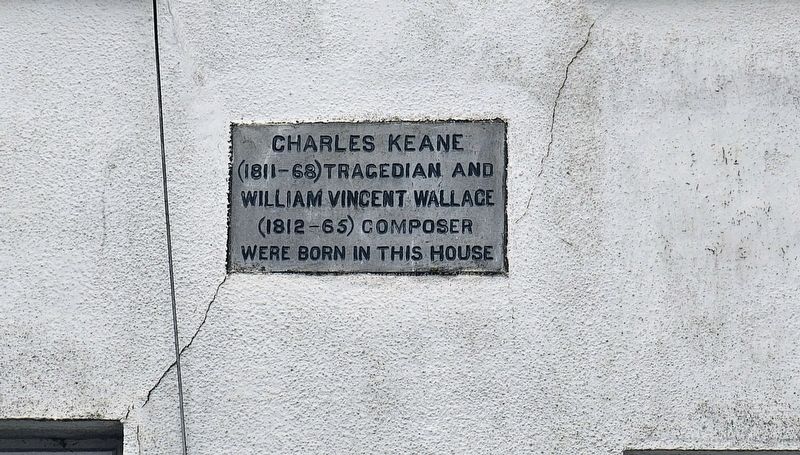
Photographed by Ian Lefkowitz, May 16, 2026
1. Charles Keane and William Vincent Wallace Marker
Topics. This historical marker is listed in this topic list: Arts, Letters, Music. A significant historical year for this entry is 1811.
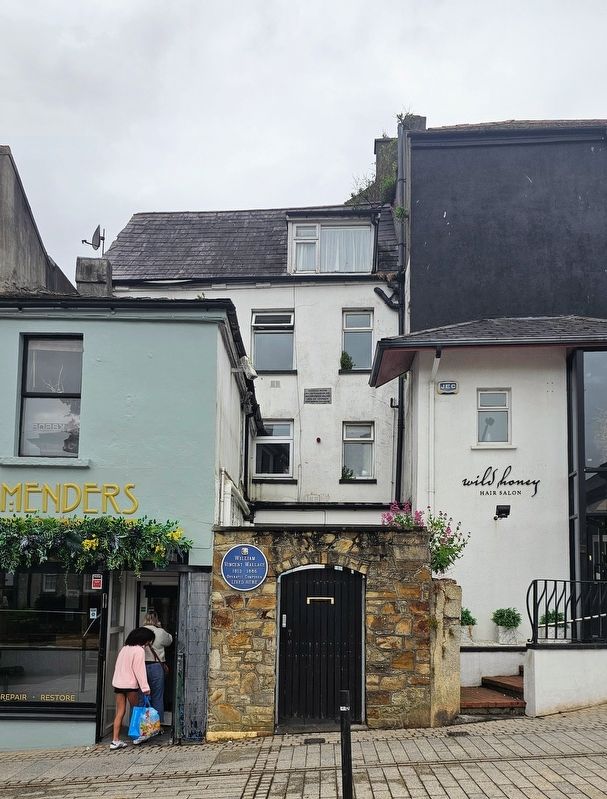
Location. 52° 15.577′ N, 7° 6.505′ W. Marker is in Waterford, Munster, in County Waterford. It is at the intersection of Colbeck Street and Lady Lane, on the right when traveling south on Colbeck Street. Touch for map. Marker is at or near this postal address: 7 Colbeck Street, Waterford, Munster, Ireland. Touch for directions.

Regionally, this marker is in the Ancient East. Globally, it is on the Atlantic Ocean, in the North Atlantic Region, in Europe, on the Island of Ireland, on the Celtic Fringe, in the European Union, in Atlantic Europe, on one of the British Isles, in the Western World, and in the Anglosphere.
Other nearby markers. At least 8 other markers are within walking distance of this marker: William Vincent Wallace (here, next to this marker); Thomas L. Mackesy, MD, FRCSI (a few steps from this marker); Colbeck Gate (a few steps from this marker); Christ Church Cathedral
this page online
Also see . . .
1. Charles Kean (Wikipedia).
Charles John Kean (18 January 1811[1] – 22 January 1868) was an Irish-born English actor and theatre manager, best known for his revivals of Shakespearean plays. Kean was born in Waterford, Ireland, a son of actor Edmund Kean and actress Mary Kean (nee Chambers).(Submitted on June 21, 2026, by Ian Lefkowitz of New York, New York.)
2. Wallace, (William) Vincent (Dictionary of Irish Biography).
Wallace moved to London in 1845, and settled into musical life there. Emulating the recent successes of his compatriot Michael William Balfe in English opera, he wrote Maritana to a feeble libretto by Edward Fitzball. The work, which is exuberant and very melodious, was a sensation at Drury Lane during the 1845–6 season, a popularity(Submitted on June 21, 2026, by Ian Lefkowitz of New York, New York.)that was maintained, following numerous performances abroad, for nigh on a century.Photographed by Ian Lefkowitz, May 16, 20262. Charles Kean and William Vincent Wallace MarkerThe marker is located on the second story of a house off the street. Charles Kean's name is misspelled on the marker.
Credits. This page was last revised on June 22, 2026. It was originally submitted on June 21, 2026, by Ian Lefkowitz of New York, New York. This page has been viewed 12 times since then. Photos: 1, 2. submitted on June 21, 2026, by Ian Lefkowitz of New York, New York. • Andrew Ruppenstein was the editor who published this page.
