Waterford in County Waterford, Munster, Ireland — Irish South-West ((Éire) North Atlantic Ocean)
The Widows’ Apartments
Les Appartements des Veuves
⎯⎯⎯
Árasáin na mBaintreach
⎯⎯⎯
Die Widows’ Apartments
Photographed by Ian Lefkowitz, May 16, 2026
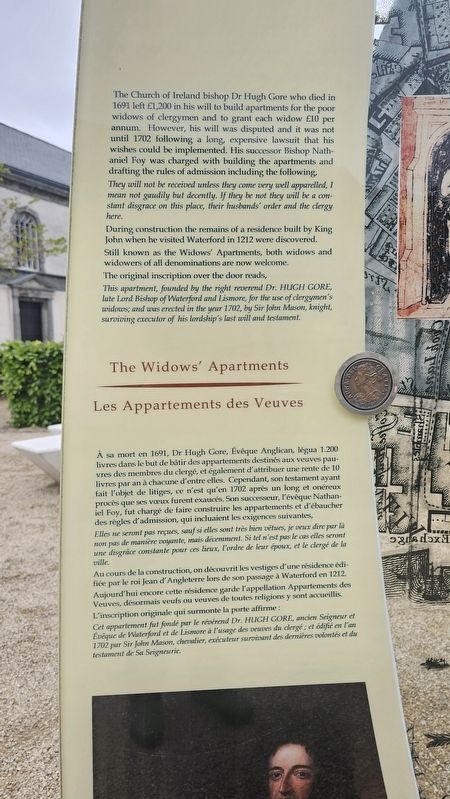
1. The Widows’ Apartments Marker, Side One
 The Widows’ Apartments
The Church of Ireland bishop Dr Hugh Gore who died in 1691 left £1,200 in his will to build apartments for the poor widows of clergymen and to grant each widow £10 per annum. However, his will was disputed and it was not until 1702 following a long, expensive lawsuit that his wishes could be implemented. His successor Bishop Nathaniel Foy was charged with building the apartments and drafting the rules of admission including the following,
They will not be received unless they come very well apparelled, I mean not gaudily but decently. If they be not they will be a constant disgrace on this place, their husbands’ order and the clergy here.
During construction the remains of a residence built by King John when he visited Waterford in 1212 were discovered.
Still known as the Widows’ Apartments, both widows and widowers of all denominations are now welcome.
The original inscription over the door reads,
This apartment, founded by the right reverend Dr. Hugh Gore, late Lord Bishop of Waterford and Lismore, for the use of clergymen’s widows; and was erected in the year 1702, by Sir John Mason, knight, surviving executor of his lordship’s last will and testament.
Les Appartements des Veuves
À sa mort en 1691, Dr Hugh Gore, Évêque Anglican, légua 1.200 livres dans le but de bâtir des appartements destinés aux veuves pauvres des membres du clergé, et également d’attribuer une rente de 10 livres par an à chacune d’entre elles. Cependant, son testament ayant fait l’objet de litiges, ce n’est qu’en 1702 après un long et onéreux procès que ses vœux furent exaucés. Son successeur, l’évêque Nathaniel Foy, fut chargé de faire construire les appartements et d’ébaucher des règles d’admission, qui incluaient les exigences suivantes,
Elles ne seront pas reçues, sauf si elles sont très bien vêtues, je veux dire par là non pas de manière voyante, mais décemment. Si tel n’est pas le cas elles seront une disgrâce constante pour ces lieux, l’ordre de leur époux, et le clergé de la ville.
Au
this page online
L’inscription originale qui surmonte la porte affirme :
Cet appartement fut fondé par le révérend Dr. Hugh Gore, ancien Seigneur et Évêque de Waterford et de Lismore à l’usage des veuves du clergé ; et édifié en l’an 1702 par Sir John Mason, chevalier, exécuteur survivant des dernières volontés et du testament de Sa Seigneurie.
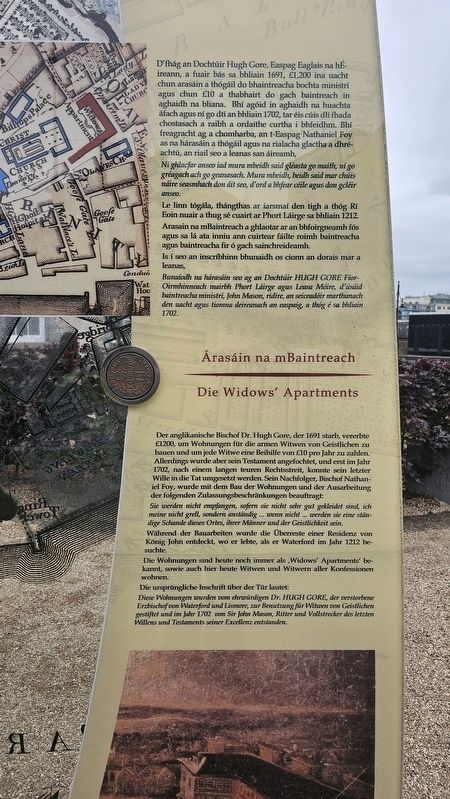
Árasáin na mBaintreach
D’fhág an Dochtúir Hugh Gore, Easpag Eaglais na hÉireann, a fuair bás sa bhliain 1691, £1,200 ina uacht chun arasáin a thógáil do bhaintreacha bochta ministrí agus chun £10 a thabhairt do gach baintreach in aghaidh na bliana. Bhí agóid in aghaidh na huachta áfach agus ní go dtí an bhliain 1702, tar éis cúis dlí fhada chostasach a raibh a ordaithe curtha i bhfeidhm. Bhí freagracht ag a chomharba, an t-Easpag Nathaniel Foy as na hárasáin a thógáil agus na rialacha glactha a dhréachtú, an riail
Photographed by Ian Lefkowitz, May 16, 2026
2. The Widows’ Apartments Marker, Side Two
Ní ghlacfar anseo iad mura mbeidh said gléasta go maith, ní go gréagach ach go geanasach. Mura mbeidh, beidh said mar chúis náire seasmhach don áit seo, d’ord a bhfear céile agus don gcléir anseo.
Le linn tógála, thángthas ar iarsmaí den tigh a thóg Rí Eoin nuair a thug sé cuairt ar Phort Láirge sa bhliain 1212.
Arasain na mBaintreach a ghlaotar ar an bhfoirgneamh fós agus sa lá ata inniu ann cuirtear fáilte roimh baintreacha agus baintreacha fir ó gach sainchreidreamh.
Is í seo an inscríbhinn bhunaidh os cionn an dorais mar a leanas,
Bunaíodh na hárasáin seo ag an Dochtúir Hugh Gore Fíor-Oirmhinneach mairbh Phort Láirge agus Leasa Móire, d’úsáid baintreacha ministrí, John Mason, ridire, an seiceadóir marthanach den uacht agus tiomna deireanach an easpaig, a thóg é sa bhliain 1702.
Die Widows’ Apartments
Der anglikanische Bischof Dr. Hugh Gore, der 1691 starb, vererbte £1200, um Wohnungen für die armen Witwen von Geistlichen zu bauen und um jede Witwe eine Beihilfe von £10 pro Jahr zu zahlen. Allerdings wurde aber sein Testament angefochten, und erst im Jahr 1702, nach einem langen teuren Rechtsstreit, konnte sein letzter Wille in die Tat umgesetzt werden. Sein Nachfolger, Bischof Nathaniel Foy, wurde mit dem Bau der Wohnungen und der Ausarbeitung der folgenden Zulassungsbeschränkungen beauftragt:
“Sie werden nicht empfungen, sofern sie nicht sehr gut gekleidet sind, ich meine nicht grell, sondern anständig … wenn nicht … werden sie eine ständige Schande dieses Ortes, ihrer Männer und der Geistlichkeit sein.”
Während der Bauarbeiten wurde die Überreste einer Residenz von König John entdeckt, wo er lebte, als er Waterford im Jahr 1212 besuchte.
Die Wohnungen sind heute noch immer als ‘Widows’ Apartments’ bekannt, sowie auch hier heute Witwen und Witwern aller Konfessionen wohnen.
Die ursprüngliche Inschrift über der Tür lautet:
Diese Wohnungen wurden vom ehrwürdigen Dr. Hugh Gore, der verstorbene Erzbischof von Waterford und Lismore, zur Benutzung für Witwen von Geistlichen gestiftet und im Jahr 1702 von Sir John Mason, Ritter und Vollstrecker des letzten Willens und Testaments seiner Excellenz entstanden.
Topics. This historical marker is listed in these topic lists: Charity & Public Work • Religion & Religious Structures. A significant historical year for this entry is 1702.
Location. 52° 15.575′ N, 7° 6.478′ W. Marker is in Waterford, Munster, in County Waterford. It can be reached from Colbeck Street near Henrietta Street, on the left when traveling south. Touch for map. Marker is at or near this postal address: 7 Colbeck St, Waterford, Munster, Ireland. Touch for directions.

Regionally, this marker is in the Ancient East. Globally, it is on the Atlantic Ocean, in the North Atlantic Region, in Europe, on the Island of Ireland, on the Celtic Fringe, in the European Union, in Atlantic Europe, on one of the British Isles, in the Western World, and in the Anglosphere.
Other nearby markers. At least 8 other markers are within walking distance of this marker: The Bishop’s Palace (here, next to this marker); Strongbow and Aoife (here, next to this marker); Christ Church Cathedral (a few steps from this marker); “No Pasaran” (a few steps from this marker); Seán Ó hEathirn / John J Hearne (a few steps from this marker); The Marriage That Changed History (a few steps from this marker); Cearnóg an Bhunreachta / Constitution Square (a few steps from this marker); September 11th 2001 (a few steps from this marker). Touch for a list and map of all markers in Waterford.
Credits. This page was last revised on June 22, 2026. It was originally submitted on June 21, 2026, by Ian Lefkowitz of New York, New York. This page has been viewed 21 times since then. Photos: 1, 2. submitted on June 21, 2026, by Ian Lefkowitz of New York, New York. • Andrew Ruppenstein was the editor who published this page.
Editor’s want-list for this marker. photo of the marker within its surroundings • Can you help?
