Waterford in County Waterford, Munster, Ireland — Irish South-West ((Éire) North Atlantic Ocean)
The Bishop’s Palace
Le Palais Épiscopal
⎯⎯⎯
Pálás an Easpaig
⎯⎯⎯
Der Bischofspalast
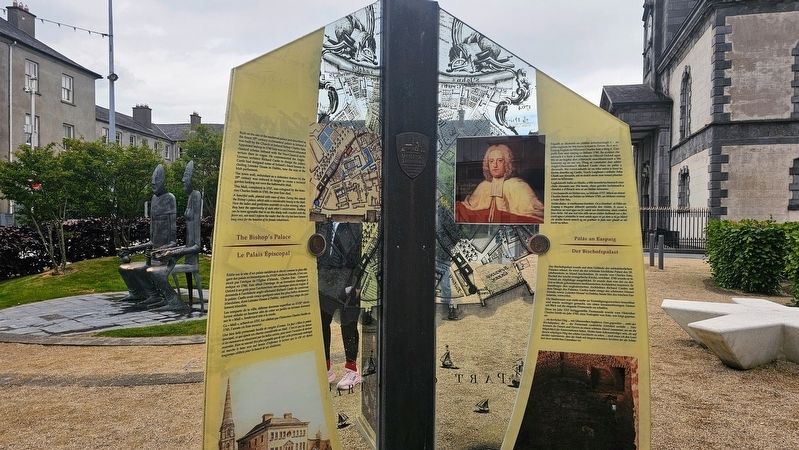
Photographed by Ian Lefkowitz, May 16, 2026
1. The Bishop’s Palace Marker

The Bishop’s Palace
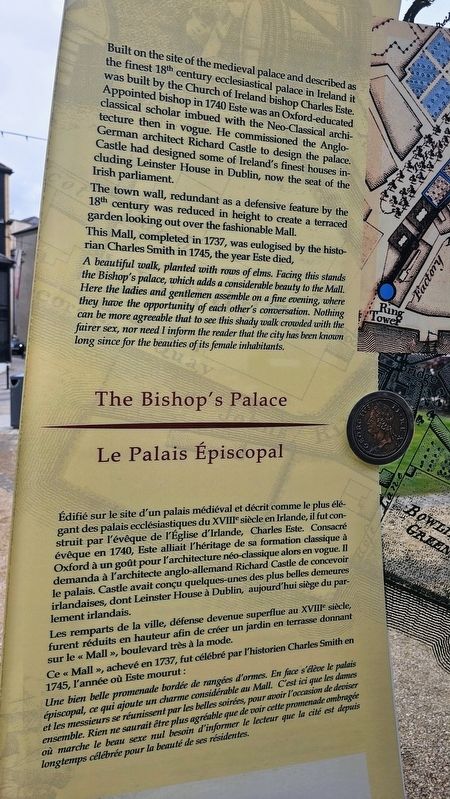
Built on the site of the medieval palace and described as the finest 18th century ecclesiastical palace in Ireland it was built by the Church of Ireland bishop Charles Este. Appointed bishop in 1740 Este was an Oxford-educated classical scholar imbued with the Neo-Classical architecture then in vogue. He commissioned the Anglo-German architect Richard Castle to design the palace. Castle had designed some of Ireland’s finest houses including Leinster House in Dublin, now the seat of the Irish parliament.
The town wall, redundant as a defensive feature by the 18th century was reduced in height to create a terraced garden looking out over the fashionable Mall. This Mall, completed in 1737, was eulogised by the historian Charles Smith in 1745, the year Este died,
A beautiful walk, planted with rows of elms. Facing this stands the Bishop’s palace, which adds a considerable beauty to the Mall. Here the ladies and gentlemen assemble on a fine evening, where they have the opportunity of each other’s conversation. Nothing can be more agreeable that to see this shady walk crowded with the fairer sex, nor need I inform the reader that the city has been known long since for the beauties of its female inhabitants.
Le Palais Épiscopal
Édifié
this page online
Les remparts de la ville, défense devenue superflue au XVIIIe siècle, furent réduits en hauteur afin de créer un jardin en terrasse donnant sur le « Mall », boulevard très à la mode. Ce « Mall », achevé en 1737, fut célébré par l’historien Charles Smith en 1745, l’année où Este mourut :
Une bien belle promenade bordée de rangées d’ormes. En face s’élève le palais épiscopal, ce qui ajoute un charme considérable au Mall. C’est ici que les dames et les messieurs se réunissent par les belles soirées, pour avoir l’occasion de deviser ensemble. Rien ne saurait être plus agréable que de voir cette promenade ombragée où marche le beau sexe nul besoin d’informer le lecteur que la cité est depuis longtemps célébrée pour la beauté de ses résidentes.
Pálás an Easpaig
Tógadh
Photographed by Ian Lefkowitz, May 16, 2026
2. The Bishop’s Palace Marker
A close-up of the English and French text.
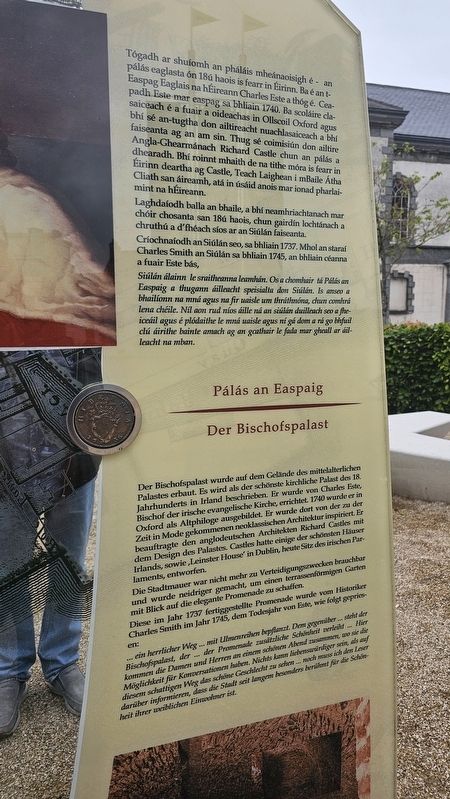
Laghdaíodh balla an bhaile, a bhí neamhriachtanach mar chóir chosanta san 18ú haois, chun gairdín lochtánach a chruthú a d’fhéach síos ar an Siúlán faiseanta. Críochnaíodh an Siúlán seo, sa bhliain 1737. Mhol an staraí Charles Smith an Siúlán sa bhliain 1745, an bhliain céanna a fuair Este bás,
Siúlán álainn le sraitheanna leamhán. Os a chomhair tá Pálás an Easpaig a thugann áilleacht speisialta don Siúlán. Is anseo a bhailíonn na mná agus na fir uaisle um thráthnóna, chun comhrá lena chéile. Níl aon rud níos áille ná an siúlán duilleach seo a fheiceáil agus é plódaithe le mná uaisle agus ní gá dom a rá go bhfuil clú áirithe bainte amach ag an gcathair le fada mar gheall ar áilleacht na mban.
Der Bischofspalast
Der Bischofspalast wurde auf dem Gelände des mittelalterlichen Palastes erbaut. Es wird als der schönste kirchliche Palast des 18. Jahrhunderts in Irland beschrieben. Er wurde von Charles Este, Bischof der irische evangelische Kirche, errichtet. 1740 wurde er in Oxford als Altphiloge ausgebildet. Er wurde dort von der zu der Zeit in Mode gekommenen neoklassischen Architektur inspiriert. Er beauftragte den anglodeutschen Architekten Richard Castles mit dem Design des Palastes. Castles hatte einige der schönsten
Photographed by Ian Lefkowitz, May 16, 2026
3. The Bishop’s Palace Marker
A close-up of the Irish and German text.
Die Stadtmauer war nicht mehr zu Verteidigungszwecken brauchbar und wurde niedriger gemacht, um einen terrassenförmigen Garten mit Blick auf die elegante Promenade zu schaffen.
Diese im Jahr 1737 fertiggestellte Promenade wurde vom Historiker Charles Smith im Jahr 1745, dem Todesjahr von Este, wie folgt gepriesen:
… ein herrlicher Weg … mit Ulmenreihen bepflanzt. Dem gegenüber … steht der Bischofspalast, der … der Promenade zusätzliche Schönheit verleiht … Hier kommen die Damen und Herren an einem schönen Abend zusammen, wo sie die Möglichkeit für Konversationen haben. Nichts kann liebenswürdiger sein, als auf diesem schattigen Weg das schöne Geschlecht zu sehen … noch muss ich den Leser darüber informieren, dass die Stadt seit langem besonders berühmt für die Schönheit ihrer weiblichen Einwohner ist.
Topics. This historical marker is listed in these topic lists: Architecture • Religion & Religious Structures. A significant historical year for this entry is 1740.
Location. 52° 15.577′ N, 7° 6.479′ W. Marker is in Waterford, Munster, in County Waterford. It can be reached from the intersection of Colbeck Street and Henrietta Street, on the left when traveling south. Touch for map. Marker is at or near this postal address: 7 Colbeck Street, Waterford, Munster, Ireland. Touch for directions.

Regionally, this marker is in the Ancient East. Globally, it is on the Atlantic Ocean, in the North Atlantic Region, in Europe, on the Island of Ireland, on the Celtic Fringe, in the European Union, in Atlantic Europe, on one of the British Isles, in the Western World, and in the Anglosphere.
Other nearby markers. At least 8 other markers are within walking distance of this marker: The Widows’ Apartments (here, next to this marker);
Photographed by Ian Lefkowitz, May 16, 2026
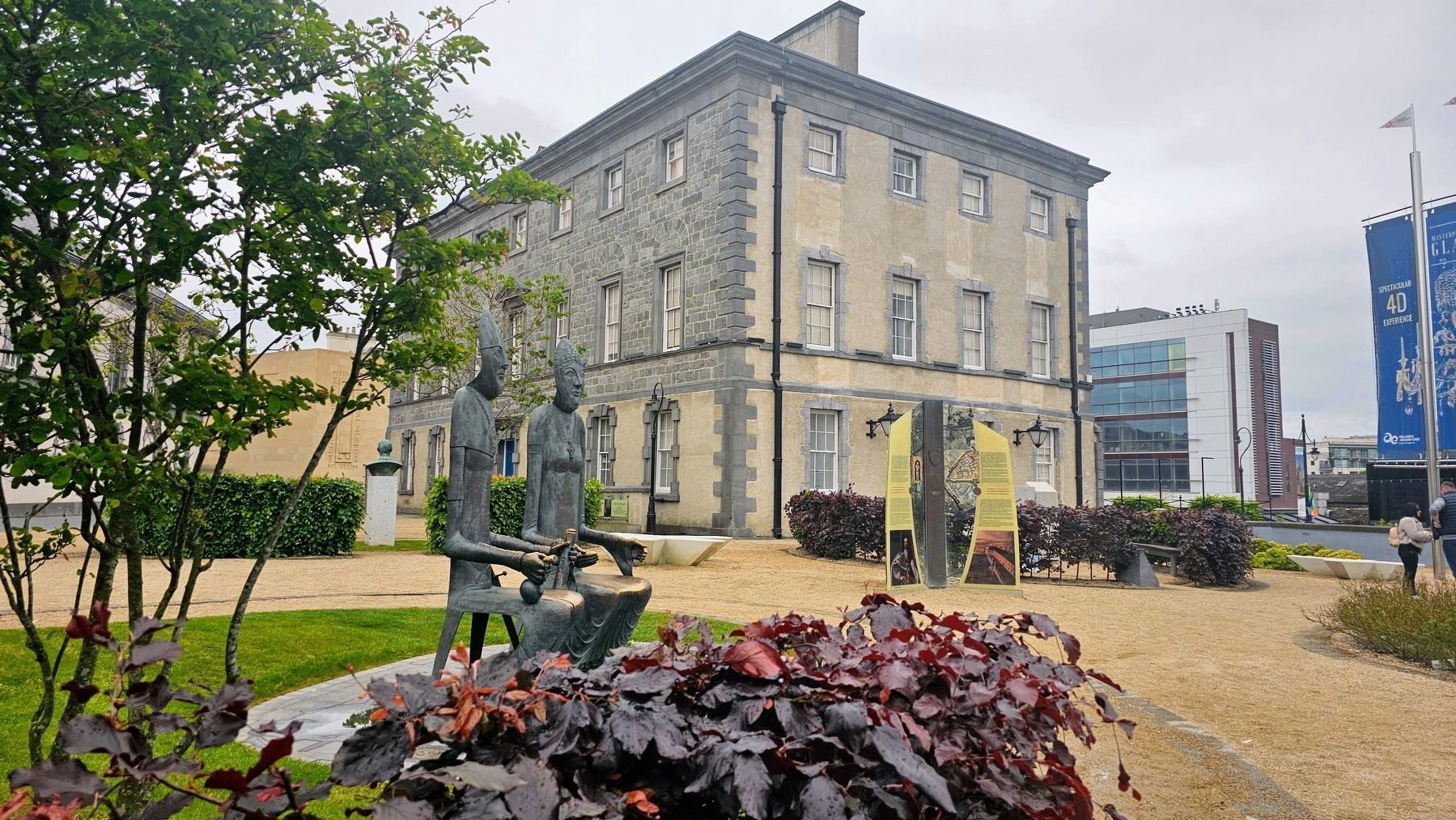
4. The Bishop’s Palace
The Bishop's Palace is one of the museums included in Waterford's Treasures in the Viking Triangle.
Also see . . . Bishop’s Palace.
The Bishop’s Palace in Cathedral Square opened as a museum in June 2011, displaying the treasures of Georgian and Victorian Waterford.(Submitted on June 22, 2026, by Ian Lefkowitz of New York, New York.)
Credits. This page was last revised on June 22, 2026. It was originally submitted on June 22, 2026, by Ian Lefkowitz of New York, New York. This page has been viewed 12 times since then. Photos: 1, 2, 3, 4. submitted on June 22, 2026, by Ian Lefkowitz of New York, New York. • Andrew Ruppenstein was the editor who published this page.
