Waterford in County Waterford, Munster, Ireland — Irish South-West ((Éire) North Atlantic Ocean)
Christ Church Cathedral
Cathédrale Christ Church
⎯⎯⎯
Ardeaglais Chríost
⎯⎯⎯
Die Christ Church Cathedral
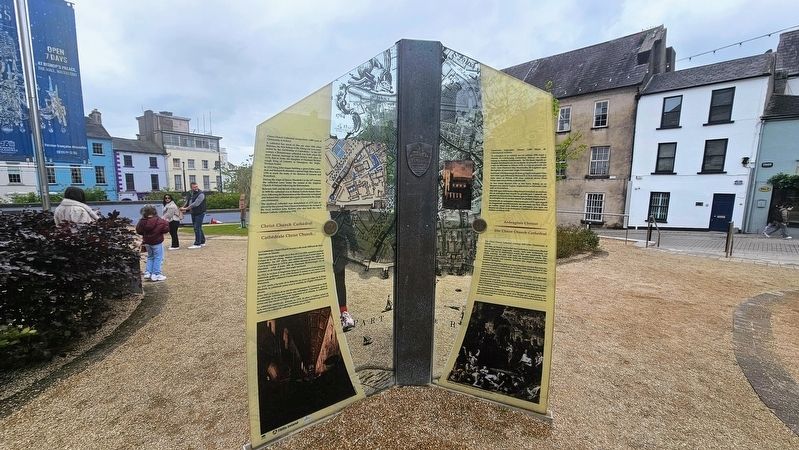
Photographed by Ian Lefkowitz, May 16, 2026
1. Christ Church Cathedral Marker

Christ Church Cathedral
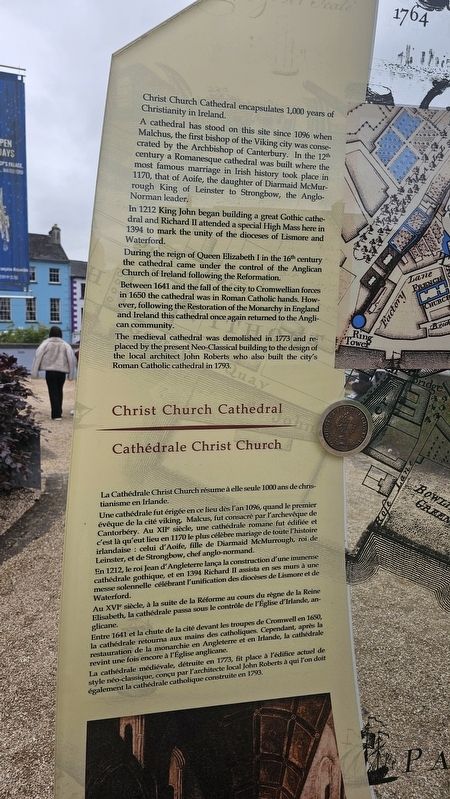
Christ Church Cathedral encapsulates 1,000 years of Christianity in Ireland. A cathedral has stood on this site since 1096 when Malchus, the first bishop of the Viking city, was consecrated by the Archbishop of Canterbury. In the 12th century a Romanesque cathedral was built where the most famous marriage in Irish history took place in 1170, that of Aoife, the daughter of Diarmaid McMurrough King of Leinster to Strongbow, the Anglo-Norman leader.
In 1212 King John began building a great Gothic cathedral and Richard II attended a special High Mass here in 1394 to mark the unity of the dioceses of Lismore and Waterford.
During the reign of Queen Elizabeth I in the 16th century the cathedral came under the control of the Anglican Church of Ireland following the Reformation.
Between 1641 and the fall of the city to Cromwellian forces in 1650 the cathedral was in Roman Catholic hands. However, following the Restoration of the Monarchy in England and Ireland this cathedral once again returned to the Anglican community.
The medieval cathedral was demolished in 1773 and replaced by the present
this page online
Cathédrale Christ Church
La Cathédrale Christ Church résume à elle seule 1000 ans de christianisme en Irlande. Une cathédrale fut érigée en ce lieu dès l’an 1096, quand le premier évêque de la cité viking, Malcus, fut consacré par l’archevêque de Cantorbéry. Au XIIe siècle, une cathédrale romane fut édifiée et c’est là qu’eut lieu en 1170 le plus célèbre mariage de toute l’histoire irlandaise : celui d’Aoife, fille de Diarmaid McMurrough, roi de Leinster, et de Strongbow, chef anglo-normand.
En 1212, le roi Jean d’Angleterre lança la construction d’une immense cathédrale gothique, et en 1394 Richard II assista en ses murs à une messe solennelle célébrant l’unification des diocèses de Lismore et de Waterford.
Au XVIe siècle, à la suite de la Réforme au cours du règne de la Reine Élisabeth, la cathédrale passa sous le contrôle de l’Église d’Irlande, anglicane.
Entre 1641 et la chute de la cité devant les troupes de Cromwell en 1650, la cathédrale retourna aux mains des catholiques. Cependant, après
Photographed by Ian Lefkowitz, May 16, 2026
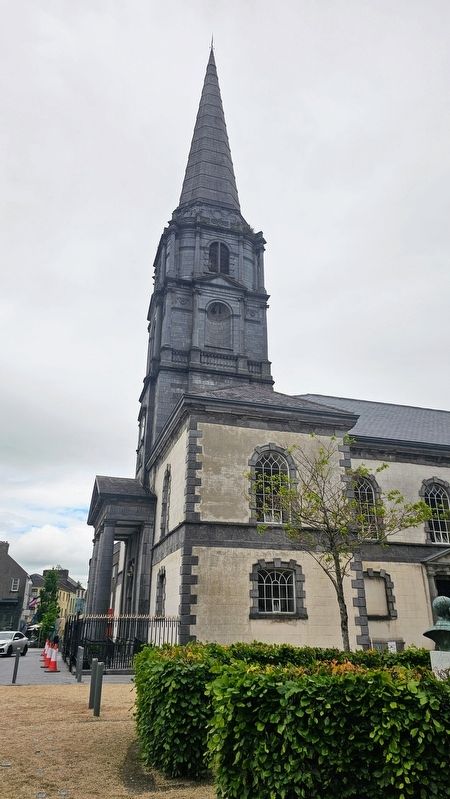
2. Christ Church Cathedral
A cathedral has existed at this location in Waterford for nearly a thousand years.
La cathédrale médiévale, détruite en 1773, fit place à l’édifice actuel de style néo-classique, conçu par l’architecte local John Roberts à qui l’on doit également la cathédrale catholique construite en 1793.
Ardeaglais Chríost
Cuimsíonn Ardeaglais Chríost 1,000 bliain de Chríostaíocht in Éirinn.
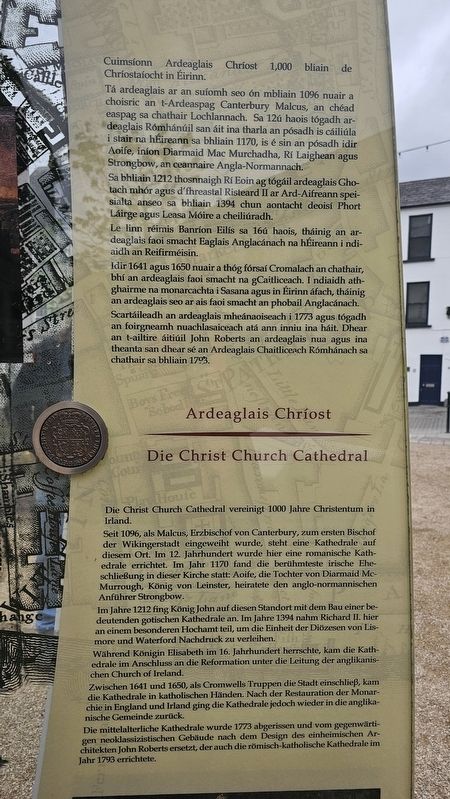
Tá ardeaglais ar an suíomh seo ón mbliain 1096 nuair a choisric an t-Ardeaspag Canterbury Malcus, an chéad easpag sa chathair Lochlannach. Sa 12ú haois tógadh ardeaglais Rómhánúil san áit ina tharla an pósadh is cáiliúla i stair na hÉireann sa bhliain 1170, is é sin an pósadh idir Aoife, iníon Diarmaid Mac Murchadha, Rí Laighean agus Strongbow, an ceannaire Angla-Normannach.
Sa bhliain 1212 thosnaigh Rí Eoin ag tógáil ardeaglais Ghotach mhór agus d’fhreastal Risteard II ar Ard-Aifreann speisialta anseo sa bhliain 1394 chun aontacht deoísí Phort Láirge agus Leasa Móire a cheiliúradh.
Le linn réimis Banríon Eilís sa 16ú haois, tháinig an ardeaglais faoi smacht Eaglais Anglacánach na hÉireann i ndiaidh an Reifirméisin.
Idir 1641 agus 1650 nuair a thóg fórsaí Cromalach an chathair, bhí an ardeaglais faoi smacht na gCaitliceach. I ndiaidh athghairme na monarcachta i Sasana agus in Éirinn áfach, tháinig an ardeaglais seo ar ais faoi smacht an phobail Anglacánach.
Scartáileadh an ardeaglais mheánaoiseach i 1773 agus tógadh an foirgneamh nuachlasaiceach atá ann inniu ina háit. Dhear an t-ailtire áitiúil John Roberts an ardeaglais nua agus ina theanta san dhear sé an Ardeaglais Chaitliceach Rómhánach sa bhliain 1793.
Die Christ Church Cathedral
Die Christ Church Cathedral vereinigt 1000 Jahre Christentum in Irland.
Seit 1096, als Malcus, Erzbischof von Canterbury, zum ersten Bischof der
Photographed by Ian Lefkowitz, May 16, 2026
3. Christ Church Cathedral Marker
A close-up of the English and French language on the marker.
Im Jahre 1212 fing König John auf diesem Standort mit dem Bau einer bedeutenden gotischen Kathedrale an. Im Jahre 1394 nahm Richard II hier an einem besonderen Hochamt teil, um die Einheit der Diözesen von Lismore und Waterford Nachdruck zu verleihen.
Während Königin Elisabeth im 16. Jahrhundert herrschte, kam die Kathedrale im Anschluss an die Reformation unter die Leitung der anglikanischen Church of Ireland.
Zwischen 1641 und 1650, als Cromwells Truppen die Stadt einschließ, kam die Kathedrale in katholischen Händen. Nach der Restauration der Monarchie in England und Irland ging die Kathedrale jedoch wieder in die anglikanische Gemeinde zurück.
Die mittelalterliche Kathedrale wurde 1773 abgerissen und vom gegenwärtigen neoklassizistischen Gebäude nach dem Design des einheimischen Architekten John Roberts ersetzt, der auch die römisch-katholische Kathedrale im Jahr 1793 errichtete.
Topics. This historical marker is listed in this topic list: Religion & Religious Structures. A significant historical year for this entry is 1096 CE.
Location. 52° 15.577′ N, 7° 6.486′ W. Marker is in Waterford, Munster, in County Waterford. It is at the intersection of Colbeck Street and Henrietta Street, on the left when traveling south on Colbeck Street. Touch for map. Marker is at or near this postal address: 7 Colbeck Street, Waterford, Munster, Ireland. Touch for directions.

Regionally, this marker is in the Ancient East. Globally, it is on the Atlantic Ocean, in the North Atlantic Region, in Europe,
Photographed by Ian Lefkowitz, May 16, 2026
4. Christ Church Cathedral Marker
A close-up of the Irish and German language panel of the marker.
Other nearby markers. At least 8 other markers are within walking distance of this marker: Strongbow and Aoife (here, next to this marker); The Bishop’s Palace (here, next to this marker); The Widows’ Apartments (a few steps from this marker); The Marriage That Changed History (a few steps from this marker); William Vincent Wallace (a few steps from this marker); Seán Ó hEathirn / John J Hearne (a few steps from this marker); “No Pasaran” (a few steps from this marker); Colbeck Gate (a few steps from this marker). Touch for a list and map of all markers in Waterford.
Credits. This page was last revised on June 22, 2026. It was originally submitted on June 22, 2026, by Ian Lefkowitz of New York, New York. This page has been viewed 17 times since then. Photos: 1, 2, 3, 4. submitted on June 22, 2026, by Ian Lefkowitz of New York, New York. • Andrew Ruppenstein was the editor who published this page.
