Central Business District in Melbourne, Victoria, Australia — Oceania
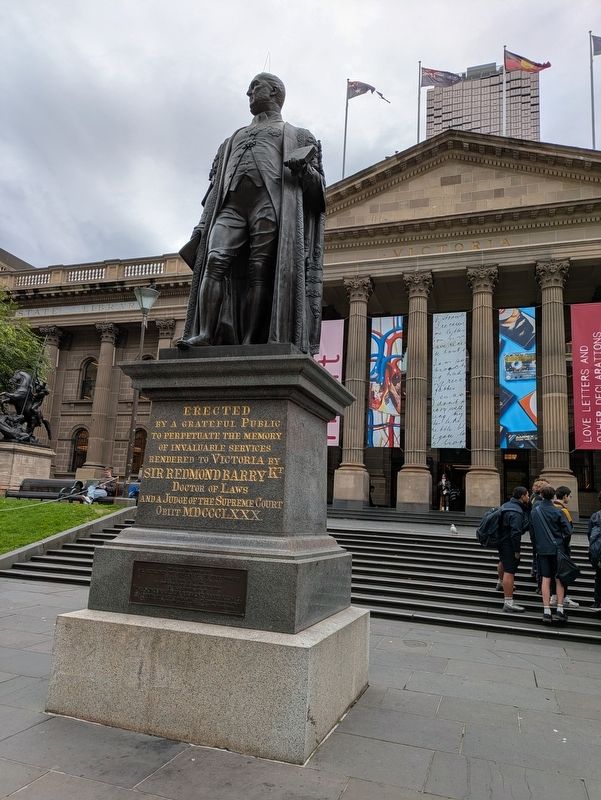
Sir Redmond Barry
Photographed by Dean Barton-Ancliffe, June 16, 2026
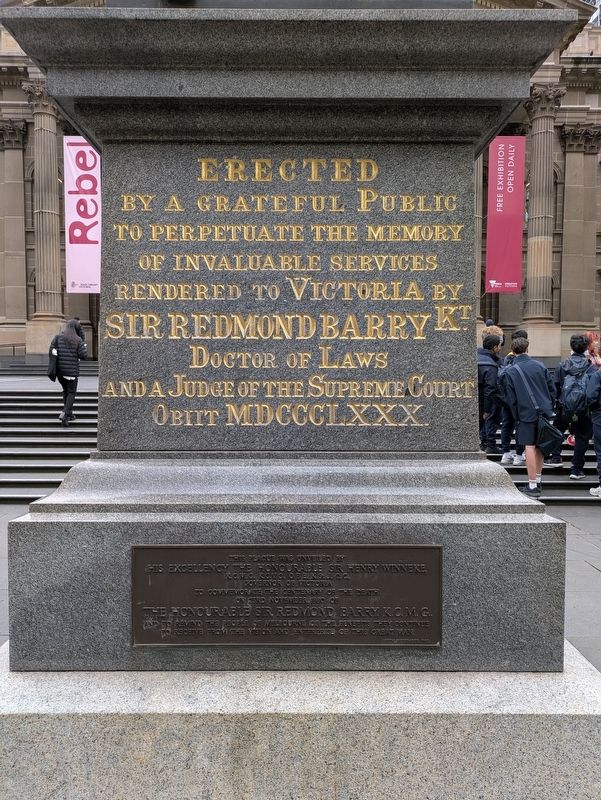
1. Sir Redmond Barry Marker
Sir Redmond Barry Kt.
Doctor of Laws
and a Judge of the Supreme Court
Obitt MCCCCLXXX
This plaque was unveiled by
His Excellency the Honourable Sir Henry Winneke
K.C.M.G. K.C.V.C. O.B.E. K.S.J. O.C.
Governor of Victoria
to commemorate the centenary of the death
on 23rd November 1880 of
The Honourable Sir Redmond Barry K.C.M.G.
and to remind the people of Melbourne of the benefits they continue to receive from the vision and enterprise of this great man
Erected 1980.
Topics. This historical marker is listed in this topic list: Charity & Public Work. A significant historical date for this entry is November 25, 1880.
Location. 37° 48.605′ S, 144° 57.859′ E. Marker is in Melbourne, Victoria. It is in the Central Business District. It is at the intersection of Swanston Street and La Trrobe Street, on the left when traveling south on Swanston Street. Touch for map. Marker is at or near this postal address: 328 Swanston Street, Melbourne VIC 3000, Australia. Touch for directions.

Regionally, it is in
this page online
Other nearby markers. At least 8 other markers are within walking distance of this marker: Charles Joseph La Trobe CB (within shouting distance of this marker); The Working Men's College (about 120 meters away, measured in a direct line); Former Working Men's College (about 150 meters away); a different marker also named Working Men's College (about 150 meters away); Bricks and spirit... (about 180 meters away); City Court (about 210 meters away); State Library Extensions (about 210 meters away); The Kelly Gate (about 210 meters away). Touch for a list and map of all markers in Melbourne.
Also see . . . Sir Redmond Barry (1813–1880). Australian Dictionary of Biography
In the early years of Melbourne Barry became unofficial standing counsel for the Aboriginals. He laboured as hard and as earnestly upon their cases, often capital matters, as he did upon his other briefs, though he rarely, if ever, received a fee for such(Submitted on June 22, 2026, by Dean Barton-Ancliffe of Rowville, Victoria.)services. His interest in the Aboriginals was general and lasted all his life. Though he accomplished for them little of practical value, his open-minded and unprejudiced approach was in advance of that of many even of the most liberal of his contemporaries.Photographed by Dean Barton-Ancliffe, June 16, 20262. Sir Redmond Barry Monument and Markers
On 2 January 1843 Governor Sir George Gipps sealed Barry's appointment to a minor judicial post, commissioner of the Court of Requests. This was a small debts court and his salary was £100, later increased to £250, plus a proportion of the court fees. The court sat only for the first few days of each month, and Barry therefore retained and developed his private practice. At the same time he was watching the possibility of securing a more important official post and applied unsuccessfully for a commissionership of crown lands.
In 1851, when the Port Phillip District was separated from New South Wales as the colony of Victoria, Barry was appointed its first solicitor-general, a position which he held briefly, for he was elevated to the new bench of the Supreme Court of Victoria in January 1852. He was the first puisne judge of that court and, after the appointment of (Sir) Edward Williams as a second puisne judge in July 1852, Barry held the appointment of senior puisne judge until his death.
Credits. This page was last revised on July 17, 2026. It was originally submitted on June 22, 2026, by Dean Barton-Ancliffe of Rowville, Victoria. This page has been viewed 22 times since then. Photos: 1, 2. submitted on June 22, 2026, by Dean Barton-Ancliffe of Rowville, Victoria. • Bill Pfingsten was the editor who published this page.
