Waterford in County Waterford, Munster, Ireland — Irish South-West ((Éire) North Atlantic Ocean)
Choristers’ Hall and Mayor’s Wine Vault
Photographed by Ian Lefkowitz, May 16, 2026
1. Choristers’ Hall and Mayor’s Wine Vault Marker

Choristers’ Hall and Mayor’s Wine Vault
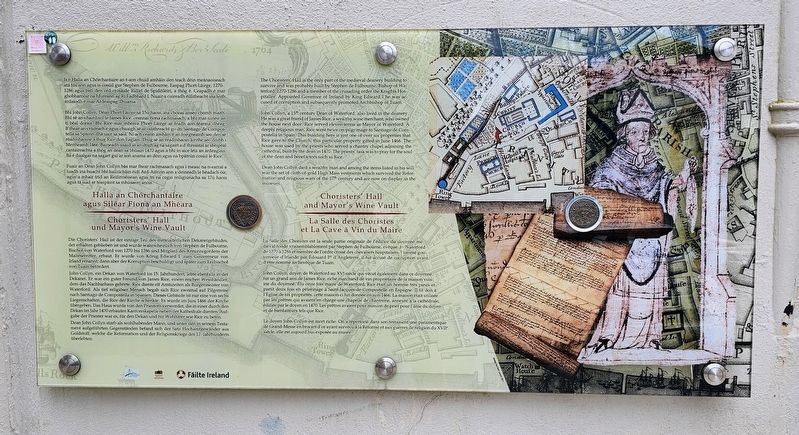
The Choristers’ Hall is the only part of the medieval deanery building to survive and was probably built by Stephen de Fulbourne, Bishop of Waterford, 1270–1286 and a member of the crusading order the Knights Hospitaller. Appointed Governor of Ireland by King Edward I he was accused of corruption and subsequently promoted Archbishop of Tuam.
John Collyn, a 15th century Dean of Waterford, also lived in the deanery. He was a great friend of James Rice, a wealthy wine merchant, who owned the house next door. Rice served eleven terms as Mayor of Waterford. A deeply religious man, Rice went twice on pilgrimage to Santiago de Compostella in Spain. This building here is just one of over six properties that Rice gave to the Church, this particular property gifted in June 1466. The house was used by the priests who served a chantry chapel adjoining the cathedral, built by the dean in 1470. The priests’ task was to pray for the soul of the dean and benefactors such as Rice.
Dean John Collyn died a wealthy man and among the items listed in his will
this page online
[Gaeilge:]
Halla an Chórchantaire agus Siléar Fíona an Mhéara
Is é Halla an Chórchantaire an t-aon chuid amháin den teach déin meánaoiseach atá fós ann agus is cosúil gur Stephen de Fulbourne, Easpag Phort Láirge, 1270–1286 agus ball den ord crosáide Ridirí de Spidéiléirí, a thóg é. Ceapadh é mar ghobharnóir na hÉireann ag Rí Éadbhard I. Nuair a cuireadh éillitheacht ina leith árdaíodh é mar Ardeaspag Thuama.
Bhí John Collyn, Déan Phort Láirge sa 15ú haois, ina chónaí anseo chomh maith. Bhí sé an-chairdiúil le James Rice, ceannaí fíona rachmasach, a bhí mar úinéir an tí béal dorais. Bhí Rice mar mhéara Phort Láirge ar feadh aon téarma dhéag. B’fhear an-cráifeach é agus chuaigh sé ar oilithreacht go dtí Santiago de Compostella sa Spáinn dhá uair sa saol. Ní ach ceann amháin é an foirgneamh seo den sé réadmhaoine a thug Rice don Eaglais. Thug sé an réadmhaoin áirithe seo dóibh i Meitheamh 1466. Baineadh úsáid as an dtigh ag na sagairt a d’fhreastal ar shéipéal cantaireachta a thóg
Photographed by Ian Lefkowitz, May 16, 2026
2. Choristers’ Hall and Mayor’s Wine Vault Marker
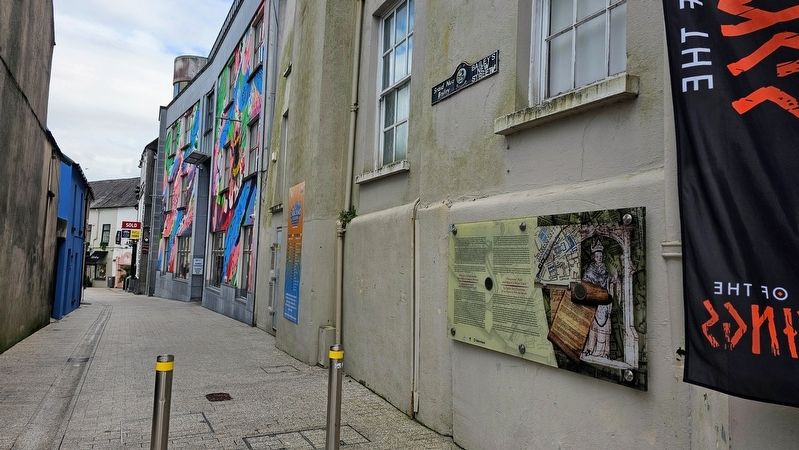
The marker is located at the entrance to Bailey's New Street.
Fuair an Déan John Collyn bás mar fhear rachmasach agus i measc na n-earraí a luadh ina huacht bhí bailiúcháin éidí Ard-Aifrinn ann a deineadh le héadach óir, agus a mhair tríd an Reifirméisean agus trí na cogaí reiligiúnacha sa 17ú haois agus tá siad ar teaspáint sa mhúsaem anois.
Choristers’ Hall und Mayor’s Wine Vault
Die Choristers’ Hall ist der einzige Teil des mittelalterlichen Dekaneigebäudes, der erhalten geblieben ist und wurde wahrscheinlich von Stephen de Fulbourne, Bischof von Waterford von 1270 bis 1286 und Mitglied des Kreuzzugordens der Malteserritter, erbaut. Er wurde von König Edward I. zum Gouverneur von Irland ernannt, dann aber der Korruption beschuldigt und später zum Erzbischof von Tuam befördert.
John Collyn, ein Dekan von Waterford im 15. Jahrhundert, lebte ebenfalls in der Dekanei. Er war ein guter Freund von James Rice, einem reichen Weinhändler, dem das Nachbarhaus gehörte. Rice diente elf Amtszeiten als Bürgermeister von Waterford. Als tief religiöser Mensch begab sich Rice zweimal auf Pilgerreise nach Santiago de Compostella in Spanien. Dieses Gebäude ist nur eine von sechs Liegenschaften, die Rice der Kirche schenkte. Es wurde im Juni 1466 der Kirche Dekan übergeben. Das Haus wurde von den Priestern verwendet, die in einer durch den Dekan im Jahr 1470 erbauten Kantoreikapelle neben der Kathedrale dienten. Aufgabe der Priester war es, für den Dekan und für Wohltäter wie Rice zu beten. Dean John Collyn starb als wohlhabender Mann, und unter den in seinem Testament aufgeführten Gegenständen befand sich der Satz Hochamtgewänder aus Goldstoff, welche die Reformation und der Religionskriege des 17. Jahrhunderts überlebten.
La Salle des Choristes et La Cave à Vin du Maire
La Salle des Choristes est la seule partie originale de l’édifice du doyenné médiéval fondé vraisemblablement par Stephen de Fulbourne, évêque de Waterford de 1270 à 1286 et membre de l’ordre croisé des chevaliers hospitaliers. Nommé gouverneur d’Irlande par Édouard Ier d’Angleterre, il fut accusé de corruption avant d’être nommé archevêque de Tuam.
John Collyn, doyen de Waterford au XVe siècle qui vécut également dans ce doyenné fut un grand ami de James Rice, riche marchand de vin propriétaire de la maison voisine du doyenné. Élu onze fois maire de Waterford, Rice était un homme très pieux et partit deux fois en pèlerinage à Saint-Jacques-de-Compostelle en Espagne. Il fit don à l’Église de six propriétés, cette maison-ci fut donnée en juin 1466. La maison était utilisée par les prêtres qui avaient en charge une chapelle de chantrerie, annexée à la cathédrale, édifiée par le doyen en 1470. Les prêtres avaient pour mission de prier pour l’âme du doyen et de bienfaiteurs tels que Rice.
Le doyen John Collyn est mort riche. On a répertorié dans son testament une paramentique de Grand-Messe en brocart d’or ayant survécu à la Réforme et aux guerres de religion du XVIIe siècle, elle est aujourd’hui exposée au musée.
Erected by Waterford Treasures.
Topics. This historical marker is listed in this topic list: Religion & Religious Structures. A significant historical month for this entry is June 1466.
Location. 52° 15.613′ N, 7° 6.417′ W. Marker is in Waterford, Munster, in County Waterford. It is on Greyfriars Street near Bailey's New Street, on the left when traveling south. Touch for map. Marker is at or near this postal address: 2 Greyfriars Street, Waterford, Munster, Ireland. Touch for directions.

Regionally, this marker is in the Ancient East. Globally, it is on the Atlantic Ocean, in the North Atlantic Region, in Europe, on the Island of Ireland, on the Celtic Fringe, in the European Union, in Atlantic Europe, on one of the British Isles, in the Western World, and in the Anglosphere.
Other nearby markers. At least 8 other markers are within walking distance of this marker: Stephen De Fulburn (here, next to this marker); Where St Patrick’s Day Began (within shouting distance of this marker); Franciscan Friary (within shouting distance of this marker); Lewis Chess Set (within shouting distance of this marker); God’s People’s House (within shouting distance of this marker); Brick Lane (within shouting distance of this marker); John Roberts (within shouting distance of this marker); Frederick Douglass (within shouting distance of this marker). Touch for a list and map of all markers in Waterford.
Credits. This page was last revised on June 23, 2026. It was originally submitted on June 23, 2026, by Ian Lefkowitz of New York, New York. This page has been viewed 12 times since then. Photos: 1, 2. submitted on June 23, 2026, by Ian Lefkowitz of New York, New York. • Andrew Ruppenstein was the editor who published this page.
