Waterford in County Waterford, Munster, Ireland — Irish South-West ((Éire) North Atlantic Ocean)
Franciscan Friary
Photographed by Ian Lefkowitz, May 16, 2026
1. Franciscan Friary Marker, Side One
 [English:]
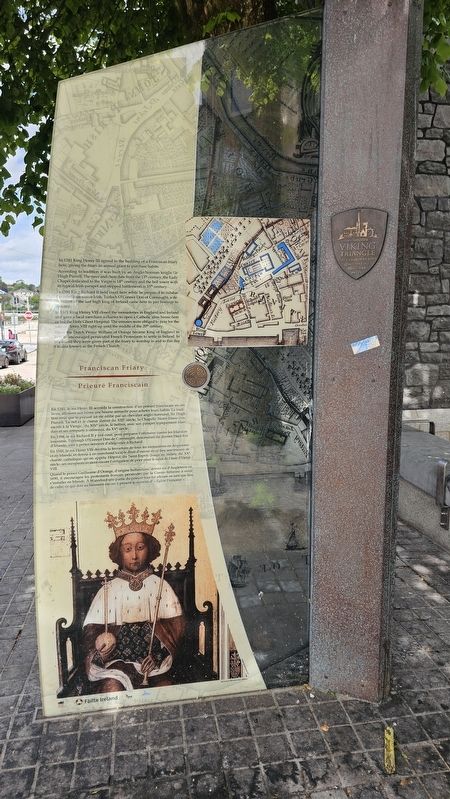
Franciscan Friary
In 1241 King Henry III agreed to the building of a Franciscan friary here, giving the friars an annual grant to purchase habits.
According to tradition it was built by an Anglo-Norman knight Sir Hugh Purcell. The nave and choir date from the 13th century, the Lady Chapel dedicated to the Virgin is 14th century and the bell tower with its typical Irish stepped battlements is 15th century.
In 1394 King Richard II held court here while he prepared to subdue the rebellious native Irish. Turloch O’Connor Don of Connaught, a descendant of the last high king of Ireland came here to pay homage to Richard.
In 1541 King Henry VIII closed the monasteries in England and Ireland and gave a local merchant a charter to open a Catholic alms house here called the Holy Ghost Hospital. The inmates were obliged to pray for the soul of Henry VIII right up until the middle of the 20th century.
When the Dutch Prince William of Orange became King of England in 1690 he encouraged persecuted French Protestants to settle in Ireland. In Waterford they were given part of the friary to worship in and to this day it is also known as the French Church.
Prieuré Franciscain
En 1241, le roi Henri III accorda la construction d’un prieuré franciscain en ces lieux, allouant aux frères une bourse annuelle pour acheter leurs habits. La tradition veut que le prieuré ait été édifié par un chevalier anglo-normand, Sir Hugh Purcell. La nef et le chœur datent du XIIIe siècle, la Chapelle Notre-Dame consacrée à la Vierge, du XIVe siècle, avec son parapet typiquement irlandais et ses remparts à créneaux, du XVe siècle.
En 1394, le roi Richard II y tint cour, pour préparer l’offensive contre les Irlandais insoumis. Turlough O’Connor Don de Connaught, descendant du dernier Haut Roi d’Irlande, vint y prêter serment d’allégeance
this page online
En 1541, le roi Henri VIII décréta la fermeture de tous les monastères en Angleterre et en Irlande, et donna à un marchand local le droit d’ouvrir en ce lieu une maison de charité catholique qu’on appela Hôpital du Saint-Esprit. Jusqu’au milieu du XXe siècle, ses occupants avaient encore l’obligation de prier pour le salut de l’âme d’Henri VIII.
Quand le prince Guillaume d’Orange, d’origine hollandaise, devint roi d’Angleterre en 1690, il encouragea les protestants persécutés par la Contre-Réforme à venir s’installer en Irlande. À Waterford une partie du prieuré leur fut allouée en tant que lieu de culte, ce qui doit au bâtiment encore à présent le surnom d’« église Française ».
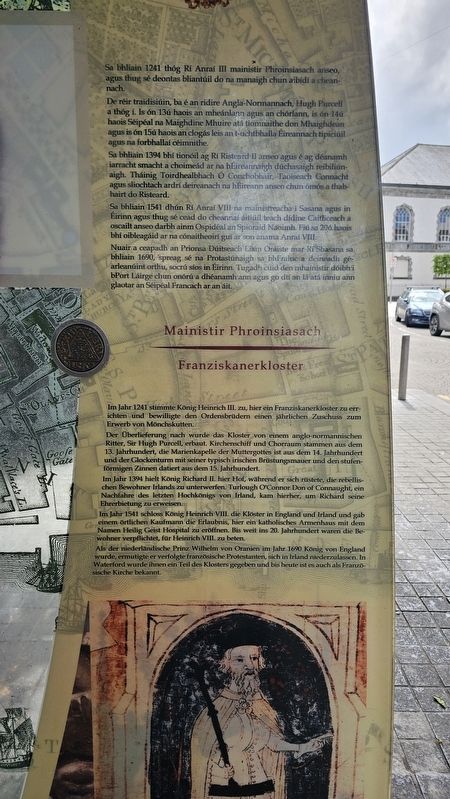
Mainistir Phroinsiasach
Sa bhliain 1241 thóg Rí Anraí III mainistir Phroinsiasach anseo, agus thug sé deontas bliantúil do na manaigh chun aibídí a cheannach.
De réir traidisiúin, ba é an ridire Angla-Normannach, Hugh Purcell a thóg í. Is ón 13ú haois an mheánlann agus an chórlann, is ón 14ú haois Séipéal na Maighdine Mhuire atá tiomnaithe don Mhaighdean agus is ón 15ú haois an clogás leis an t-úchtbhalla Éireannach tipiciúil agus na forbhallaí
Photographed by Ian Lefkowitz, May 16, 2026
2. Franciscan Friary Marker, Side Two
Sa bhliain 1394 bhí tionóil ag Rí Risteard II anseo agus é ag déanamh iarracht smacht a choimeád ar na hÉireannaigh dúchasaigh reiliúnaigh. Tháinig Toirdhealbhach Ó Conchobhair, Taoiseach Connacht agus slíochtach ardrí deireannach na hÉireann anseo chun ómós a thabhairt do Risteard.
Sa bhliain 1541 dhún Rí Anraí VIII na mainistreacha i Sasana agus in Éirinn agus thug sé cead do cheannaí áitiúil teach dídine Caitliceach a oscailt anseo darbh ainm Ospidéal an Spioraid Naoimh. Fiú sa 20ú haois bhí oibleagáid ar na cónaitheoirí guí ar son anama Anraí VIII.
Nuair a ceapadh an Prionsa Dúitseach Liam Oráiste mar Rí Shasana sa bhliain 1690, spreag sé na Protastúnaigh sa bhFrainc a deineadh géarleanúint orthu, socrú síos in Éirinn. Tugadh cuid den mhainistir dóibh i bPort Láirge chun onórú a dhéanamh ann agus go dtí an lá atá inniu ann glaotar an Séipéal Francach ar an áit.
Franziskanerkloster
Im Jahr 1241 stimmte König Heinrich III. zu, hier ein Franziskanerkloster zu errichten und bewilligte den Ordensbrüdern einen jährlichen Zuschuss zum Erwerb von Mönchskutten.
Der Überlieferung nach wurde das Kloster von einem anglo-normannischen Ritter, Sir Hugh Purcell, erbaut. Kirchenschiff und Chorraum stammen aus dem 13. Jahrhundert, die Marienkapelle der Muttergottes ist aus dem 14. Jahrhundert und der Glockenturm mit seiner typisch irischen Brüstungsmauer und den stufenförmigen Zinnen datiert aus dem 15. Jahrhundert.
Im Jahr 1394 hielt König Richard II. hier Hof, während er sich rüstete, die rebellischen Bewohner Irlands zu unterwerfen. Turlough O’Connor Don of Connaught, ein Nachfahre des letzten Hochkönigs von Irland, kam hierher, um Richard seine Ehrerbietung zu erweisen.
Im Jahr 1541 schloss König Heinrich VIII. die Klöster in England und Irland und gab einem örtlichen Kaufmann die Erlaubnis, hier ein katholisches
Photographed by Ian Lefkowitz, May 16, 2026
3. Franciscan Friary Marker
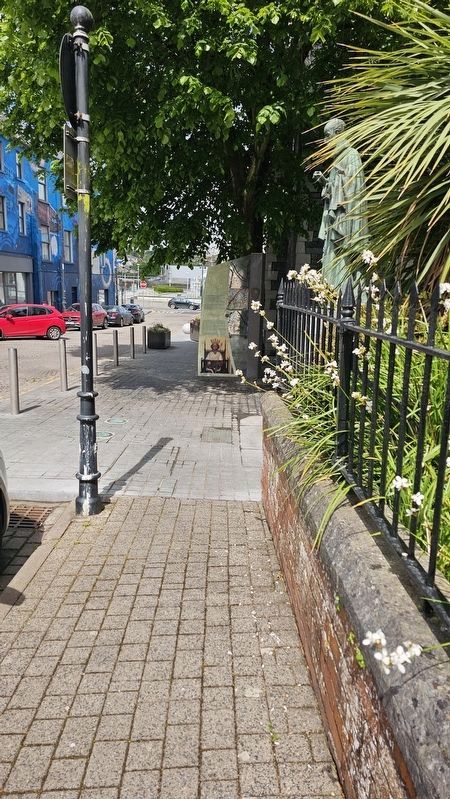
The marker is located next to the statue of Luke Wadding, theologian and progenitor of St. Patrick's Day.
Als der niederländische Prinz Wilhelm von Oranien im Jahr 1690 König von England wurde, ermutigte er verfolgte französische Protestanten, sich in Irland niederzulassen. In Waterford wurde ihnen ein Teil des Klosters gegeben und bis heute ist es auch als Französische Kirche bekannt.
Erected by Waterford Treasures.
Topics. This historical marker is listed in this topic list: Religion & Religious Structures. A significant historical year for this entry is 1241.
Location. 52° 15.631′ N, 7° 6.42′ W. Marker is in Waterford, Munster, in County Waterford. It is on Greyfriars Street north of Bailey's New Street, on the left when traveling south. Touch for map. Marker is at or near this postal address: 1 Greyfriars St, Waterford, Munster, Ireland. Touch for directions.

Regionally, this marker is in the Ancient East. Globally, it is on the Atlantic Ocean, in the North Atlantic Region, in Europe, on the Island of Ireland, on the Celtic Fringe, in the European Union, in Atlantic Europe, on one of the British Isles, in the Western World, and in the Anglosphere.
Other nearby markers. At least 8 other markers are within walking distance of this marker: Where St Patrick’s Day Began (a few steps from this marker); Brick Lane (within shouting distance of this marker); Stephen De Fulburn (within shouting distance of this marker); Choristers’ Hall and Mayor’s Wine Vault (within shouting distance of this marker); Lewis Chess Set (within shouting distance of this marker); God’s People’s House (within shouting distance of this marker); King Richard II of England (within shouting distance of this marker); John Roberts (within shouting distance of this marker). Touch for a list and map
Photographed by Ian Lefkowitz, May 16, 2026
4. Franciscan Friary Marker
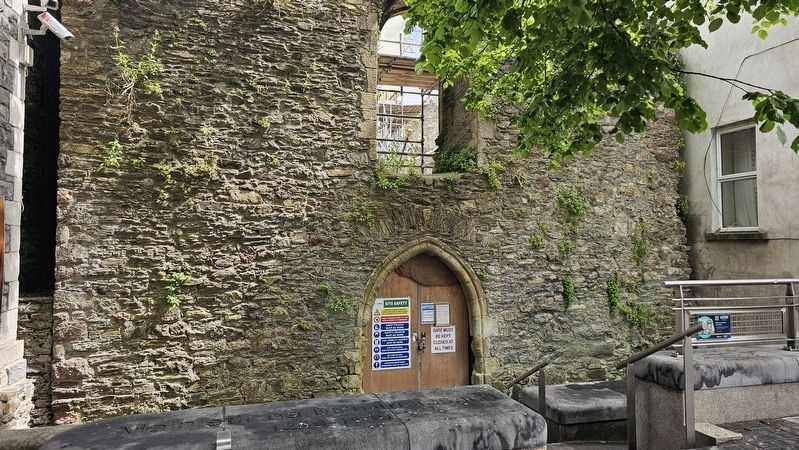
The gates of the Franciscan Friary.
Also see . . . Former Friaries: Waterford (Franciscans).
The original friary (one of the first in Ireland) was founded 1240. With the turmoil of the Reformation the church was turned into a hospital for the poor in 1541...In May 2019 the Franciscans Friars departed Waterford Friary. The friars in Clonmel travel daily to the Franciscan church in Lady Lane for Masses and Confessions. The friary was given over by the Franciscans to a community of nuns – the Sisters of the Morning Star.(Submitted on June 23, 2026, by Ian Lefkowitz of New York, New York.)
Credits. This page was last revised on June 23, 2026. It was originally submitted on June 23, 2026, by Ian Lefkowitz of New York, New York. This page has been viewed 11 times since then. Photos: 1, 2, 3, 4. submitted on June 23, 2026, by Ian Lefkowitz of New York, New York. • Andrew Ruppenstein was the editor who published this page.
