Saint Marys in Perth County, Ontario — Central Canada (North America)
St. Marys Cement Plant
Historic St. Marys
Photographed by Tim Boyd, June 21, 2026
1. St. Marys Cement Plant Marker
Background:
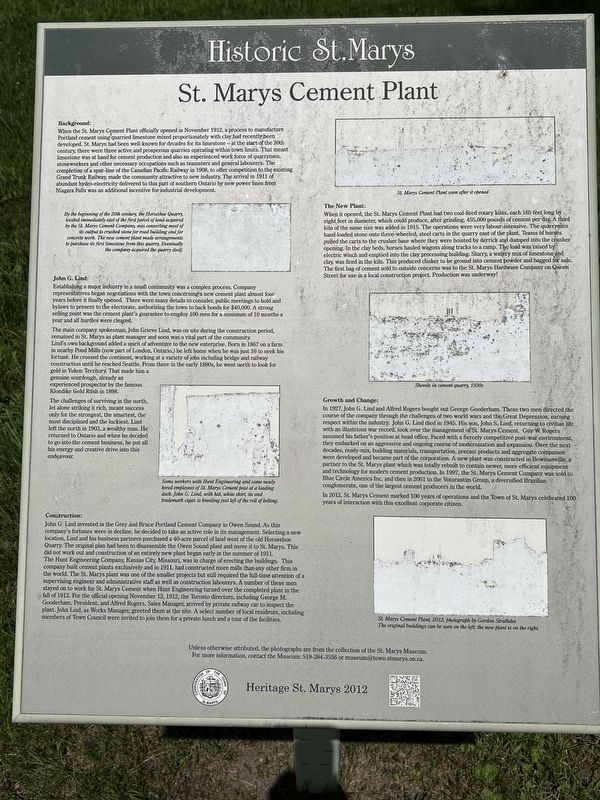
When the St. Marys Cement Plant officially opened in November 1912, a process to manufacture Portland cement using quarried limestone mixed proportionately with clay had recently been developed. St. Marys had been well known for decades for its limestone at the start of the 20th-century, there were three active and prosperous quarries operating within towns limits. That meant limestone was at hand for cement production and also an experienced work force of quarrymen stoneworkers and other necessary occupations such as teamsters and general labourers. The completion of a spur-line of the Canadian Pacific Railway in 1908, to offer competition to the Grand Trunk Railway, made the community attractive to new industry. The arrival in 1911 of abundant hydro-electricity delivered to this part of southern Ontario by new power lines from Niagara Falls was an additional incentive for industrial development.
John G. Lind:
Establishing a major industry in a small community was a complex process. Company representatives began negotiations with the town concerning a new cement plant almost four years before it finally
this page online
The main company spokesman, John Grieve Lind, was on site during the construction period, remained in St. Marys as plant manager and soon was a vital part of the community. Lind's own background added a spirit of adventure to the new enterprise. Born in 1867 on a farm in nearby Pond Mills (now part of London, Ontario,) he left home when he was just 16 to seek his fortune. He crossed the continent, working at a variety of jobs including bridge and railway construction until he reached Seattle. From there in the early 1890s, he went north to look for gold in Yukon Territory. That made him a genuine sourdough, already an experienced prospector by the famous Klondike Gold Rush in 1898.
The challenges of surviving in the north, let alone striking it rich, meant success only for the strongest, the smartest, the most disciplined and the luckiest.
Photographed by Tim Boyd, June 21, 2026
2. St. Marys Cement Plant Marker
Construction:
John G. Lind invested in the Grey and Bruce Portland Cement Company in Owen Sound. As this company's fortunes were in decline, he decided to take an active role in its management. Selecting a new location, Lind and his business partners purchased a 40-acre parcel of land west of the old Horseshoe Quarry. The original plan had been to disassemble the Owen Sound plant and move it to St. Marys. This did not work out and construction of an entirely new plant began early in the summer of 1911. The Hunt Engineering Company Kansas City, Missouri, was in charge of erecting the buildings. This company built cement plants exclusively and in 1921, had constructed more mills than any other firm in the world. The St. Marys plant was one of the smaller projects but still required the full-time attention of a supervising engineer and administrative staff as well as construction labourers. A number of these men stayed on to work for St. Marys Cement when Hunt Engineering turned over the completed plant in the fall of 1912. For the official opening November 12, 1912, the Toronto directors, including George M. Gooderham, President, and Alfred Rogers, Sales Manager, arrived by private railway car to inspect the plant. John Lind, as Works Manager, greeted them at the site. A select number of local residents, including members of Town Council were invited to join them for a private lunch and a tour of the facilities.
The New Plant
When it opened, the St. Marys Cement Plant had two coal-fired rotary kilns, each 10 feet long by eight feet in diameter, which could produce, after grinding, 455,000 pounds of cement per day. A third kiln of the same size was added in 1915. The operations were very labour intensive. The quarrymen hand-loaded stone onto three-wheeled, steel carts in the quarry east of the plant. Teams of horses pulled the carts to the crusher base where they were hoisted by derrick and dumped into the crusher opening. In the clay beds, horses hauled wagons along tracks to a ramp. The load was raised by electric winch and emptied into the clay processing building. Slurry, a watery mix of limestone and clay was fired in the kilns. This produced clinker to be ground into cement powder and bagged for sale. The first bag of cement sold to outside concerns was to the St. Marys Hardware Company on Queen Street for use in a local construction project. Production was underway!
Growth and Change:
In 1927, John G. Lind and Alfred Rogers bought out George Gooderham. These two mes directed the course of the company through the challenges of two world wars and the Great Depression, earning respect within the industry. John G. Lind died in 1945. His son, John S. Lind, returning to civilian life with an illustrious war record, took over the management of St. Marys Cement. Guy W. Rogers assumed his father's position at head office. Faced with a fiercely competitive post-war environment, they embarked on an aggressive and ongoing course of modernization and expansion. Over the next decades, ready-mix, building materials, transportation, precast products and aggregate companies were developed and became part of the corporation. A new plant was constructed in Bowmanville, partner to the St Marys plant which was totally rebuilt to contain newer, more efficient equipment and technology for modern cement production. In 1997, the St. Marys Cement Company was sold to Blue Circle America Inc. and then in 2001 to the Votorantim Group, a diversified Brazilian conglomerate, one of the largest cement producers in the world. In 2012, St. Marys Cement marked 100 years of operations and the Town of St. Marys celebrated 100 years of interaction with this excellent corporate citizen.
Erected 2012 by Heritage St. Marys.
Topics. This historical marker is listed in this topic list: Industry & Commerce. A significant historical year for this entry is 1912.
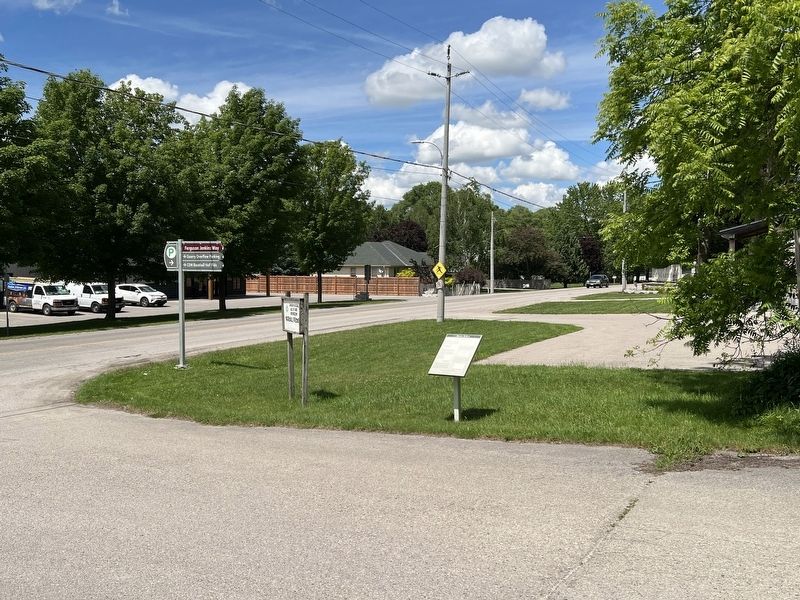
Location. 43° 14.852′ N, 81° 9.05′ W. Marker is in Saint Marys, Ontario, in Perth County. It is on Water Street South 0.1 kilometers north of Church Street South, on the right when traveling north. Touch for map. Marker is at or near this postal address: 478 Water Street S, Saint Marys ON N4X 1A1, Canada. Touch for directions.

Regionally, this marker is in the Huron-Perth-Waterloo-Wellington Area and in Southwestern Ontario. It is also in Central Canada. Globally, it is in North America, the Western Hemisphere, the Western World, and the Anglosphere. Historically, it finds itself in what was once a British colony, the Viceroyalty of New France, the Haudenosaunee (Iroquois) Confederacy, and Rupert’s Land.
Other nearby markers. At least 8 other markers are within walking distance of this marker: The Quarry (about 210 meters away, measured in a direct line); The Tracy House (approx. 1.1 kilometers away); Stonetown Insurance (approx. 1.2 kilometers away); The Armouries (approx. 1.4 kilometers away); St. Marys Opera House (approx. 1.4 kilometers away); Mill Wheel (approx. 1.4 kilometers away); Mill Race (approx. 1.4 kilometers away); The Hutton-MacPherson Block (approx. 1.4 kilometers away). Touch for a list and map of all markers in Saint Marys.
Credits. This page was last revised on June 24, 2026. It was originally submitted on June 23, 2026, by Tim Boyd of Hamilton, Ontario. This page has been viewed 15 times since then. Photos: 1, 2. submitted on June 23, 2026, by Tim Boyd of Hamilton, Ontario. • Andrew Ruppenstein was the editor who published this page.
