Marker Logo
THE HISTORICAL
MARKER DATABASE
“Bite-Size Bits of Local, National, and Global History”
Bennington in Bennington County, Vermont — The American Northeast (New England)
 

Gibney Block

528 Main Street

— Downtown Bennington Historic District —


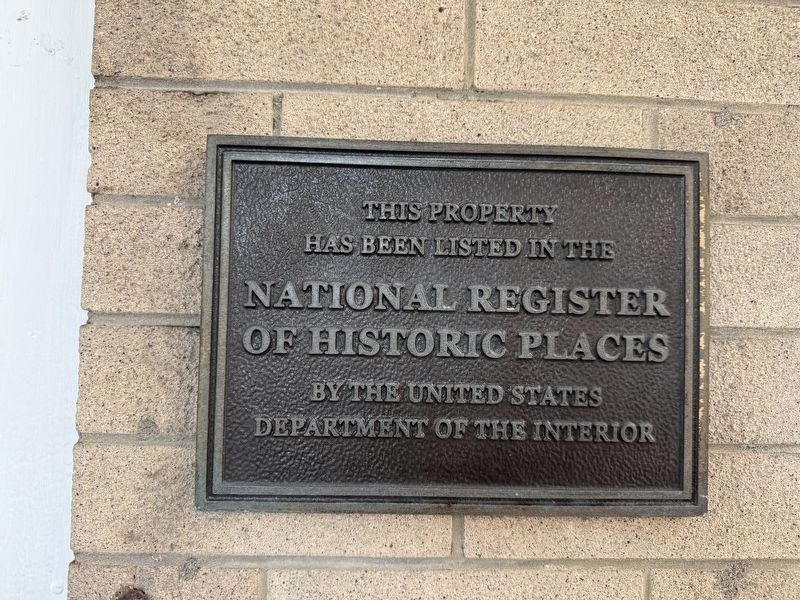
Gibney Block Marker image. Click for full size.
Photographed by Devry Becker Jones (CC0), June 20, 2026
1. Gibney Block Marker
Inscription.
This property
has been listed in the
National Register
of Historic Places

by the United States
Department of the Interior

 
Topics. This historical marker is listed in these topic lists: ArchitectureIndustry & Commerce.
 
Location. 42° 52.69′ N, 73° 11.625′ W. Marker is in Bennington, Vermont, in Bennington County. It is at the intersection of Main Street (Route 9) and Silver Street, on the right when traveling west on Main Street. Touch for map. Marker is at or near this postal address: 528 Main St, Bennington VT 05201, United States of America. Touch for directions.

Regionally, this marker is in Southern Vermont. It is also in the American Northeast and in New England. Globally, it is in North America, the Western Hemisphere, the Western World, and the Anglosphere.

Other nearby markers. At least 8 other markers are within walking distance of this marker: Shaffe’s (about 300 feet away, measured in a direct line); Norton-Fenton House (about 400 feet away); Luther Park House (about 600 feet away); Bennington (approx. 0.2 miles away); General John Stark's "Live Free or Die" Letter (approx. 0.2 miles away); Old Post Office (approx. 0.2 miles away); Veterans Memorial (approx. 0.2 miles away); Textile Mill Office (approx. 0.2 miles away). Touch for a list and map of all markers in Bennington.
 
Also see . . .  National Register of Historic Places Boundary Increase Registration Form.
Gibney Block is a contributing structure to the Downtown Bennington Historic District. This Boundary Increase was prepared by Paula Sagerman, Historic
Paid Advertisement
Click or scan to see
this page online
Preservation Consultant, on December 3, 2007. A description of historical significance for the historic district begins on page 7:
This National Register nomination reflects a resurvey and boundary increase to the original Downtown Bennington Historic District, which was listed on the National Register of Historic Places in 1980.... The Downtown Bennington Historic District is a unique, densely-settled historic district composed of diverse streetscapes, and is the cultural, political and commercial center of the Town of Bennington. The focal point of the cross-shaped historic district is Putnam Square, also known as the Four Corners, which is in the heart of the village at the intersection of Vermont Routes 7 and 9. The Walloomsac River flows east-west through the village and crosses the north end of the historic district. The historic district includes sections of Route 7 (South Street and North Street), which runs north-south and Route 9 (Main Street on both sides of Route 7), which runs east-west....

The historic district is primarily commercial in character, but the seventy-three primary resources also include a mix of domestic, civic, fraternal, educational and ecclesiastical buildings, a transportation structure, and domestic buildings that have been converted to commercial uses. There is a rich variety of historic architectural styles ranging
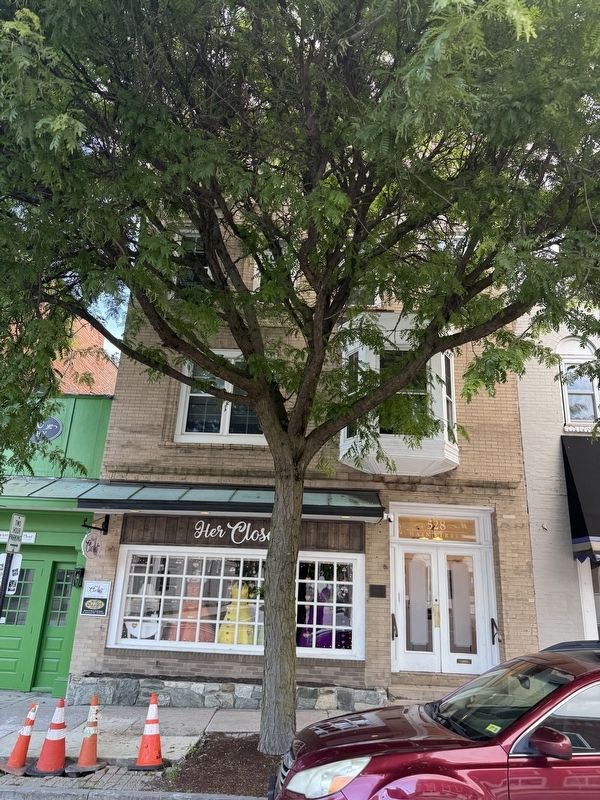
Gibney Block image. Click for full size.
Photographed by Devry Becker Jones (CC0), June 20, 2026
2. Gibney Block
from the second quarter of the nineteenth-century to the end of the twentieth century, including Greek Revival, Italianate, Second Empire, Renaissance Revival, High Victorian Gothic, Colonial Revival, Neo-Classical Revival, Tudor Revival, Bungalow, Art Deco, American International Style, and Post-Modern. There are also good examples of historic storefront commercial and industrial buildings. Fifty-eight of the seventy-three primary resources contribute to the historic district's significance. The historic structures and streetscapes sufficiently depict the historic appearance of the historic district, which retains to a large degree its integrity of location, design, setting, materials, workmanship, feeling, and association.

The Gibney Block is described in detail on page 92:
72. Gibney Block, 528 Main Street, c. 1899, contributing
This three-story wood frame commercial building is located on the north side of Main Street. It abuts the sidewalk and is attached to the building to the east and attached to a one-story structure that connects it to the building to the west. It has a yellow brick-veneer faηade with a falsefront parapet that conceals a front-gabled slate roof, and vinyl siding at the side elevations. The first story has a modern storefront, the second story has a right-hand oriel window, and the third story
Paid Advertisement
has four regularly-spaced window openings.

The parapet has a tall brick entablature with scrolled modillion blocks supporting a molded denticulated cornice, a frieze with an egg-and-dart band and a band of dentils, and a tall molded architrave. The window openings have brick architrave casings and molded brick cornices. The storefront has a brick cornice with a molded frieze, and a horizontal multi-pane display window with a sheet-metal shed-roofed hood that is shared with the entry to the connector building. To the right of the storefront, there is a doorway with a paneled wood enframement, double-leaf wood doors with full-height single-pane lights, and a single-pane transom. The three-sided oriel window has a plain entablature and molded base, and a one-over-one window in each face. The other second story window has paired one-over-one replacement windows, and the third story has one-over-one windows.

The building was constructed sometime between 1896 and 1901, with a different storefront of unknown appearance. The extant storefront dates to after 1977. Otherwise the building does not appear to have any major alterations, and is a good example of a turn-of-the twentieth-century building with brick ornamentation. The building has probably always been known as the Gibney Block. Its first occupants included a Maguire's Barber Shop and a dentist's office. Maguire's remained open until at least 1977, and the dentist office remained until at least the 1920s. Two of the dentists included A.Z. Cutler and Rollin D. Jenney. In 1914, the building also became the location of the Bennington Water Power and Light Company offices. (Submitted on June 25, 2026, by Devry Becker Jones of Washington, District of Columbia.) 
 
 
Credits. This page was last revised on June 25, 2026. It was originally submitted on June 25, 2026, by Devry Becker Jones of Washington, District of Columbia. This page has been viewed 5 times since then. Photos:   1, 2. submitted on June 25, 2026, by Devry Becker Jones of Washington, District of Columbia.

m=303933

CeraNet Cloud Computing sponsors the Historical Marker Database.
This website earns income from purchases you make after using our links to Amazon.com. We appreciate your support.
Paid Advertisement
Jun. 27, 2026