Manchester Center in Bennington County, Vermont — The American Northeast (New England)
Manchester
Heart of the Northshire
| — | Stone Valley Byway | — |
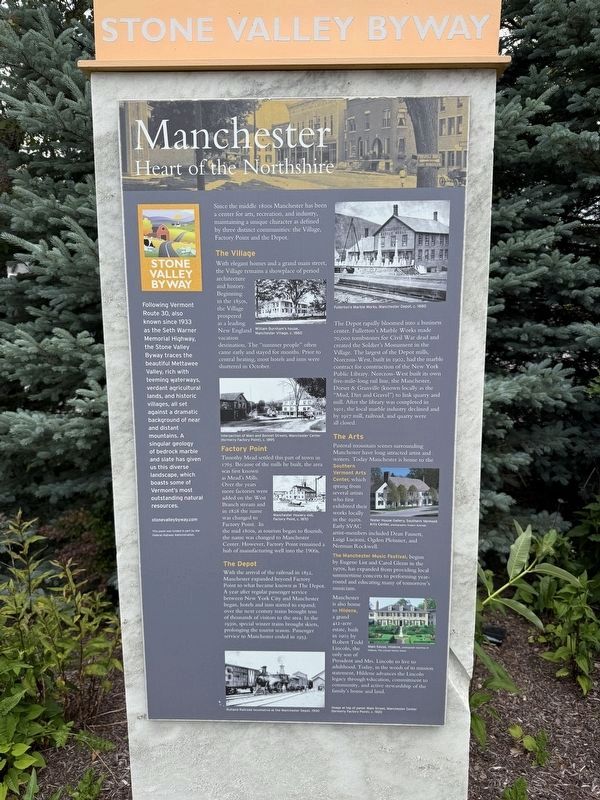
Following Vermont Route 30, also known since 1933 as the Seth Warner Memorial Highway, the Stone Valley Byway traces the beautiful Mettawee Valley, rich with teeming waterways, verdant agricultural lands, and historic villages, all set against a dramatic background of near and distant mountains. A singular geology of bedrock marble and slate has given us this diverse landscape, which boasts some of Vermont's most outstanding natural resources.
stonevalleybyway.com
Since the middle 1800s Manchester has been a center for arts, recreation, and industry, maintaining a unique character as defined by three distinct communities: the Village, Factory Point and the Depot.
The Village
With elegant homes and a grand main street, the Village remains a showplace of period architecture and history. Beginning in the 1850s, the Village prospered as a leading New England vacation destination. The "summer people" often came early and stayed for months. Prior to central heating, most hotels and inns were shuttered in October.
Factory Point
Timothy Mead settled this part of town in 1769. Because of the mills he built, the area
this page online
The Depot
With the arrival of the railroad in 1852, Manchester expanded beyond Factory Point to what became known as The Depot. A year after regular passenger service between New York City and Manchester began, hotels and inns started to expand; over the next century trains brought tens of thousands of visitors to the area. In the 1930s, special winter trains brought skiers, prolonging the tourist season. Passenger service to Manchester ended in 1953.
The Depot rapidly bloomed into a business center. Fullerton's Marble Works made 70,000 tombstones for Civil War dead and created the Soldier's Monument in the Village. The largest of the Depot mills, Norcross-West, built in 1902, had the marble contract for construction of the New York Public Library. Norcross-West built its own five-mile-long rail line, the Manchester,
The Arts
Pastoral mountain scenes surrounding Manchester have long attracted artists and writers. Today Manchester is home to the Southern Vermont Arts Center, which sprang from several artists who first exhibited their works locally in the 1920s. Early SVAC artist-members included Dean Fausett, Luigi Lucioni, Ogden Pleissner, and Norman Rockwell.
The Manchester Music Festival, begun by Eugene List and Carol Glenn in the 1970s, has expanded from providing local summertime concerts to performing year-round and educating many of tomorrow's musicians.
Manchester is also home to Hildene, a grand 412-acre estate, built in 1905 by Robert Todd Lincoln, the only son of President and Mrs. Lincoln to live to adulthood. Today, in the words of its mission statement, Hildene advances the Lincoln legacy through education, commitment to community, and active stewardship of the family's home and land.
Topics. This historical marker is listed in these topic lists: Arts, Letters, Music • Industry & Commerce • Railroads & Streetcars • Settlements & Settlers. A significant historical year for this entry is 1933.
Location. 43° 10.646′ N, 73° 3.328′ W. Marker is in Manchester, Vermont, in Bennington County. It is in Manchester Center. It is on Main Street (Vermont Route 7A) east of Bonnet Street, on the left when traveling west. Touch for map. Marker is at or near this postal address: 4960 Main St, Manchester Center VT 05255, United States of America. Touch for directions.

Regionally, this marker is in Southern Vermont. It is also in the American Northeast and in New England. Globally, it is in North America, the Western Hemisphere, the Western World, and the Anglosphere. Historically, it finds itself in what was once the Vermont Republic.
Other nearby markers. At least 8 other markers are within walking distance of this marker: Wait Block (about 300 feet away, measured in a direct line); Seth Warner Memorial Highway (about 400 feet away); The Battenkill: The Early Years (about 400 feet away); Manchester: Our Place in American History (about 500 feet away); Veterans Memorial (about 500 feet away); September 11, 2001 Memorial (about 600 feet away); Ye Olde Tavern (approx. 0.2 miles away); Manchester Vampire (approx. ¼ mile away). Touch for a list and map of all markers in Manchester.
Credits. This page was last revised on June 26, 2026. It was originally submitted on June 26, 2026, by Devry Becker Jones of Washington, District of Columbia. This page has been viewed 16 times since then. Photos: 1, 2. submitted on June 26, 2026, by Devry Becker Jones of Washington, District of Columbia.
