Collingwood in Simcoe County, Ontario — Central Canada (North America)
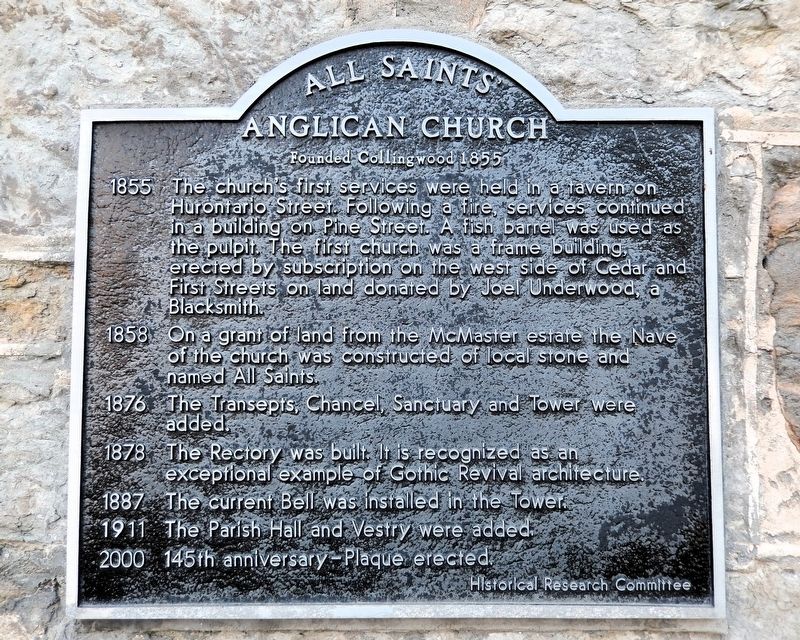
All Saints' Anglican Church
Founded Collingwood 1855
Photographed by Cosmos Mariner, June 4, 2024
1. All Saints' Anglican Church Marker
1855
The church’s first services were held in a tavern on Hurontario Street. Following a fire, services continued in a building on Pine Street. A fish barrel was used as the pulpit. The first church was a frame building, erected by subscription on the west side of Cedar and First Streets on land donated by Joel Underwood, a blacksmith.
1858
On a grant of land from the McMaster estate the Nave of the church was constructed of local stone and named All Saints.
1876
The Transepts, Chancel, Sanctuary and Tower were added.
1878
The Rectory was built. It is recognized as an exceptional example of Gothic Revival architecture.
1887
The current Bell was installed in the Tower.
1911
The Parish Hall and Vestry were added.
2000
145th anniversary — Plaque erected.
Erected 2000 by Historical Research Committee.
Topics. This historical marker is listed in these topic lists: Architecture • Religion & Religious Structures. A significant historical year for this entry is 1855.
Location. 44° 30.019′ N, 80° 12.905′ W. Marker is in Collingwood, Ontario, in Simcoe County. It is at the intersection of Elgin Street and Saint Marie Street, on
this page online

Regionally, this marker is in Central Ontario Cottage Country and specifically in Georgian Bay Country. It is also in Central Canada. Globally, it is in North America, on the Great Lakes, in the Western Hemisphere, in the Western World, and in the Anglosphere. Historically, it finds itself in what was once a British colony, the Viceroyalty of New France, the Haudenosaunee (Iroquois) Confederacy, and Rupert’s Land.
Other nearby markers. At least 8 other markers are within walking distance of this marker: St. Mary's Collingwood, 1858 (about 90 meters away, measured in a direct line); St. Charles Garnier, SJ (about 90 meters away); Pride Flag (about 90 meters away); Simcoe Street - Late 1890's (about 120 meters away); Collingwood World War I Cenotaph (approx. 0.3 kilometers away); The Northern Railway Company of Canada (approx. 0.3 kilometers away); The Associated Country Women of the World / L'union mondiale des femmes rurales

Photographed by Cosmos Mariner, June 4, 2024
2. All Saints' Anglican Church Marker
The marker is mounted on the northeast corner of the church, facing Elgin Street.
Also see . . . From Tavern Services to the Establishment of a Permanent Sanctuary.
Excerpt: In 1855, two years after settlement began in what is now the town of Collingwood, a few members of the “United Episcopal Church of England and Ireland”, as it was then known, met for worship on the upper floor of a tavern on the northeast corner of Hurontario and Ontario Streets.(Submitted on June 28, 2026, by Cosmos Mariner of Cape Canaveral, Florida.)Construction of a new and larger building was made possible when the McMaster Estate gave the north portion of the land between Ste. Marie and Elgin Streets as a gift to the parish. Here on a more centrally located lot, the stone building which continues to serve as the nave of the present church was erected in 1858.
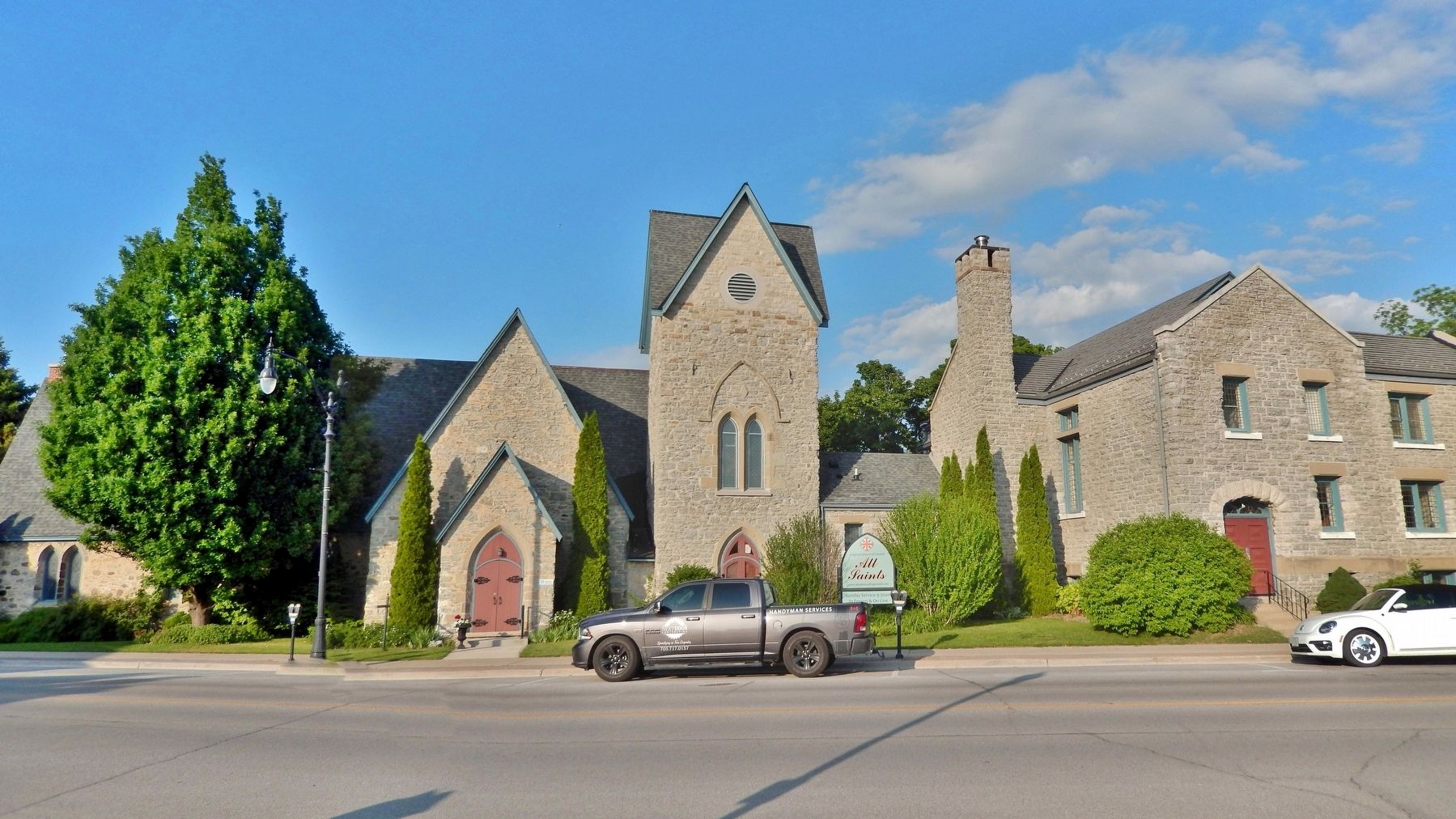
In 1876 the church building was expanded to include transepts, chancel, sanctuary, and bell tower. Not long after, the remaining portion of the land bounded by Elgin, Ontario and Ste. Marie Streets was acquired and the beautiful stone rectory was built. The present parish hall
and the connecting vestry were built in 19ll to serve the needs of the expanding congregation. These changes and additions completed the church complex as we see it today; considered by many as the finest example of such work outside of the City of Toronto. Over its long history, the church has been enhanced by a number of memorials, including magnificent stained glass windows, white oak organ case and marble font as well as unique brass pulpit and lectern, a beautiful and distinctive altar and a dramatic relief carving of “The Last Supper”.Photographed by Cosmos Mariner, June 4, 20243. All Saints' Anglican Church (northeast elevation)


Photographed by Cosmos Mariner, June 4, 2024
4. All Saints' Anglican Church (north elevation)
Photographed by Cosmos Mariner, June 4, 2024
5. All Saints' Anglican Church (west elevation)
Credits. This page was last revised on June 28, 2026. It was originally submitted on June 27, 2026, by Cosmos Mariner of Cape Canaveral, Florida. This page has been viewed 14 times since then. Photos: 1, 2, 3, 4, 5. submitted on June 28, 2026, by Cosmos Mariner of Cape Canaveral, Florida.
