Mitte in Leipzig, Saxony, Germany — Central Europe
Max Klinger
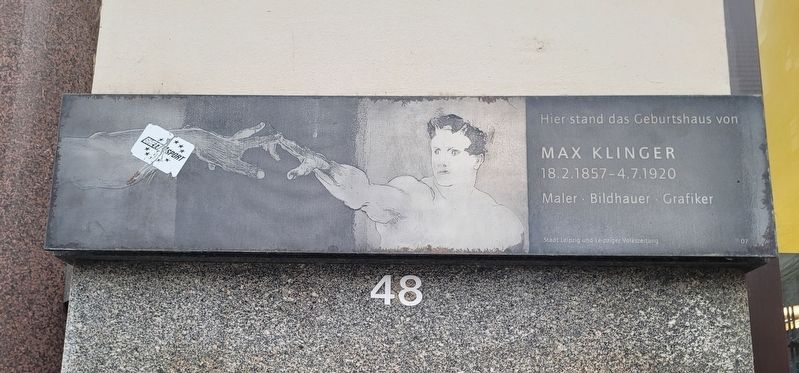
Photographed by James Hulse, March 11, 2026
1. Max Klinger Marker

Max Klinger
18.2.1857–4.7.1920
Maler, Bildhauer, Grafiker
Here stood the birthplace of Max Klinger (February 18, 1857 – July 4, 1920), a painter, sculptor, and graphic artist.
Erected 2007 by City of Leipzig and Leipziger Volkszeitung newspaper.
Topics. This historical marker is listed in this topic list: Notable Buildings. A significant historical date for this entry is February 18, 1857.
Location. 51° 20.226′ N, 12° 22.497′ E. Marker is in Leipzig, Sachsen (Saxony). It is in Mitte. It is at the intersection of Petersstraße and Schloßgasse, on the left when traveling north on Petersstraße. Touch for map. Marker is at or near this postal address: Petersstraße 48, Leipzig SN 04109, Germany. Touch for directions.

Regionally, this marker is in Central Germany. Globally, it is in Europe, the European Union, Atlantic Europe, Central Europe, the Schengen Area, Western Europe, and the Western World. Historically, it finds itself in what was once the Holy Roman Empire and also the former East Germany.
Other nearby markers. At least 8 other markers are
this page online
Also see . . . Max Klinger. Wikipedia
Max Klinger (18 February 1857 – 5 July 1920) was a German artist who produced significant work in painting, sculpture, prints and graphics, as well as writing a treatise articulating his ideas on art and the role of graphic arts and printmaking in relation to painting. He is associated with symbolism, the Vienna Secession, and Jugendstil (Youth Style), the German manifestation of Art Nouveau. He is best known today for his many prints, particularly(Submitted on June 29, 2026, by James Hulse of Medina, Texas.)a series entitled Paraphrase on the Finding of a Glove and his monumental sculptural installation in homage to Beethoven at the Vienna Secession in 1902.Photographed by James Hulse, March 11, 20262. Max Klinger Marker
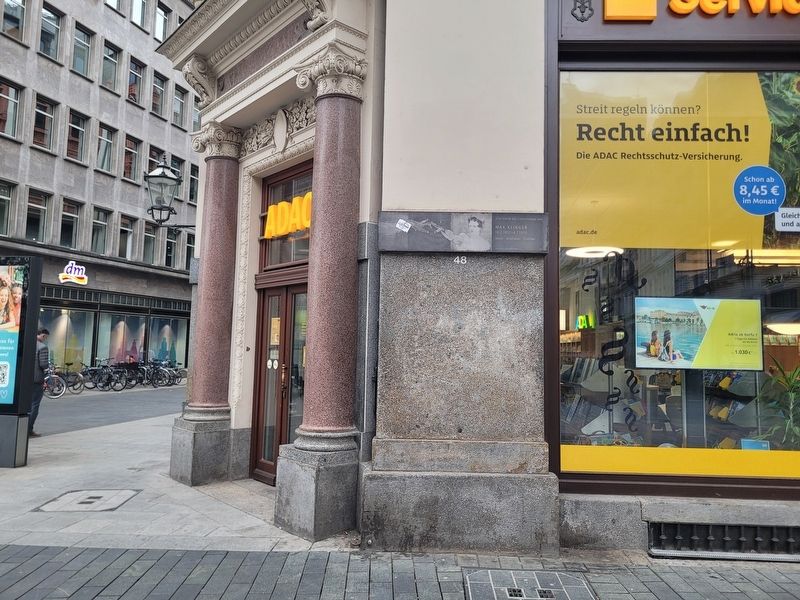
Photographed by James Hulse, March 11, 2026
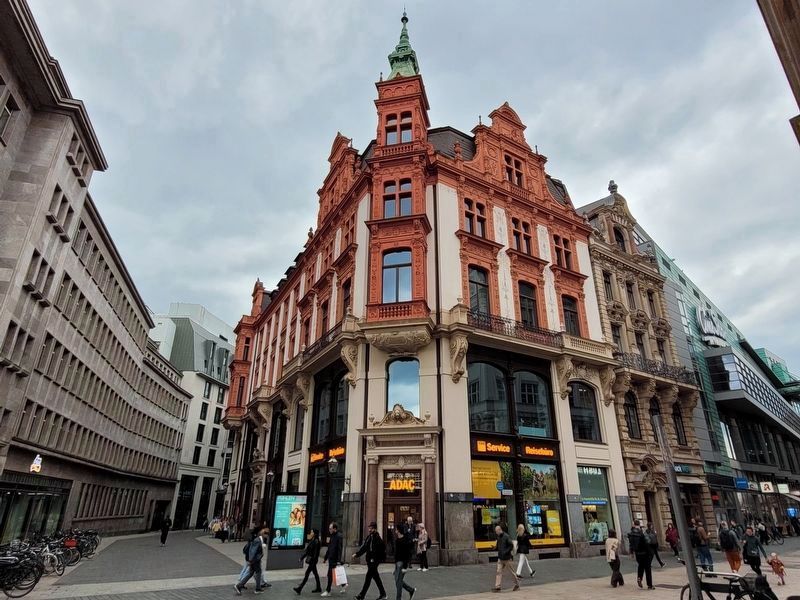
3. Max Klinger Marker
The view of the Klingerhaus and marker from across the street. The current building was built by Heinrich Klinger in 1887/88 over the older building.
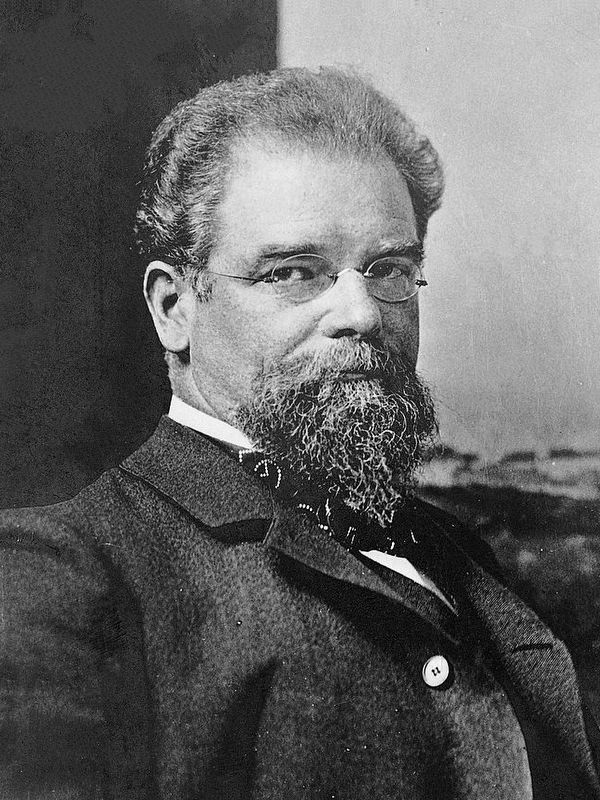
Public Domain via Wikipedia Commons, Nicola Perscheid, circa 1900
4. Max Klinger
Credits. This page was last revised on June 29, 2026. It was originally submitted on June 27, 2026, by James Hulse of Medina, Texas. This page has been viewed 10 times since then. Photos: 1, 2, 3, 4. submitted on June 29, 2026, by James Hulse of Medina, Texas.
