Dalton in Berkshire County, Massachusetts — The American Northeast (New England)
Fitch-Hoose House
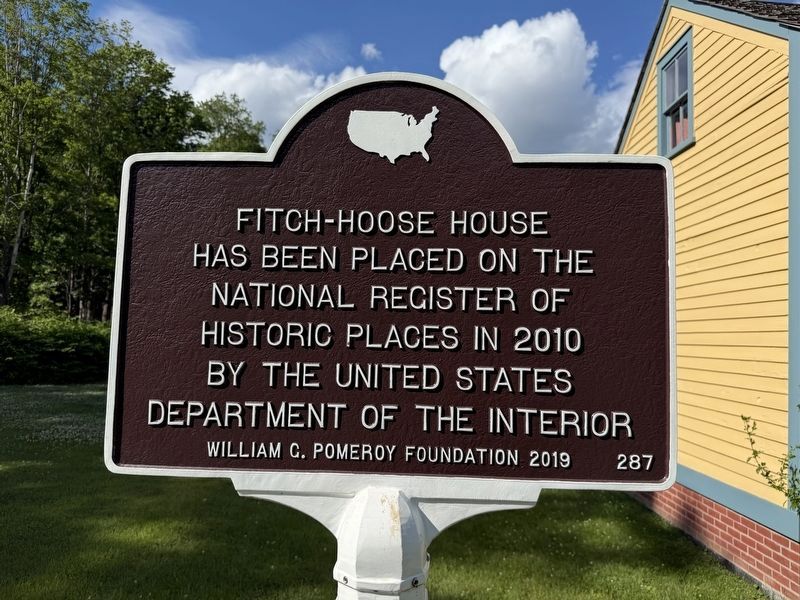
Fitch-Hoose House has been placed on the National Register of Historic Places in 2010 by the United States Department of the Interior
Erected 2019 by William G. Pomeroy Foundation. (Marker Number 287.)
Topics and series. This historical marker is listed in these topic lists: African Americans • Architecture. In addition, it is included in the William G. Pomeroy Foundation series list. A significant historical year for this entry is 2010.
Location. 42° 28.845′ N, 73° 10.533′ W. Marker is in Dalton, Massachusetts, in Berkshire County. It is on Gulf Road west of Bridle Road, on the right when traveling west. Touch for map. Marker is at or near this postal address: 41 Gulf Rd, Dalton MA 01226, United States of America. Touch for directions.

Regionally, this marker is in the Berkshires. It is also in the American Northeast and in New England. Globally, it is in North America, the Western Hemisphere, the Western World, and the Anglosphere. Historically, it finds itself in what was once one of the original Thirteen Colonies.
Other nearby markers. At least 8 other markers are within 2 miles of this marker,
this page online
Also see . . . The National Register of Historic Places Nomination Form for the house.
This form was prepared by Neil Larson, consultant with Betty Freiedberg, NR Director, Massachusetts Historical Commission in May 2010. A summary statement of historical significance is on page 8:
The Fitch-Hoose House is significant as a distinctive example of a dwelling built for and occupied by African Americans in the town of Dalton, MA. It is located at the edge "The Gulf," a rugged waste area known to have been settled by African Americans in the early 1800s as they either were freed or fled from slavery following the Revolutionary War. Philip Hoose was(Submitted on June 27, 2026, by Devry Becker Jones of Washington, District of Columbia.)one of a number of men arriving in Berkshire County who were either freed or fugitive slaves from the Hudson Valley of New York and who retained the Dutch names of their masters. (Hoose is derived from Hoes, Goes, or Van Hoesen.) Philip Hoose first appears in the 1820 census for neighboring Cheshire, but he moved to Dalton, and most likely The Gulf, by 1830, where he and his wife, Hannah, raised a large family.
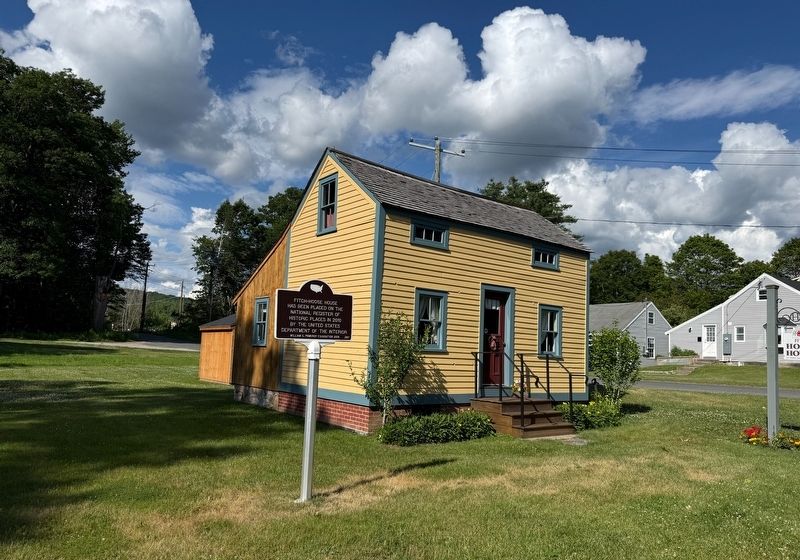
Philip Hoose's grandson Charles Hoose bought the Hoose House from farmer John Curtis in 1868. The house had been occupied by different black families since it was built in 1846 by William H. Bogart, a Dalton cotton manufacturer, and sold to Henry Fitch, an African American bom in Connecticut. The Hoose family occupied the house for three generations, and represents an important African-American presence in the town. The 1½-story wood-frame house has changed little, except superficially, in its more-than-160-year history. Its transitional wood frame, with principal timbers and secondary sawn components, is intact and typical of its mid 19th-century construction period. The two-room floor plan is a common size and arrangement for a laborer's dwelling. The shed-roof rear extension was probably built after Charles Hoose purchased the property to add kitchen space. Such small dwellings are rare, especially without transformative additions and alterations.
The property meets National Register Criteria A and C at the local level. Under Criterion A, it has historical significance for its association with the origin and development of the African-American community in Dalton and its neighboring towns. It also is a landmark of community planning in the era when blacks were physically as well as socially marginalized on poorer quality lands on the fringe of white settlements. In terms of Criterion C the house is a rare, distinctive, and well-documented example of a 19th-century African-American dwelling with continued use through the entire 20th century.
Credits. This page was last revised on June 27, 2026. It was originally submitted on June 27, 2026, by Devry Becker Jones of Washington, District of Columbia. This page has been viewed 18 times since then. Photos: 1, 2. submitted on June 27, 2026, by Devry Becker Jones of Washington, District of Columbia.
