East Canaan in North Canaan in Northwest Hills Region, Connecticut — The American Northeast (New England)
What is This Place?
Beckley Furnace Industrial Monument
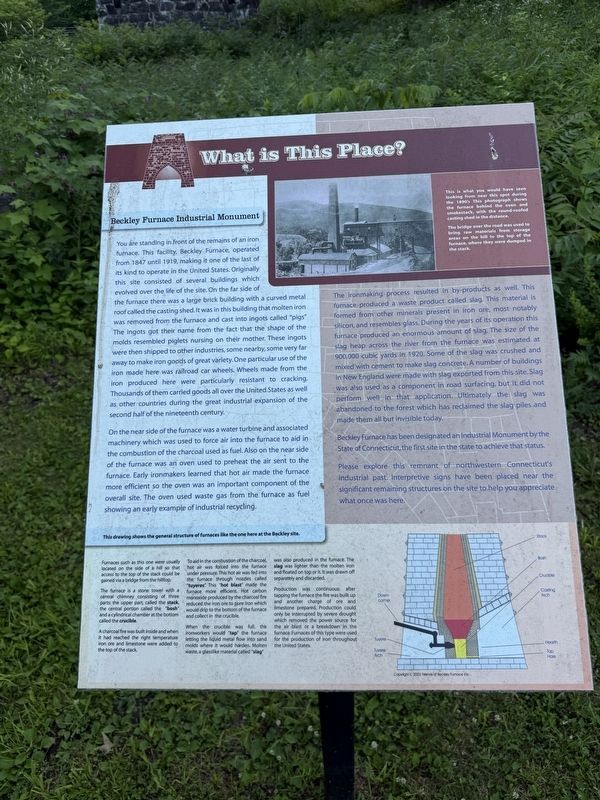
You are standing in front of the remains of an iron furnace. This facility, Beckley Furnace, operated from 1847 until 1919, making it one of the last of its kind to operate in the United States. Originally, this site consisted of several buildings which evolved over the life of the site. On this side of the furnace there was a large brick building with a curved metal roof called the casting shed. It was in this building that molten iron was removed from the furnace and cast into ingots called "pigs". The ingots got their name from the fact that the shape of the molds resembled piglets nursing on their mother. These ingots were then shipped to other industries, some nearby, some very far away to make iron goods of great variety. One particular use of the iron made here was railroad car wheels. Wheels made from the iron produced here were particularly resistant to cracking. Thousands of them carried goods all over the United States as well as other countries during the great industrial expansion of the second half of the nineteenth century.
On the far side of the building was a water turbine and associated machinery
this page online
The ironmaking process resulted in by-products as well. This furnace produced a waste product called slag. This material is formed from other minerals present in iron ore, most notably silicon, and resembles glass. During the years of its operation this furnace produced an enormous amount of slag. The size of the slag heap across the river from the furnace was estimated at 900,000 cubic yards in 1920. Some of the slag was crushed and mixed with cement to make slag concrete. A number of buildings in New England were made with slag exported from this site. Slag was also used as a component in road surfacing, but it did not perform well in that application. Ultimately the slag was abandoned to the forest which has reclaimed
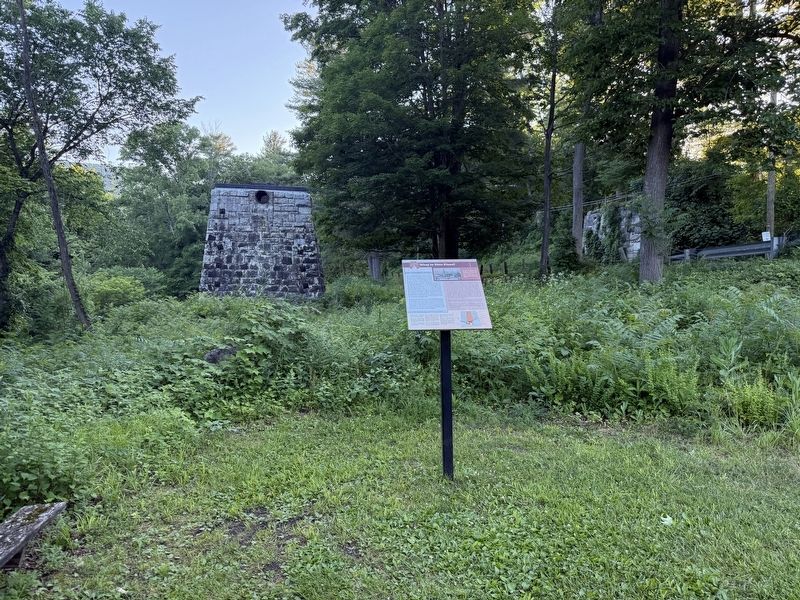
Photographed by Devry Becker Jones (CC0), June 20, 2026
2. What is This Place? Marker
This plaque is nearly identical to its counterpart down below.
Beckley Furnace has been designated an Industrial Monument by the State of Connecticut, the first site in the state to achieve that status.
Please explore this remnant of northwestern Connecticut's industrial past. Interpretive signs have been placed near the significant remaining structures on the site to help you appreciate what once was here.
Furnaces such as this one were usually located on the side of a hill so that access to the top of the stack could be gained via a bridge from the hilltop.
The furnace is a stone tower with a central chimney consisting of three parts: the upper part, called the stack , the central portion called the "bosh"and a cylindrical chamber at the bottom called the crucible.
A charcoal fire was built inside and when it had reached the right temperature iron ore and limestone were added to the top of the stack.
To aid in the combustion of the charcoal, hot air was forced into the furnace under pressure. This hot air was fed into the furnace through nozzles called "tuyeres". This "hot blast" made the furnace more efficient. Hot carbon monoxide produced by the charcoal fire reduced the iron ore to pure iron which would drip to the bottom of the furnace and collect in the crucible.
When the crucible was full, the ironworkers would "tap" the furnace letting the liquid metal flow into sand molds where it would harden. Molten waste, a glasslike material called "slag" was also produced in the furnace. The slag was lighter than the molten iron and floated on top of it. It was drawn off separately and discarded.
Production was continuous: after tapping the furnace the fire was built up and another charge of ore and limestone prepared. Production could only be interrupted by severe drought which removed the power source for the air blast or a breakdown in the furnace. Furnaces of this type were used for the production of iron throughout the United States.
Erected by The State of Connecticut; The Town of North Canaan; The Friends of Beckley Furnace, Inc.
Topics. This historical marker is listed in this topic list: Industry & Commerce. A significant historical year for this entry is 1847.
Location. 42° 0.67′ N, 73° 17.513′ W. Marker is in North Canaan in Northwest Hills Region, Connecticut. It is in East Canaan. It is on Lower Road west of Furnace Hill Road, on the left when traveling west. Touch for map. Marker is at or near this postal address: 140 Lower Rd, East Canaan CT 06024, United States of America. Touch for directions.

Regionally, this marker is in the Berkshire Foothills and in the Litchfield Hills. It is also in the American Northeast and in New England. Globally, it is in North America, the Western Hemisphere, the Western World, and the Anglosphere. Historically, it finds itself in what was once Litchfield County and also one of the original Thirteen Colonies.
Other nearby markers. At least 8 other markers are within walking distance of this marker: Leffel Turbine (a few steps from this marker); Hydraulic turbine and blast pump (within shouting distance of this marker); Turbine (within shouting distance of this marker); Tuyere Arch (within shouting distance of this marker); Birth of an Industry (within shouting distance of this marker); Beckley Furnace Industrial Monument (within shouting distance of this marker); Salamander (within shouting distance of this marker); What Is This Place? (within shouting distance of this marker). Touch for a list and map of all markers in North Canaan.
Credits. This page was last revised on June 28, 2026. It was originally submitted on June 28, 2026, by Devry Becker Jones of Washington, District of Columbia. This page has been viewed 12 times since then. Photos: 1, 2. submitted on June 28, 2026, by Devry Becker Jones of Washington, District of Columbia.
