Collingwood in Simcoe County, Ontario — Central Canada (North America)
The Aftermath of the Great Fire of 1881

Photographed by Cosmos Mariner, June 4, 2024
1. The Aftermath of the Great Fire of 1881 Marker
In Collingwood's early years, the lake was used as a source of drinking water, and for personal bathing. Town By-Laws from 1884 considered the issue important enough to pass this law: “No person shall bathe or wash his person in the Lake, the Harbor, within or opposite to the limits of the Town, between the hours of seven in the forenoon, and nine in the afternoon.” Notice that there is not an outright ban on bathing or washing oneself in the Harbour?
Following the Great Fire of September 1881, when about half of the business district was destroyed, the Town worked toward installing water and sewer lines, not only for the citizens' convenience and health, but also to fight fires. The water mains were laid in place in 1888 and 1889 by the company of Lindsay and Burdett.
“On Huron Street, the water used to come up to our back door, and in stormy weather the spray would come into the sheds and kitchens. We used to go out of the back door, to the lake, for all our water, and in the winter had to make holes in the ice to get it. Those living at a distance from the lake had water drawn to them in barrels. Afterwards we got artesian
this page online
The word “outhouse” was used to speak of an outdoor washroom, located usually to the rear of the house. Early Collingwood had many of these little buildings, and it was this practice that contaminated the first wells, as John Nettleton mentions.
The west end of town was the first to receive water and sewer systems. The “East Enders” apparently did not receive the same services until well into the 20th century. Rivalry existed between the two sections of town, partly because of the water and sewer situation.
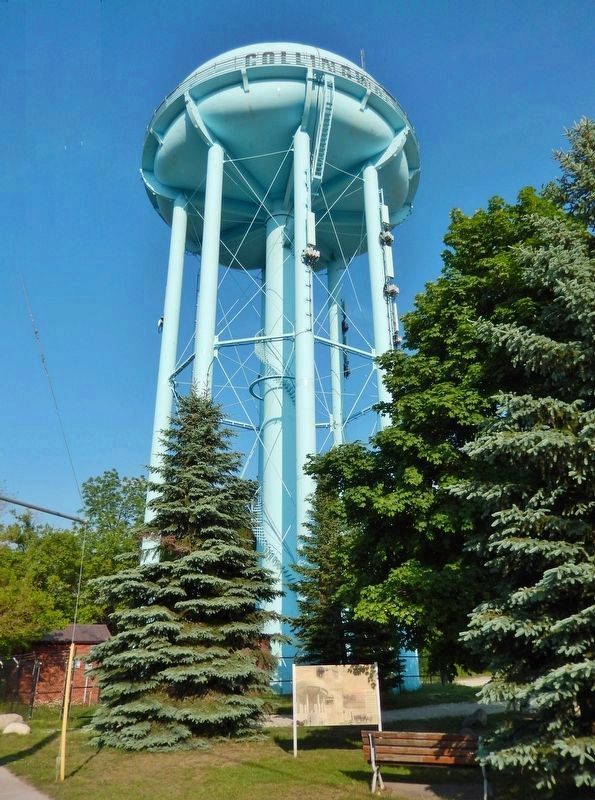
The “Water Tower” on Hume Street was erected in 1960. The tower was made just after the end of World War II by Chicago Bridge & Iron (Horton Steel), and uses the same complex steel construction methods that once made Collingwood proud with her magnificent steel ships. Once a landmark on Wilson Avenue in North York, it was eventually taken down in 1959. A year later, it became a landmark in Collingwood.

Photographed by Cosmos Mariner, June 4, 2024
2. The Aftermath of the Great Fire of 1881 Marker
The fire is beside the sidewalk, overlooking the west side of the Collingwood Water Tower.
Technically, the water tower is known as a gravity tank. Water from the lake is pumped up into it, and it forms a reservoir. The pressure from gravity ensures good water pressure in town faucets.
All unmarked photographs are from the Collingwood Museum Collection. For more information about our local heritage, please visit the Collingwood Museum. Photographs of Hume Street water tower by Gordon "Steamer" Clark, c. 1960.
[background photo captions]
• The Victoria Day Flood of May 1912. Obviously the sewer lines could not cope with this one.
• In the background, the sewer line being laid on Pine Street, 1909.
• The William Toner home, 199 Third Street, at the northeast corner of Beech and Third Streets, is thought to be the first home with an indoor toilet.
• Even the Shipyard had a water tower. This one supplied the water for fire protection and sewer applications.
Topics. This historical marker is listed in these topic lists: Charity & Public Work • Disasters • Settlements & Settlers. A significant historical year for this entry is 1881.
Location. 44° 29.795′ N, 80° 12.567′ W. Marker is in Collingwood, Ontario, in Simcoe County.
Photographed by Cosmos Mariner, June 4, 2024
3. Collingwood Water Tower and Marker

Regionally, this marker is in Central Ontario Cottage Country and specifically in Georgian Bay Country. It is also in Central Canada. Globally, it is in North America, on the Great Lakes, in the Western Hemisphere, in the Western World, and in the Anglosphere. Historically, it finds itself in what was once a British colony, the Viceroyalty of New France, the Haudenosaunee (Iroquois) Confederacy, and Rupert’s Land.
Other nearby markers. At least 8 other markers are within walking distance of this marker: St. Charles Garnier, SJ (approx. half a kilometer away); St. Mary's Collingwood, 1858 (approx. half a kilometer away); All Saints' Anglican Church (approx. 0.6 kilometers away); Simcoe Street - Late 1890's (approx. 0.7 kilometers away); Pride Flag (approx. 0.7 kilometers away); Shannon's Bridge (approx. 0.8 kilometers away); Collingwood World War I Cenotaph (approx. 0.8 kilometers away); The Northern Railway Company of Canada (approx. 0.8 kilometers away). Touch for a list and map of all markers in Collingwood.
Also see . . . On This Day in 1881 (Facebook - Collingwood Museum).
Excerpt: On this day in 1881 a multi-building fire tore through downtown Collingwood and 140 years later its impact on our town is still talked about.(Submitted on June 28, 2026, by Cosmos Mariner of Cape Canaveral, Florida.)
The fire began in the late afternoon on September 25. The flames quickly spread along Hurontario Street between Huron and Simcoe Streets and down the west side of Ste Marie Street. Despite the best efforts of Collingwood’s volunteer fire brigade, rubble was all that was left of once successful businesses and homes as seen in this photograph.
Many of today's brick buildings along the first block of Hurontario Street were built directly after this disastrous fire. The materials, size and architectural style of these historic buildings were important factors in defining Collingwood’s Downtown Heritage Conservation District.
Credits. This page was last revised on June 28, 2026. It was originally submitted on June 28, 2026, by Cosmos Mariner of Cape Canaveral, Florida. This page has been viewed 14 times since then. Photos: 1, 2, 3. submitted on June 28, 2026, by Cosmos Mariner of Cape Canaveral, Florida.
