Rochester in Beaver County, Pennsylvania — The American Northeast (Mid-Atlantic)
Stepping into Historic Rochester
Entertainment
Photographed by Bradley Owen, June 20, 2026
1. Stepping into Historic Rochester Marker
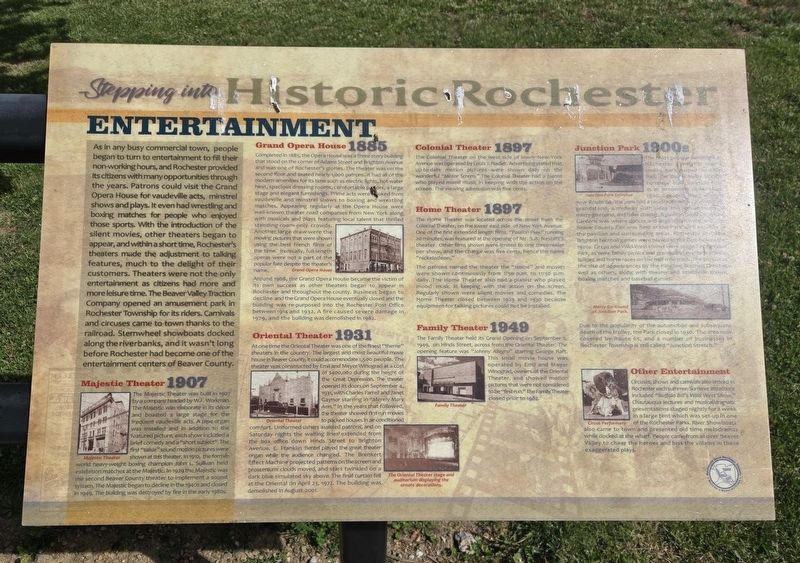
As in any busy commercial town, people began to turn to entertainment to fill their non-working hours, and Rochester provided its citizens with many opportunities through the years. Patrons could visit the Grand Opera House for vaudeville acts, minstrel shows and plays. It even had wrestling and boxing matches for people who enjoyed those sports. With the introduction of the silent movies, other theaters began to appear, and within a short time, Rochester's theaters made the adjustment to talking features, much to the delight of their customers. Theaters were not the only entertainment as citizens had more and more leisure time. The Beaver Valley Traction Company opened an amusement park in Rochester Township for its riders. Carnivals and circuses came to town thanks to the railroad. Sternwheel showboats docked along the riverbanks, and it wasn't long before Rochester had become one of the entertainment centers of Beaver County.
Majestic Theater 1907
The Majestic Theater was built in 1907 by a company headed by W.F. Workman. The Majestic was elaborate in its décor and boasted a large stage for the frequent vaudeville
this page online
Grand Opera House 1885
Completed in 1885, the Opera House was a three story building that stood on the corner of Adams Street and Brighton Avenue and was one of Rochester's glories. The theater was on the second floor and seated nearly 1,000 patrons. It had all of the modern amenities for its time such as electric lights, hot water heat, spacious dressing rooms, comfortable parlors, a large stage and elegant furnishings. Prime acts were booked from vaudeville and minstrel shows to boxing and wrestling matches. Appearing regularly at the Opera House were well-known theater road companies from New York along with musicals

Photographed by Bradley Owen, June 20, 2026
2. Stepping into Historic Rochester Marker
Marker is on the right.
Oriental Theater 1931
At one time the Oriental Theater was one of the finest "theme" theaters in the country. The largest and most beautiful movie house in Beaver County, it could accommodate 1,500 people. The theater was constructed by Emil and Meyer Winograd at a cost of $400,000 during the height of the Great Depression. The theater opened its doors on September 4, 1931, with Charles Farrell and Janet Gaynor starring in "Merely Mary Ann." In the years that followed, the theater showed first-run movies to packed houses in air-conditioned comfort. Uniformed ushers assisted patrons, and on Saturday nights the waiting lines extended from the box office down Hinds Street to Brighton Avenue. E. Franklin Bentel played the great theater organ while the audience changed. The Brenkert Effect Machine projected patterns on the screen and proscenium: clouds moved, and stars twinkled on a dark blue simulated sky above. The final curtain fell at the Oriental on April 23, 1972. The building was demolished in August 2001.
Colonial Theater 1897
The Colonial Theater on the west side of lower New York Avenue was operated by Louis J. Nadler. Advertising stated that up-to-date motion pictures were shown daily on the wonderful "Mirror Screen." The Colonial Theater had a pianist who played mood music in keeping with the action on the screen. The viewing admission was five cents.
Home Theater 1897
The Home Theater was located across the street from the Colonial Theater, on the lower east side of New York Avenue. One of the first extended length films, "Passion Play," running 20 minutes, was featured at the opening of Mr. S.A. Nesbitt's theater. Other films shown were limited to one three reeler per show, and the charge was five cents, hence the name "nickelodeon."
The patrons named the theater the "Home" and movies were shown continuously from 1:30 p.m. to 11:30 p.m. daily. The Home Theater also had a pianist who played mood music in keeping with the action on the screen. Regularly shown were silent movies and comedies. The Home Theater closed between 1929 and 1930 because equipment for talking pictures could not be installed.
Family Theater 1949
The Family Theater held its Grand Opening on September 2, 1949, on Hinds Street, across from the Oriental Theater. The opening feature was "Johnny Allegro" starring George Raft. This small movie house was operated by Emil and Meyer Winograd, owners of the Oriental Theater, and showed motion pictures that were not considered to be "first-run." The Family Theater closed prior to 1982.
Junction Park 1900
The most popular landmark in Rochester Township was a trolley park named Junction Park. The Beaver Valley Trolley Company built Junction Park as an amusement center about 1900. Located along what is now Route 65, the park had a racetrack with a grandstand, a midway with rides and amusement, a merry-go-round, and roller coaster. A pavilion called Colored Gardens was where dances and large affairs were held. The Beaver County Fair was held at the Park with exhibits in the pavilion and surrounding areas. Rochester and New Brighton Football games were played at the Park before the 1920s. Circus and Wild West shows were staged at Junction Park, as were family picnics and grandstand events featuring sulkies and horse races on the half mile track. The park was the site of appearances by the Ringling Brothers Circus as well as others, along with theater and vaudeville shows, boxing matches and baseball games.
Due to the popularity of the automobile and subsequent death of the trolley, the Park closed in 1930. The area now covered by Route 65, and a number of businesses in Rochester Township is still called "Junction Stretch."
Other Entertainment
Circuses, shows and carnivals also arrived in Rochester each summer. Summer attractions included "Buffalo Bill's Wild West Show," Chautauqua lectures and musical/dramatic presentations staged nightly for a week in a large tent which was set-up in one of the Rochester Parks. River Showboats also came to town and presented old time melodramas while docked at the wharf. People came from all over Beaver Valley to cheer the heroes and hiss the villains in these exaggerated plays.
Erected by Rochester Area Heritage Society.
Topics. This historical marker is listed in this topic list: Entertainment. A significant historical year for this entry is 1907.
Location. 40° 42.126′ N, 80° 17.122′ W. Marker is in Rochester, Pennsylvania, in Beaver County. It is at the intersection of North Park Street and Brighton Avenue (Pennsylvania Route 18), on the right when traveling east on North Park Street. Touch for map. Marker is at or near this postal address: 50 North Park Street, Rochester PA 15074, United States of America. Touch for directions.

Regionally, this marker is in Greater Pittsburgh. It is also in the American Northeast, in the Mid-Atlantic, and in the Ohio River Valley. Globally, it is in North America, the Western Hemisphere, the Western World, and the Anglosphere. Historically, it finds itself in what was once the Haudenosaunee (Iroquois) Confederacy and also one of the original Thirteen Colonies.
Other nearby markers. At least 8 other markers are within walking distance of this marker: A different marker also named Stepping into Historic Rochester (here, next to this marker); a different marker also named Stepping into Historic Rochester (here, next to this marker); a different marker also named Stepping into Historic Rochester (here, next to this marker); Major General Joseph H. Pendleton (a few steps from this marker); a different marker also named Stepping into Historic Rochester (a few steps from this marker); a different marker also named Stepping into Historic Rochester (a few steps from this marker); History of the Rochester Fire Department (a few steps from this marker); a different marker also named Stepping into Historic Rochester (a few steps from this marker). Touch for a list and map of all markers in Rochester.
Credits. This page was last revised on June 29, 2026. It was originally submitted on June 29, 2026, by Bradley Owen of Morgantown, West Virginia. This page has been viewed 17 times since then. Photos: 1, 2. submitted on June 29, 2026, by Bradley Owen of Morgantown, West Virginia.
