
Grapevine in Tarrant County, Texas — The American South (West South Central)
The Bragg House
(Also Known as the Zebulon Jenkins Tenant Farmer's House)
Photographed by Mansfieldphoto.com, April 5, 2026
1. The Bragg House Marker
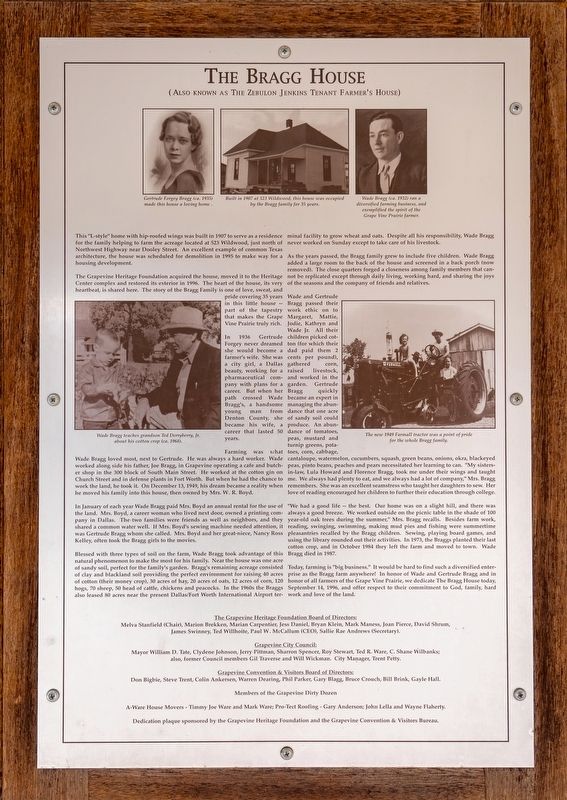
This "L-style" home with hip-roofed wings was built in 1907 to serve as a residence for the family helping to farm the acreage located at 523 Wildwood, just north of Northwest Highway near Dooley Street. An excellent example of common Texas architecture, the house was scheduled for demolition in 1995 to make way for a housing development.
The Grapevine Heritage Foundation acquired the house, moved it to the Heritage Center complex and restored its exterior in 1996. The heart of the house, its very heartbeat, is shared here. The story of the Bragg Family is one of love, sweat, and pride covering 35 years in this little house part of the tapestry that makes the Grape Vine Prairie truly rich.
In 1936 Gertrude Forgey never dreamed she would become a farmer's wife. She was a city girl, a Dallas beauty, working for a pharmaceutical company with plans for a career. But when her path crossed Wade Bragg's, a handsome young man from Denton County, she became his wife, a career that lasted 50 years.
Farming was what Wade Bragg loved most, next to Gertrude. He was always a hard worker. Wade worked along side his father, Joe
this page online
In January of each year Wade Bragg paid Mrs. Boyd an annual rental for the use of the land. Mrs. Boyd, a career woman who lived next door, owned a printing company in Dallas. The two families were friends as well as neighbors, and they shared a common water well. If Mrs. Boyd's sewing machine needed attention, it was Gertrude Bragg whom she called. Mrs. Boyd and her great-niece, Nancy Ross Kelley, often took the Bragg girls to the movies.
Blessed with three types of soil on the farm, Wade Bragg took advantage of this natural phenomenon to make the most for his family. Near the house was one acre of sandy soil, perfect for the family's garden. Bragg's remaining acreage consisted of clay and blackland soil providing the perfect environment for raising 40 acres of cotton (their money

Photographed by Mansfieldphoto.com, April 5, 2026
2. The Bragg House Marker
The marker is located on the front porch of the house.
As the years passed, the Bragg family grew to include five children. Wade Bragg added a large room to the back of the house and screened in a back porch (now removed). The close quarters forged a closeness among family members that cannot be replicated except through daily living, working hard, and sharing the joys of the seasons and the company of friends and relatives.
Wade and Gertrude Bragg passed their work ethic on to Margaret, Mattie, Jodie, Kathryn and Wade Jr. All their children picked cotton (for which their dad paid them 2 cents per pound), gathered corn, raised livestock, and worked in the garden. Gertrude Bragg quickly became an expert in managing the abundance that one acre of sandy soil could produce. An abundance of tomatoes, peas, mustard and turnip greens, potatoes, corn, cabbage, cantaloupe, watermelon, cucumbers, squash, green beans, onions, okra, blackeyed peas, pinto beans, peaches and pears necessitated her learning to can. "My sisters-in-law, Lula Howard and Florence Bragg, took me under their wings and taught me. We always had plenty to eat, and we always had a lot of company," Mrs. Bragg remembers. She was an excellent seamstress who taught her daughters to sew. Her love of reading encouraged her children to further their education through college.
"We had a good life the best. Our home was on a slight hill, and there was always a good breeze. We worked outside on the picnic table in the shade of 100 year-old oak trees during the summer," Mrs. Bragg recalls. Besides farm work, reading, swinging, swimming, making mud pies and fishing were summertime pleasantries recalled by the Bragg children. Sewing, playing board games, and using the library rounded out their activities. In 1973, the Braggs planted their last cotton crop, and in October 1984 they left the farm and moved to town. Wade Bragg died in 1987.
Today, farming is "big business." It would be hard to find such a diversified enterprise as the Bragg farm anywhere! In honor of Wade and Gertrude Bragg and in honor of all farmers of the Grape Vine Prairie, we dedicate The Bragg House today, September 14, 1996, and offer respect to their commitment to God, family, hard work and love of the land.
The Grapevine Heritage Foundation Board of Directors:
Melva Stanfield (Chair), Marion Brekken, Marian Carpentier, Jess Daniel, Bryan Klein, Mark Maness, Joan Pierce, David Shrum, James Swinney, Ted Willhoite, Paul W. McCallum (CEO), Sallie Rae Andrews (Secretary).
Grapevine City Council:
Mayor William D. Tate, Clydene Johnson, Jerry Pittman, Sharron Spencer, Roy Stewart, Ted R. Ware, C. Shane Wilbanks; also, former Council members Gil Traverse and Will Wickman. City Manager, Trent Petty.
Grapevine Convention & Visitors Board of Directors:
Don Bigbie, Steve Trent, Colin Ankersen, Warren Dearing, Phil Parker, Gary Blagg, Bruce Crouch, Bill Brink, Gayle Hall.
Members of the Grapevine Dirty Dozen
A-Ware House Movers - Timmy Joe Ware and Mark Ware; Pro-Tect Roofing Gary Anderson; John Lella and Wayne Flaherty.
Captions
Gertrude Forgey Bragg (ca. 1935) made this house a loving home.
Built in 1907 at 523 Wildwood, this house was occupied by the Bragg family for 35 years.
Wade Bragg (ca. 1932) ran a diversified farming business, and exemplified the spirit of the Grape Vine Prairie farmer.
Wade Bragg teaches grandson Ted Derryberry, Jr. about his cotton стор (са. 1968).
The new 1949 Farmall tractor was a point of pride for the whole Bragg family.
Erected by the Grapevine Heritage Foundation and the Grapevine Convention & Visitors Bureau.
Topics. This historical marker is listed in this topic list: Notable Buildings. A significant historical date for this entry is September 14, 1996.
Location. 32° 56.053′ N, 97° 4.619′ W. Marker is in Grapevine, Texas, in Tarrant County. It is at the intersection of South Main Street and E Hudgins Street on South Main Street. Touch for map. Marker is at or near this postal address: 703 S Main St, Grapevine TX 76051, United States of America. Touch for directions.

Regionally, this marker is in the Prairies & Lakes Region and in the Dallas-Fort Worth Metropolitan Area. It is also in the American South. Globally, it is in North America, a Gulf of Mexico state, the Western Hemisphere, the Western World, and the Anglosphere. Historically, it finds itself in what was once New Spain, the Republic of Texas, and one of the Confederate States of America.
Other nearby markers. At least 8 other markers are within walking distance of this marker: Grapevine Cotton Belt Section Foreman's House (a few steps from this marker); In Honor of Walter Franklin Landrith (a few steps from this marker); Aermotor Windmill (a few steps from this marker); Petrified Wood (a few steps from this marker); The Grapevine Blacksmith Shop (within shouting distance of this marker); Nat Barrett (about 400 feet away, measured in a direct line); The Cotton Belt Railroad Depot (about 400 feet away); The Grapevine Mill (about 400 feet away). Touch for a list and map of all markers in Grapevine.
Credits. This page was last revised on July 7, 2026. It was originally submitted on June 30, 2026, by James Hulse of Medina, Texas. This page has been viewed 11 times since then. Photos: 1. submitted on July 1, 2026, by James Hulse of Medina, Texas. 2. submitted on July 6, 2026, by James Hulse of Medina, Texas.
