Grapevine in Tarrant County, Texas — The American South (West South Central)
The Grapevine Blacksmith Shop
Photographed by Mansfieldphoto.com, April 5, 2026
1. The Grapevine Blacksmith Shop Marker
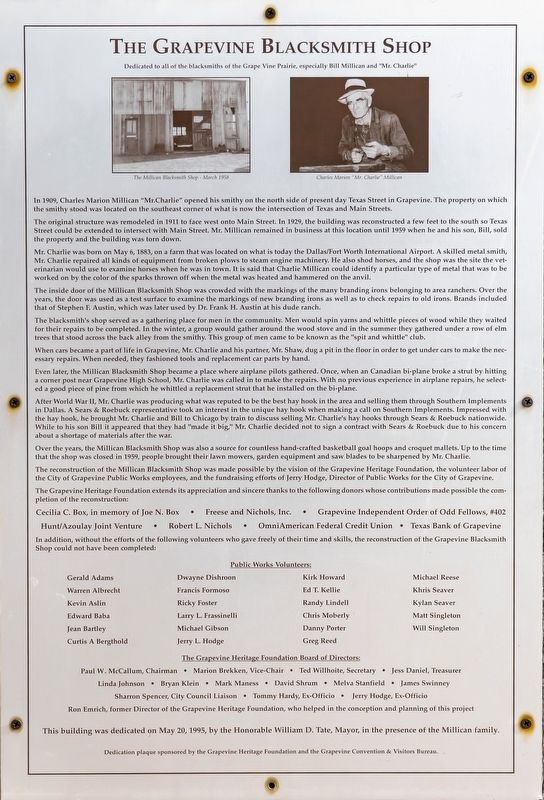
Dedicated to all of the blacksmiths of the Grape Vine Prairie, especially Bill Millican and "Mr. Charlie"
In 1909, Charles Marion Millican "Mr. Charlie" opened his smithy on the north side of present day Texas Street in Grapevine. The property on which the smithy stood was located on the southeast corner of what is now the intersection of Texas and Main Streets.
The original structure was remodeled in 1911 to face west onto Main Street. In 1929, the building was reconstructed a few feet to the south so Texas Street could be extended to intersect with Main Street. Mr. Millican remained in business at this location until 1959 when he and his son, Bill, sold the property and the building was torn down.
Mr. Charlie was born on May 6, 1883, on a farm that was located on what is today the Dallas/Fort Worth International Airport. A skilled metal smith, Mr. Charlie repaired all kinds of equipment from broken plows to steam engine machinery. He also shod horses, and the shop was the site the veterinarian would use to examine horses when he was in town. It is said that Charlie Millican could identify a particular type of metal that was to be worked on by the color of the sparks thrown off when the metal was heated and hammered on the anvil.
The inside door of the Millican Blacksmith Shop was crowded with the markings of the many branding irons belonging to area ranchers. Over the years, the door was used as a test surface to examine the markings of new branding irons as well as to check repairs to old irons. Brands included that of Stephen F. Austin, which was later used by Dr. Frank H. Austin at his dude ranch.
The blacksmith's shop served as a gathering place for men in the community. Men would spin yarns and whittle pieces of wood while they waited for their repairs to be completed. In the winter,
this page online
When cars became a part of life in Grapevine, Mr. Charlie and his partner, Mr. Shaw, dug a pit in the floor in order to get under cars to make the necessary repairs. When needed, they fashioned tools and replacement car parts by hand.
Even later, the Millican Blacksmith Shop became a place where airplane pilots gathered. Once, when an Canadian bi-plane broke a strut by hitting a corner post near Grapevine High School, Mr. Charlie was called in to make the repairs. With no previous experience in airplane repairs, he selected a good piece of pine from which he whittled a replacement strut that he installed on the bi-plane.
After World War II, Mr. Charlie was producing what was reputed to be the best hay hook in the area and selling them through Southern Implements in Dallas. A Sears & Roebuck representative took an interest in the unique hay hook when making a call on Southern Implements. Impressed with the hay hook,

Photographed by Mansfieldphoto.com, April 5, 2026
2. The Grapevine Blacksmith Shop Marker
Over the years, the Millican Blacksmith Shop was also a source for countless hand-crafted basketball goal hoops and croquet mallets. Up to the time that the shop was closed in 1959, people brought their lawn mowers, garden equipment and saw blades to be sharpened by Mr. Charlie.
The reconstruction of the Millican Blacksmith Shop was made possible by the vision of the Grapevine Heritage Foundation, the volunteer labor of the City of Grapevine Public Works employees, and the fundraising efforts of Jerry Hodge, Director of Public Works for the City of Grapevine.
The Grapevine Heritage Foundation extends its appreciation and sincere thanks to the following donors whose contributions made possible the com-pletion of the reconstruction:
Cecilia C. Box, in memory of Joe N. Box • Freese and Nichols, Inc. • Grapevine Independent Order of Odd Fellows, #402 • Hunt/Azoulay Joint Venture • Robert L. Nichols • Omni American Federal Credit Union • Texas Bank of Grapevine
In addition, without the efforts of the following volunteers who gave freely of their time and skills, the reconstruction of the Grapevine Blacksmith Shop could not have been completed:
Public Works Volunteers:
Gerald Adams • Warren Albrecht • Kevin Aslin • Edward Baba • Jean Bartley • Curtis A Bergthold • Kirk Howard • Francis Formoso • Dwayne Dishroon • Ricky Foster • Larry L. Frassinelli • Michael Gibson • Jerry L. Hodge • Ed T. Kellie • Randy Lindell • Chris Moberly • Danny Porter • Greg Reed • Michael Reese • Khris Seaver • Kylan Seaver • Matt Singleton • Will Singleton
The Grapevine Heritage Foundation Board of Directors:
Paul W. McCallum, Chairman • Marion Brekken, Vice-Chair • Ted Willhoite, Secretary • Jess Daniel, Treasurer • Linda Johnson • Bryan Klein • Mark Maness • David Shrum • Melva Stanfield • James Swinney • Sharron Spencer, City Council Liaison • Tommy Hardy, Ex-Officio • Jerry Hodge, Ex-Officio • Ron Emrich, former Director of the Grapevine Heritage Foundation, who helped in the conception and planning of this project
This building was dedicated on May 20, 1995, by the Honorable William D. Tate, Mayor, in the presence of the Millican family.
Captions:
The Millican Blacksmith Shop - March 1958
Charles Marion "Mr. Charlie" Millican
Erected 1995 by the Grapevine Heritage Foundation and the Grapevine Convention & Visitors Bureau.
Topics. This historical marker is listed in this topic list: Industry & Commerce. A significant historical date for this entry is May 6, 1883.
Location. 32° 56.052′ N, 97° 4.596′ W. Marker is in Grapevine, Texas, in Tarrant County. It is at the intersection of South Main Street and E Hudgins Street on South Main Street. Touch for map. Marker is at or near this postal address: 707 S Main St, Grapevine TX 76051, United States of America. Touch for directions.

Regionally, this marker is in the Prairies & Lakes Region and in the Dallas-Fort Worth Metropolitan Area. It is also in the American South. Globally, it is in North America, a Gulf of Mexico state, the Western Hemisphere, the Western World, and the Anglosphere. Historically, it finds itself in what was once New Spain, the Republic of Texas, and one of the Confederate States of America.
Other nearby markers. At least 8 other markers are within walking distance of this marker: Petrified Wood (a few steps from this marker); Aermotor Windmill (a few steps from this marker); The Bragg House (within shouting distance of this marker); In Honor of Walter Franklin Landrith (within shouting distance of this marker); Grapevine Cotton Belt Section Foreman's House (within shouting distance of this marker); The Cotton Belt Railroad Depot (about 500 feet away, measured in a direct line); Nat Barrett (about 500 feet away); The Grapevine Mill (about 500 feet away). Touch for a list and map of all markers in Grapevine.
Credits. This page was last revised on July 6, 2026. It was originally submitted on June 30, 2026, by James Hulse of Medina, Texas. This page has been viewed 16 times since then. Photos: 1. submitted on July 1, 2026, by James Hulse of Medina, Texas. 2. submitted on July 6, 2026, by James Hulse of Medina, Texas.
