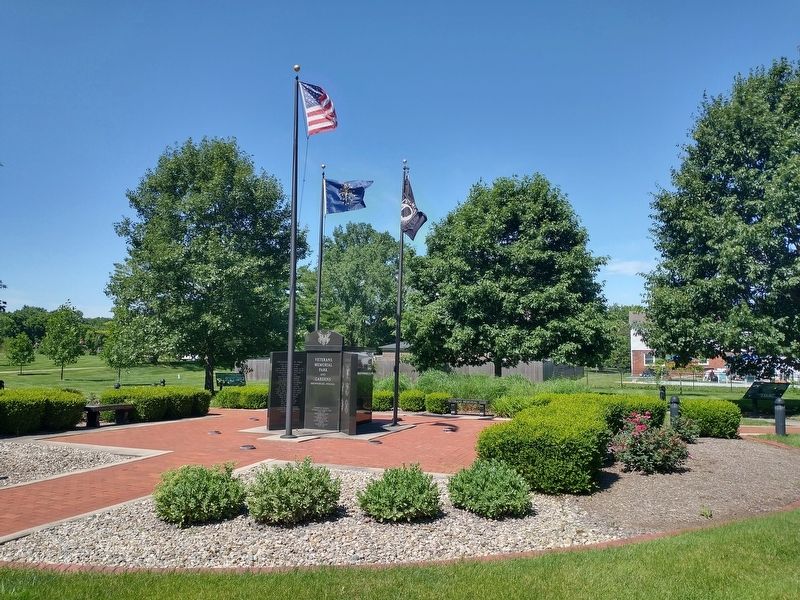
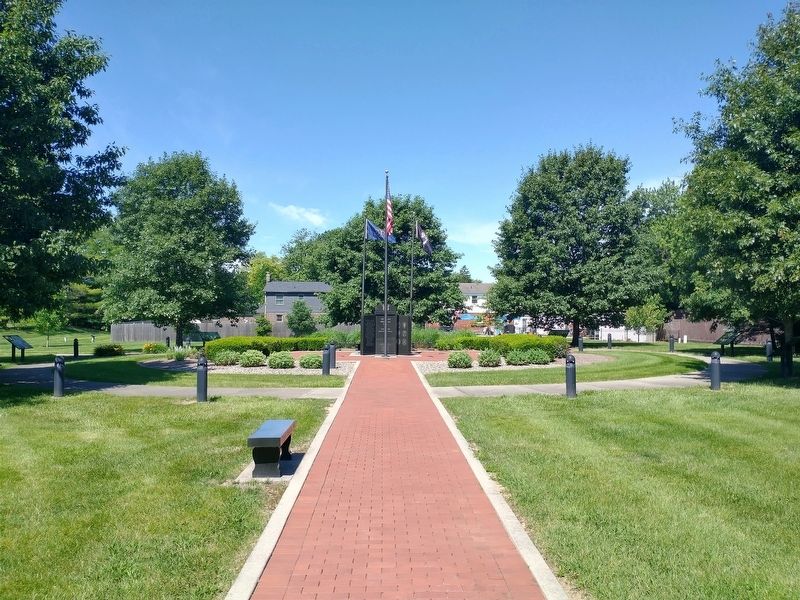
Brownsburg in Hendricks County, Indiana — The American Midwest (Great Lakes)
World War II
A Salute to Freedom
Photographed by Tom Bosse, June 16, 2026
1. A Salute to Freedom Marker
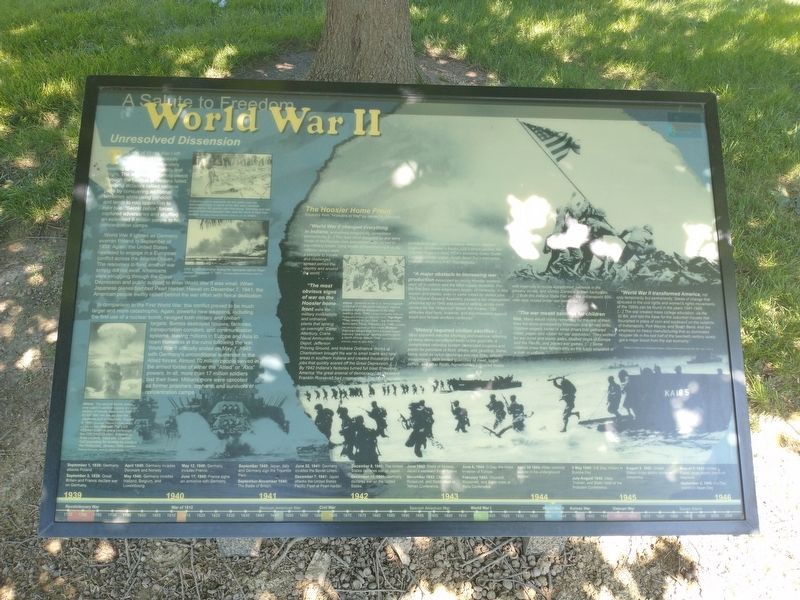
Unresolved Dissension
The end of World War I left many nations hopelessly {unreadable} and desperately seeking to {unreadable} and might. The attempts to promote peace through the League of Nations failed. Powerful dictators rallied national pride by conquering additional territories while using genocide and terror to rout opposition to their rule. “Secret police” forces captured adversaries and shuffled an estimated 6 million people to Nazi concentration camps.
World War II ignited as Germany overran Poland in September of 1939. Again, the United States hesitated to engage in a European conflict across the Atlantic Ocean. The resource to fund another war simply did not exist. Americans were struggling through the Great Depression and public support to enter World War II was small. When Japanese planes bombed Pearl Harbor, Hawaii on December 7, 1941, American people swiftly rallied behind the war effort with fierce dedication.
In comparison to the First World War, this conflict proved to be much larger and more catastrophic. Again, powerful new weapons, including the first use of a nuclear bomb, ravaged both military
this page online
The Hoosier Home Front
Excerpts from “Hoosiers at War” by James H Madison
“World War II changed everything in Indiana, sometime temporarily, sometimes permanently […]. The lives o most disrupted by war were those of the Hoosier men and women who served in the military forces. Long weeks of hard training in dusty military camps were a prelude to travels and challenges spread across the country and around the world.”
“The most obvious signs of the war on the Hoosier home front were the military installations and ordnance plants that sprang up overnight. Camp Atterbury, Crane Naval AmmunitionDepot, Jefferson Proving Ground, and Indiana Ordinance Works at Charlestown brought the war to small towns and rural areas in southern Indiana and created thousands of jobs that quickly scared off the Great Depression. […] By 1942 Indiana’s factories turned full blast to making America “the greatest arsenal of democracy” as President Franklin Roosevelt had commanded. The list of Hoosier contributions was nearly endless. Allison’s airplane engines, Studebaker’s trucks, Lilly’s blood plasma, the Calumet Region’s steel, RCA’s proximity fuses, Guide Lamp’s cartridge cases, South Bend Toy’s tent poles, Republic Aviation’s P-47 Thunderbolts.”Photographed by Tom Bosse, June 16, 20262. A Salute to Freedom MarkerMarker is on the right.
“A major obstacle to increasing war production developed as young Hoosier workers went off in uniform and the labor supply dwindled. For the first time some employers began, of necessity, to hire women and blacks, even in some cases for skilled jobs. The Indiana General Assembly passed a fair employment practices act in 1945 and joined in setting up day-care centers or the children of “Rosie the Riveter”. Old attitudes died hard, however, and discrimination against black and female workers continued.”
“Victoryrequired civilian sacrifice […]. Most apparent was the shortage and eventual rationing of many items considered basic to the good life. A complicated rationing system demanded coupons and points for purchase of food, shoes, and gasoline. Some items, such as nylon stockings and new tires, virtually disappeared. With limited quantities of meat, sugar, coffee, and other foods, homemakers prepared meals with ingenuity in recipe substitution, patience in the grocery stores, and Victory Gardens in their backyards. […] Both the Indiana State Fair and the Indianapolis 500 mile race closed under war demands.”Photographed by Tom Bosse, June 16, 20263. A Salute to Freedom Marker
“The war meant sacrifice for children too. Many would vividly remember for the rest of their lives the terror produced by blackouts and air-raid drills. Children eagerly joined in scrap drives that gathered metal, paper, and rubber for war production. They worked for war bond and stamp sales, studied maps of Europe and the Pacific, and played war games. […] Some children knew their fathers only as the fizzy snapshot of a man in uniform.”
“World War II transformed America, not only temporarily but permanently. Seeds of change that sprouted in the civil rights and women’s rights movements of the 1960s can be found in the years 1941-1945. […] The war created mass college education, via the GI Bill, and laid the base for the suburban houses that flourished in place off corn and soybeans on the outskirts of Indianapolis, Fort Wayne, and South Bend. And the emphasis on heavy manufacturing that so dominated Hoosier life in the last half of the twentieth century surely got a major boost from the war economy.”
[Timeline:]September 1, 1939: Germany attacks Poland
September 3, 1939: Great Britain and France declare war on Germany
April 1940: Germany invades Denmark and Norway.
May 1940: Germany invades Holland, Belgium, and Luxembourg.
May 12, 1940: Germany invades France.
June 1, 1940: France signs an armistice with Germany.
September 1940: Japan, Italy, and Germany sign the Tripartite Pact.
September – November 1940: The Battle of Britain
June 22, 1941: Germany invades the Soviet Union.
December 7, 1941: Japan attacks the United States Pacific Fleet at Pearl Harbor.
December 8, 1941: The United States declares war on Japan.
December 11, 1941: Germany declares war on the United States.
June 1942: Battle of Midway, Japan’s eastward thrust halted.
November 1943: Churchill, Roosevelt, and Stalin meet at Tehran Conference.
June 6, 1944: D-Day, the Allied invasion of Europe.
February 1945: Churchill, Roosevelt, and Stalin meet at Yalta Conference.
April 30, 1945: Hitler commits suicide in his underground bunker.
5 May 1945: V-E Day, Victory in Europe Day.
July – August 1945: Atlee, Truman, and Stalin meet at the Potsdam Conference.
August 6, 1945: United States drops atomic bomb on Hiroshima.
August 9, 1945: United States drops atomic bomb on Nagasaki.
September 2, 1945: V-J Day, Victory in Japan Day.
Erected by Brownsburg Parks.
Topics. This historical marker is listed in this topic list: War, World II. A significant historical month for this entry is January 1945.
Location. 39° 49.868′ N, 86° 24.395′ W. Marker is in Brownsburg, Indiana, in Hendricks County. It is on South Locust Lane, on the left when traveling north. Marker is located at the Veteran's Memorial Park and Gardens. Touch for map. Marker is at or near this postal address: 940 South Locust Lane, Brownsburg IN 46112, United States of America. Touch for directions.
Regionally, this marker is in Central Indiana and specifically in Greater Indianapolis. It is also in the American Midwest and in the Corn Belt. Globally, it is in North America, the Western Hemisphere, the Western World, and the Anglosphere. Historically, it finds itself in what was once the territory of the Mississippian Culture and also the Northwest Territory.
Other nearby markers. At least 8 other markers are within one mile of this marker, measured as the crow flies: The War of 1812 (here, next to this marker); The Civil War (a few steps from this marker); World War I (a few steps from this marker); The Revolutionary War (a few steps from this marker); The Korean War (a few steps from this marker); The Vietnam War (a few steps from this marker); Robbie Stanley (about 400 feet away, measured in a direct line); Howdy Bell (approx. 1.1 miles away). Touch for a list and map of all markers in Brownsburg.
Related markers. Click here for a list of markers that are related to this marker. A Salute to Freedom
Credits. This page was last revised on July 14, 2026. It was originally submitted on July 1, 2026, by Tom Bosse of Jefferson City, Tennessee. This page has been viewed 13 times since then. Photos: 1, 2, 3. submitted on July 1, 2026, by Tom Bosse of Jefferson City, Tennessee. • Devry Becker Jones was the editor who published this page.