Mitte in Leipzig, Saxony, Germany — Central Europe
Abbruch der Treppe
⎯⎯⎯
Demolition of the Staircase
Photographed by James Hulse, March 11, 2026
1. Abbruch der Treppe / Demolition of the Staircase Marker

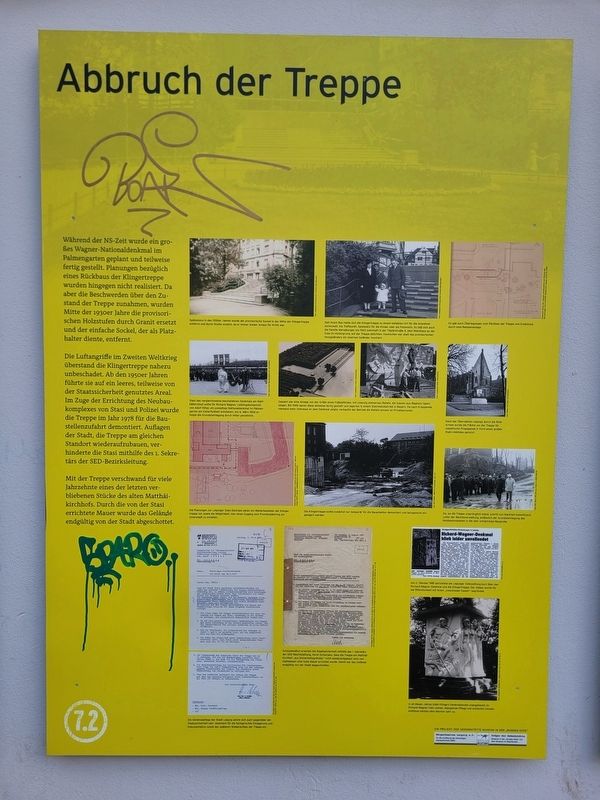
Während der NS-Zeit wurde ein großes Wagner-Nationaldenkmal im Palmengarten geplant und teilweise fertiggestellt. Planungen bezüglich eines Rückbaus der Klingertreppe wurden hingegen nicht realisiert. Da aber die Beschwerden über den Zustand der Treppe zunahmen, wurden Mitte der 1930er Jahre die provisorischen Holzstufen durch Granit ersetzt und der einfache Sockel, der als Platzhalter diente, entfernt.
Die Luftangriffe im Zweiten Weltkrieg überstand die Klingertreppe nahezu unbeschadet. Ab den 1950er Jahren führte sie auf ein leeres, teilweise von der Staatssicherheit genutztes Areal. Im Zuge der Errichtung des Neubaukomplexes von Stasi und Polizei wurde die Treppe im Jahr 1978 für die Baustellenzufahrt demontiert. Auflagen der Stadt, die Treppe am gleichen Standort wiederaufzubauen, verhinderte die Stasi mithilfe des 1. Sekretärs der SED-Bezirksleitung.
Mit der Treppe verschwand für viele Jahrzehnte eines der letzten verbliebenen Stücke des alten Matthäikirchhofs. Durch die von der Stasi errichtete Mauer wurde das Gelände endgültig von der Stadt abgeschottet.
Bildunterschriften:
Spätestens in den 1930er Jahren wurde der provisorische Sockel in der Mitte der Klingertreppe entfernt und durch Stufen ersetzt, da er immer wieder Anlass für Kritik war.
Seit ihrem Bau hatte sich die Klingertreppe zu einem beliebten Ort für die Anwohner entwickelt: als Treffpunkt, Spielplatz für die Kinder oder als Fotomotiv. So ließ sich auch die Familie Merseburger, bis 1943 wohnhaft in der Töpferstraße 4, dem Wohnhaus an der Ecke im Hintergrund, auf der Treppe ablichten. Inzwischen war statt des provisorischen Holzgeländers ein eisernes Geländer montiert.
Es gab auch Überlegungen zum Rückbau der Treppe und Ersetzung durch eine Rampenanlage.
Statt des vergleichsweise bescheidenen Denkmals am Matthäikirchhof sollte für Richard Wagner, Lieblingskomponist von Adolf Hitler, ein pompöses Nationaldenkmal im Palmengarten am Elsterflutbett entstehen. Am 6. März 1934 erfolgte die Grundsteinlegung durch Hitler persönlich.
Geplant war eine Anlage von der Größe eines Fußballfeldes, mit zwanzig steinernen Reliefs, die Szenen aus Wagners Opern zeigen. Bis 1945 waren diese teilweise fertiggestellt und lagerten in einem Steinmetzbetrieb in Bayern. Da nach Kriegsende niemand mehr Interesse an dem Denkmal zeigte, verkaufte der Betrieb die Reliefs einzeln an Privatpersonen.
Nach der Übernahme Leipzigs durch die Rote Armee wurde die Fläche vor der Treppe für sowjetische Propaganda in Form eines großen Stalin-Abbildes genutzt.
Die Planungen zur Leipziger Stasi-Zentrale sahen ein Weiterbestehen der Klingertreppe vor sowie die Möglichkeit, hier einen Zugang vom Promenadenring zur Innenstadt zu erhalten.
Die Klingertreppe sollte zunächst nur temporär für die Bauarbeiten demontiert und fachgerecht eingelagert werden.
Da, wo die Treppe ursprünglich stand, schritt nun Manfred Hummitzsch, Leiter der Bezirksverwaltung, anlässlich der Grundsteinlegung des Neubaukomplexes in die sehr schlammige Baugrube.
Die Denkmalpflege der Stadt Leipzig setzte sich auch gegenüber der Staatssicherheit sehr vehement für die fachgerechte Einlagerung und Dokumentation sowie den späteren Wiederaufbau der Treppe ein.
Schlussendlich erwirkte die Staatssicherheit mithilfe des 1. Sekretärs der SED-Bezirksleitung, Horst Schumann, dass die Treppe am Matthäikirchhof „aus Sicherheitsgründen“ nicht wiederaufgebaut wird und stattdessen eine hohe Mauer errichtet wurde. Damit war das Gelände endgültig von der Stadt abgeschnitten.
Am 2. Oktober 1981 berichtete die Leipziger Volkszeitung kurz über das Richard-Wagner-Denkmal und die Klingertreppe. Der Abbau wurde für die Öffentlichkeit mit ihrem „zwecklosen Dasein“ begründet.
In all diesen Jahren blieb Klingers Denkmalsockel unangetastet im Richard-Wagner-Hain stehen. Mangelnde Pflege und schlechte Umwelteinflüsse setzten dem Marmor sehr zu.
During
this page online
The Klinger Staircase survived the air raids of the Second World War largely unscathed. Beginning in the 1950s, it led to an empty area that was partially used by the State Security Service (Stasi). During the construction of the new Stasi and police complex, the staircase was dismantled in 1978 to provide access for construction vehicles. Efforts by the city to require the staircase to be rebuilt at the same location were blocked by the Stasi with the assistance of the First Secretary of the SED District Leadership.
With the disappearance of the staircase, one of the last remaining pieces of the old Matthäikirchhof vanished for many decades. The wall erected by the Stasi finally cut the area off from the city completely.
Captions:
By the 1930s at the latest, the temporary pedestal in the center of the Klinger Staircase had been removed and replaced with steps, as it had repeatedly been the subject of criticism.
Since its construction, the Klinger Staircase had developed into a popular place for local residents: as a meeting place, a playground for children, and a favorite photographic subject. The Merseburger family, who lived until 1943 at Töpferstraße 4, the house visible in the background at the corner, also had their photograph taken on the staircase. By this time, the temporary wooden railing had been replaced with an iron one.
There were also proposals to remove the staircase and replace it with a ramp.
Instead of the comparatively modest monument at the Matthäikirchhof, a grand National Monument to Richard Wagner, Adolf Hitler's favorite composer, was to be erected in the Palmengarten near the Elster floodplain. On March 6, 1934, the cornerstone was laid personally by Hitler.
The planned complex was to be the size of a football field and include twenty stone reliefs depicting scenes from Wagner's operas. By 1945, some of these had been completed and were stored at a stonemasonry workshop in Bavaria. Since no one was interested in the monument after the war, the workshop sold the reliefs individually to private individuals.
Following the capture of Leipzig by the Red Army, the area in front of the staircase was used for Soviet propaganda in the form of a large portrait of Stalin.
Plans for the Leipzig Stasi headquarters originally called for the Klinger Staircase to remain in place, while preserving a pedestrian connection from the Promenadenring to the city center.
The Klinger Staircase was initially intended to be dismantled only temporarily during construction work and stored professionally for later reinstallation.
Where the staircase had once stood, Manfred Hummitzsch, head of the district administration, now stepped into the very muddy construction pit during the cornerstone ceremony for the new building complex.
The historic preservation authorities of the City of Leipzig argued vigorously, even against the State Security Service, for the proper storage and documentation of the staircase and for its eventual reconstruction.
Ultimately, with the assistance of the First Secretary of the SED District Leadership, Horst Schumann, the State Security Service secured a decision that the staircase would not be rebuilt at the Matthäikirchhof for "security reasons" and that a high wall would instead be erected. The area was thereby permanently cut off from the city.
On October 2, 1981, the Leipziger Volkszeitung briefly reported on the Richard Wagner Monument and the Klinger Staircase. The demolition was publicly justified on the grounds of the staircase's "purposeless existence."
Throughout these years, Klinger's monument pedestal remained untouched in the Richard Wagner Grove. A lack of maintenance and the effects of environmental pollution caused considerable damage to the marble.
Erected by Leipzig
Photographed by James Hulse, March 11, 2026
2. Abbruch der Treppe / Demolition of the Staircase Marker
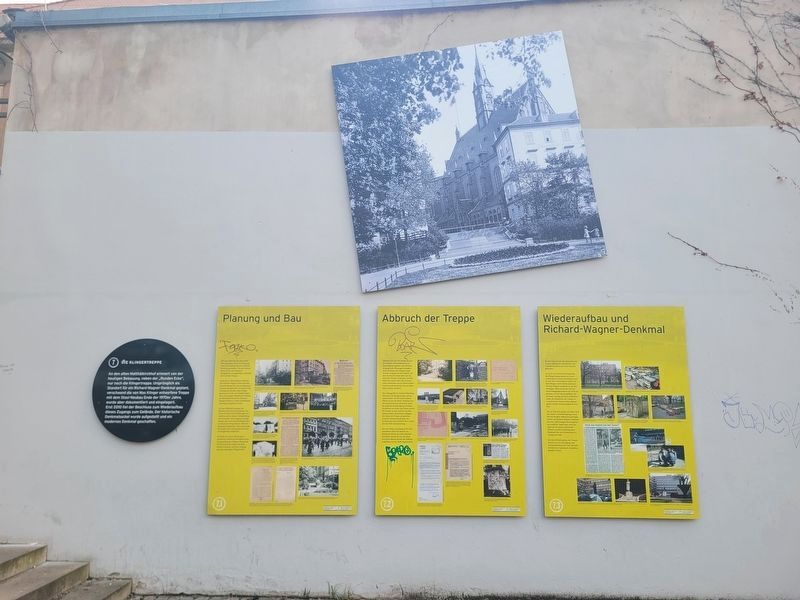
The view of the markers at the top of the stairs.
Topics. This historical marker is listed in this topic list: Notable Places. A significant historical year for this entry is 1978.
Location. 51° 20.544′ N, 12° 22.227′ E. Marker is in Leipzig, Sachsen (Saxony). It is in Mitte. It is on Goerdelerring just north of Dittrichring, on the right when traveling north. Touch for map. Marker is at or near this postal address: Goerdelerring 20, Leipzig SN 04109, Germany. Touch for directions.

Regionally, this marker is in Central Germany. Globally, it is in Europe, the European Union, Atlantic Europe, Central Europe, the Schengen Area, Western Europe, and the Western World. Historically, it finds itself in what was once the Holy Roman Empire and also the former East Germany.
Other nearby markers. At least 8 other markers are within walking distance of this marker: Planung und Bau / Planning and Construction (here, next to this marker); Wiederaufbau und Richard-Wagner-Denkmal / Reconstruction and the Richard Wagner Monument (here, next to this marker); Die Klingertreppe / The Klinger Staircase (here, next to this marker); Bezirksverwaltung für Staatssicherheit Leipzig / Leipzig District Administration for State Security
Photographed by James Hulse, March 11, 2026
3. Abbruch der Treppe / Demolition of the Staircase Marker
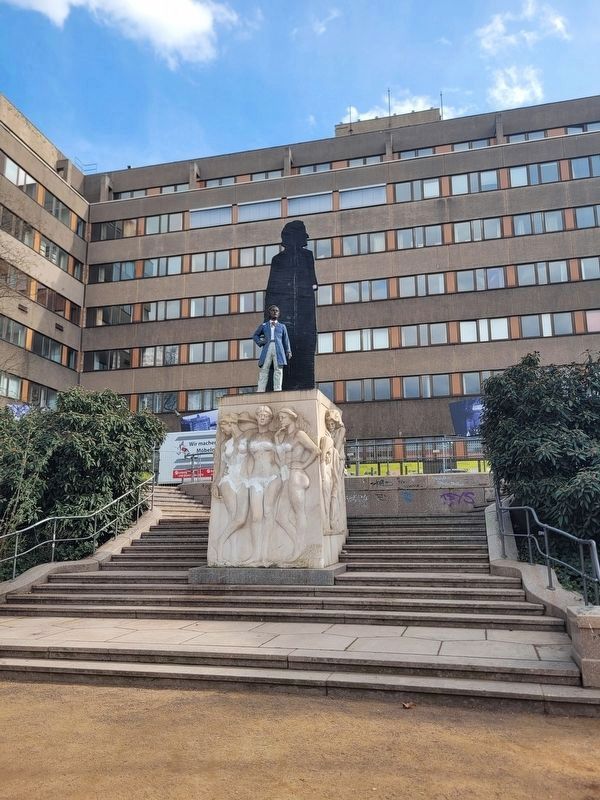
The view of the Richard Wagner statue on the stairs.
Credits. This page was last revised on July 3, 2026. It was originally submitted on July 1, 2026, by James Hulse of Medina, Texas. This page has been viewed 10 times since then. Photos: 1, 2, 3. submitted on July 3, 2026, by James Hulse of Medina, Texas.
