Mitte in Leipzig, Saxony, Germany — Central Europe
Wiederaufbau und Richard-Wagner-Denkmal
⎯⎯⎯
Reconstruction and the Richard Wagner Monument

Photographed by James Hulse, March 11, 2026
1. Wiederaufbau und Richard-Wagner-Denkmal / Reconstruction and the Richard Wagner Monument

Im Jahr 1991 wurden die Einzelteile der Treppe zufällig von Mitarbeitern des Grünflächenamtes auf einer Deponie gefunden.
Im April 2010 fiel die Entscheidung, die Klingertreppe wieder an ihrem ursprünglichen Platz aufzubauen und sie mit dem vorhandenen Sockel von Max Klinger sowie einem modernen Richard-Wagner-Denkmal zu vervollständigen. Dazu wurde ein Teil des Notstromaggregatehauses der Stasi abgerissen und die Mauer geöffnet. Da die Stadt Leipzig die Stasi verpflichtet hatte, die Einzelteile der Treppe zu nummerieren, konnte diese originalgetreu wieder zusammengesetzt werden.
Am 22. Mai 2013, genau 100 Jahre nach der ersten Grundsteinlegung, wurde die von Stephan Balkenhol gefertigte Statue von Richard Wagner, anlässlich des 200. Geburtstages des Komponisten, enthüllt. Damit fand auch die mehr als 100 Jahre andauernde Debatte um die Errichtung eines Denkmals für den Komponisten in Leipzig ein Ende.
Mit dem Wiederaufbau der Treppe konnte der alte Durchgang vom Promenadenring über den Matthäikirchhof zur Innenstadt wiederhergestellt werden.
Bildunterschriften:
Bis 2010 blieb das Stasi-Areal entlang des Promenadenringes durch die von der Stasi errichtete Mauer und das Notstromaggregatehaus abgeschottet.
Zerlegt in etwa 200 Einzelteile, wurde die Klingertreppe zufällig auf einem Lagerplatz wiederentdeckt.
Für den Wiederaufbau der Treppe wurde Anfang 2010 ein Teil der alten Stasi-Bebauung am Promenadenring abgebrochen.
Zuvor war bereits der Marmorsockel aus dem Palmengarten an den Dittrichring transportiert und im Innenhof der ehemaligen Stasi-Bezirksverwaltung abgestellt worden. Umwelteinflüsse und Vandalismus hatten dem Werk stark zugesetzt.
Ende März 2010 wurden die Treppenteile angeliefert und in der Grünanlage zwischengelagert. Gut erkennbar sind die Nummerierungen auf dem Naturstein.
Der Wiederaufbau der Treppe und die Setzung von Klingers Sockel entfachten die Debatte um ein Wagner-Denkmal in Leipzig erneut.
Anlässlich der Grundsteinlegung für den Wiederaufbau der Treppenanlage am 7. April 2010 sprach unter anderen Heiko Rosenthal, Umweltbürgermeister der Stadt Leipzig. Im Anschluss wurde in den Grundstein eine Zeitkapsel eingesetzt.
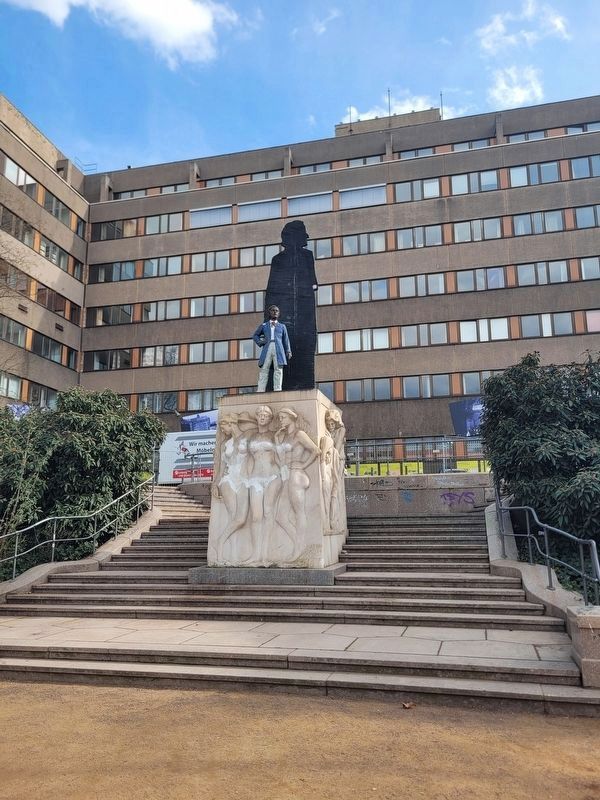
Am 22. Mai 2013 wurde am Matthäikirchhof das lange geplante Denkmal für den Komponisten enthüllt. Im Gegensatz zur ursprünglichen Gestaltungsidee einer monumentalen Statue zeigt die Interpretation von Stephan Balkenhol eine lebensgroße Wagner-Figur mit einem überlebensgroßen Schatten.
Blick auf Klingertreppe, Richard-Wagner-Denkmal und die dahinter aufragende ehemalige Bezirksverwaltung für Staatssicherheit Leipzig.
In
this page online
In April 2010, the decision was made to rebuild the Klinger Staircase at its original location and to complete it with Max Klinger's existing pedestal and a modern Richard Wagner monument. To make this possible, part of the Stasi emergency generator building was demolished and the wall was opened. Because the City of Leipzig had required the Stasi to number the individual pieces of the staircase, it was possible to reassemble it true to the original design.
On May 22, 2013, exactly 100 years after the laying of the first cornerstone, the statue of Richard Wagner created by Stephan Balkenhol was unveiled on the occasion of the 200th anniversary of the composer's birth. This finally brought to an end the debate, which had lasted for more than one hundred years, over the construction of a monument to the composer in Leipzig.
With the reconstruction of the staircase, the historic passageway from the Promenadenring through the Matthäikirchhof to the city center was restored.
Captions:
Until 2010, the Stasi compound along the Promenadenring remained cut off by the wall erected by the State Security Service and by the emergency generator building.
Disassembled into approximately 200 individual pieces, the Klinger Staircase was rediscovered by chance at a storage site.
To facilitate the reconstruction of the staircase, part of the former Stasi complex along the Promenadenring was demolished in early 2010.
Prior to this, the marble pedestal had already been transported from the Palmengarten to the Dittrichring and placed in the courtyard of the former Stasi district headquarters. Environmental damage and vandalism had taken a severe toll on the work.
At the end of March 2010, the staircase components were delivered and temporarily stored in the nearby green space. The numbering on the natural stone blocks is clearly visible.
The reconstruction of the staircase and the placement of Klinger's pedestal reignited the debate over a Wagner monument in Leipzig.
At the cornerstone ceremony for the reconstruction of the staircase on April 7, 2010, one of the speakers was Heiko Rosenthal, Deputy Mayor for the Environment for the City of Leipzig. Following the ceremony, a time capsule was placed into the cornerstone.
On May 22, 2013, the long-planned monument to the composer was unveiled at the Matthäikirchhof. In contrast to the original concept of a monumental statue, the interpretation by Stephan Balkenhol depicts a life-sized figure of Richard Wagner accompanied by an oversized shadow.
View of the Klinger Staircase, the Richard Wagner Monument, and the former Leipzig District Administration for State Security rising in the background.
Erected by Leipzig

Photographed by James Hulse, March 11, 2026
2. Wiederaufbau und Richard-Wagner-Denkmal / Reconstruction and the Richard Wagner Monument
The view of the markers at the top of the stairs.
Topics. This historical marker and monument is listed in this topic list: Notable Places. A significant historical month for this entry is April 2010.
Location. 51° 20.545′ N, 12° 22.225′ E. Marker is in Leipzig, Sachsen (Saxony). It is in Mitte. It is on Goerdelerring just north of Dittrichring, on the right when traveling north. Touch for map. Marker is at or near this postal address: Goerdelerring 20, Leipzig SN 04109, Germany. Touch for directions.

Regionally, this marker and monument is in Central Germany. Globally, it is in Europe, the European Union, Atlantic Europe, Central Europe, the Schengen Area, Western Europe, and the Western World. Historically, it finds itself in what was once the Holy Roman Empire and also the former East Germany.
Other nearby markers. At least 8 other markers are within walking distance of this marker: Abbruch der Treppe / Demolition of the Staircase (here, next to this marker); Planung und Bau / Planning and Construction (here, next to this marker); Die Klingertreppe / The Klinger Staircase (here, next to this marker); Bezirksverwaltung für Staatssicherheit Leipzig / Leipzig District Administration for State Security
Photographed by James Hulse, March 11, 2026
3. Wiederaufbau und Richard-Wagner-Denkmal / Reconstruction and the Richard Wagner Monument
The view of the Richard Wagner statue on the stairs.
Also see . . . Richard Wagner. Wikipedia
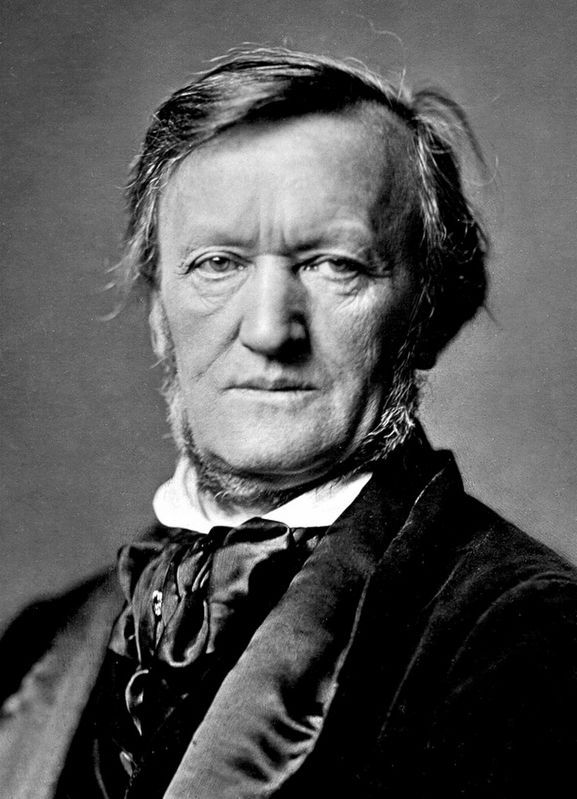
Wilhelm Richard Wagner (22 May 1813 – 13 February 1883) was a German composer, theatre director, essayist, and conductor, best known for his operas, although his mature works are often referred to as music dramas. Unlike most composers, Wagner wrote both the libretti and the music for all of his stage works. He first achieved recognition with works in the Romantic tradition of Carl Maria von Weber and Giacomo Meyerbeer, but revolutionised the genre through his concept of the Gesamtkunstwerk ("total work of art"), which sought to unite poetic, musical, visual, and dramatic elements. In that approach, the drama unfolds as a(Submitted on July 3, 2026, by James Hulse of Medina, Texas.)continuously sung narrative, with the music evolving organically from the text rather than alternating between arias and recitatives. Wagner outlined those ideas in a series of essays published between 1849 and 1852, most fully realising them in the first half of his four-opera cycle Der Ring des Nibelungen (The Ring of the Nibelung).Photographed by James Hulse, March 11, 20264. Wiederaufbau und Richard-Wagner-Denkmal / Reconstruction and the Richard Wagner MonumentClose-up of the relief on the base of the Richard Wagner monument, originally begun by artist Max Klinger.

Public Domain via Wikipedia Commons, Franz Hanfstaengl and Bavarian State Library, 1871
5. Richard Wagner
Credits. This page was last revised on July 3, 2026. It was originally submitted on July 1, 2026, by James Hulse of Medina, Texas. This page has been viewed 13 times since then. Photos: 1, 2, 3, 4, 5. submitted on July 3, 2026, by James Hulse of Medina, Texas.
