National Museum of Transportation near Kirkwood in St. Louis County, Missouri — The American Midwest (Upper Plains)
The Push Poles and Poling
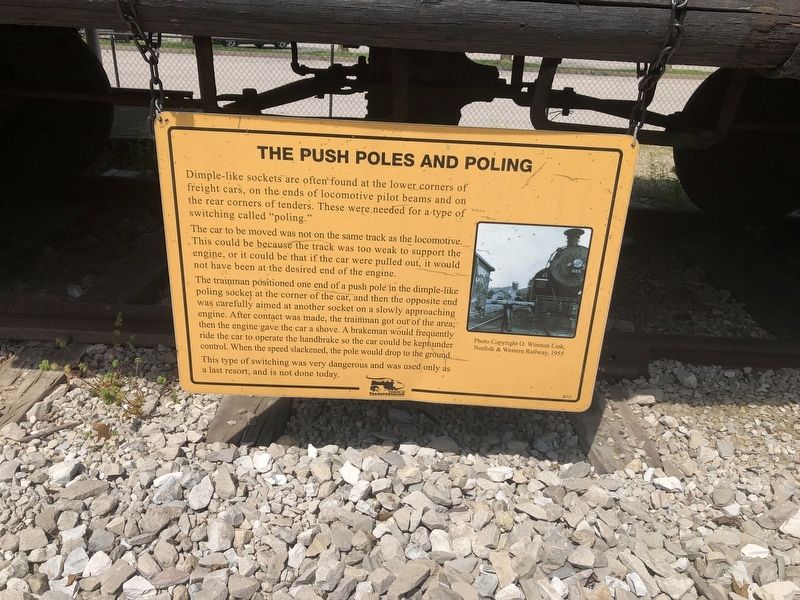
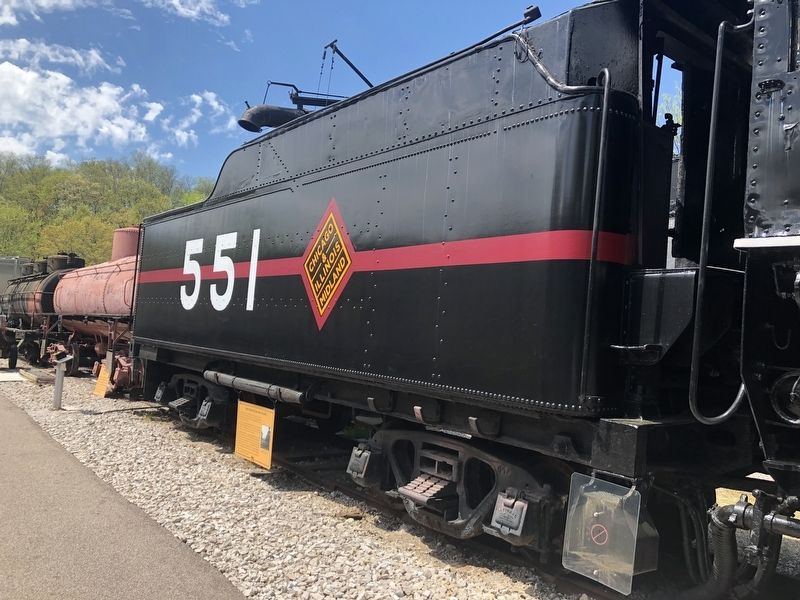
Dimple-like sockets are often found at the lower corner of freight cars, on the ends of locomotive pilot beams and on the rear corners of tenders. These were needed for a type of switching called "poling."
The car to be moved was not on the same track as the locomotive. This could be because the track was too weak to support the engine, or it could be that if the car were pulled out, it would not have been at the desired end of the engine.
The trainman positioned one end of a push pole in the dimple-like poling socket at the corner of the car, and then the opposite end was carefully aimed at another socket on a slowly approaching engine. After contact was made, the trainman got out of the area; then the engine gave the car a shove. A brakeman would frequently ride the car to operate the handbrake so the car could be kept under control. When the speed slackened, the pole would drop to the ground.
This type of switching was very dangerous and was used only as a last resort, and is not done today.
Erected 2013 by National Museum of Transportation.
Topics. This historical marker is listed in this topic
this page online
Location. 38° 34.302′ N, 90° 27.762′ W. Marker is near Kirkwood, Missouri, in St. Louis County. It is in National Museum of Transportation. It can be reached from Barrett Station Road east of Old Dougherty Ferry Road, on the right when traveling east. Touch for map. Marker is at or near this postal address: 3015 Barrett Station Road, Saint Louis MO 63122, United States of America. Touch for directions.

Regionally, this marker is in Greater St. Louis. It is also in the American Midwest, in the Lewis & Clark Corridor, in the Corn Belt, and in the Great River Road Region. Globally, it is in North America, the Western Hemisphere, the Western World, and the Anglosphere. Historically, it finds itself in what was once the Viceroyalty of New France, the territory of the Mississippian Culture, the Louisiana Purchase, and the Antebellum South.
Other nearby markers. At least 8 other markers are within walking distance of this marker: Chicago, Burlington & Quincy #1942 (here, next to this marker); UTLX #14387 (a few steps from this marker); #9908 "Silver Charger"
Credits. This page was last revised on July 7, 2026. It was originally submitted on April 28, 2019, by Devry Becker Jones of Washington, District of Columbia. This page has been viewed 614 times since then and 53 times this year. Last updated on July 1, 2026, by Garrett Koch of Saint Louis, Missouri. Photos: 1, 2. submitted on April 28, 2019, by Devry Becker Jones of Washington, District of Columbia.
