
Concord Armory
1887

This property has been placed on the
National Register of Historic Places
by the United States Department of the Interior
Topics and series. This historical marker is listed in these topic lists: Architecture • Notable Buildings. In addition, it is included in the National Register of Historic Places (NRHP) series list. A significant historical year for this entry is 1887.
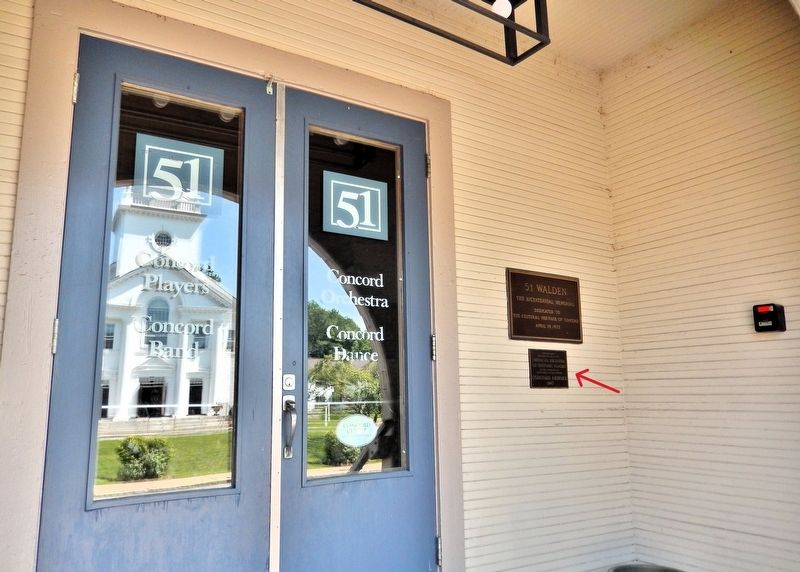
Location. 42° 27.531′ N, 71° 20.952′ W. Marker is in Concord, Massachusetts, in Middlesex County. It is on Walden Street just south of Hubbard Street, on the left when traveling south. The marker is mounted directly on the subject building, on the right side of the front entrance. Touch for map. Marker is at or near this postal address: 51 Walden Street, Concord MA 01742, United States of America. Touch for directions.

Regionally, this marker is in Greater Boston. It is also in the American Northeast, in New England, and on the Eastern Seaboard. Globally, it is in the North Atlantic Region, North America, the Western Hemisphere, the Western World, and the Anglosphere. Historically, it finds itself in what was once one of the original Thirteen
this page online
Other nearby markers. At least 8 other markers are within walking distance of this marker: The Millpond (about 500 feet away, measured in a direct line); The First Provincial Congress (about 500 feet away); The Wright Tavern (about 500 feet away); The Milldam (about 500 feet away); Jethro’s Tree (about 600 feet away); Concord Massachusetts War Memorials (about 600 feet away); Concord Massachusetts World War II Honor Roll (about 600 feet away); Henry David Thoreau (about 600 feet away). Touch for a list and map of all markers in Concord.
Regarding Concord Armory. National Register of Historic Places № 07000945.
From the National Register Nomination prepared by Anne Forbes & Betsy Friedberg, 7/2007:
The late Victorian building that began as the Concord Armory is a long rectangular, largely wood-frame structure. Its present form is the result of five building campaigns. The three earliest sections, built between 1887 and 1896 — the headhouse, drill shed, and a rear drill-shed addition — rest on a fieldstone foundation which is topped with brick above ground level. The other parts of the building — the 1922 stage andthe 1927 scene dock — have high concrete-block foundations. Most of the building is clad in wood shingles, although the upper section of the front portion, the original headhouse, is clapboarded.Photographed by Cosmos Mariner, July 7, 20192. Bicentennial Memorial Marker(mounted directly above the NRHP marker)
51 Walden
This Bicentennial Memorial
dedicated to
the Cultural Heritage of Concord
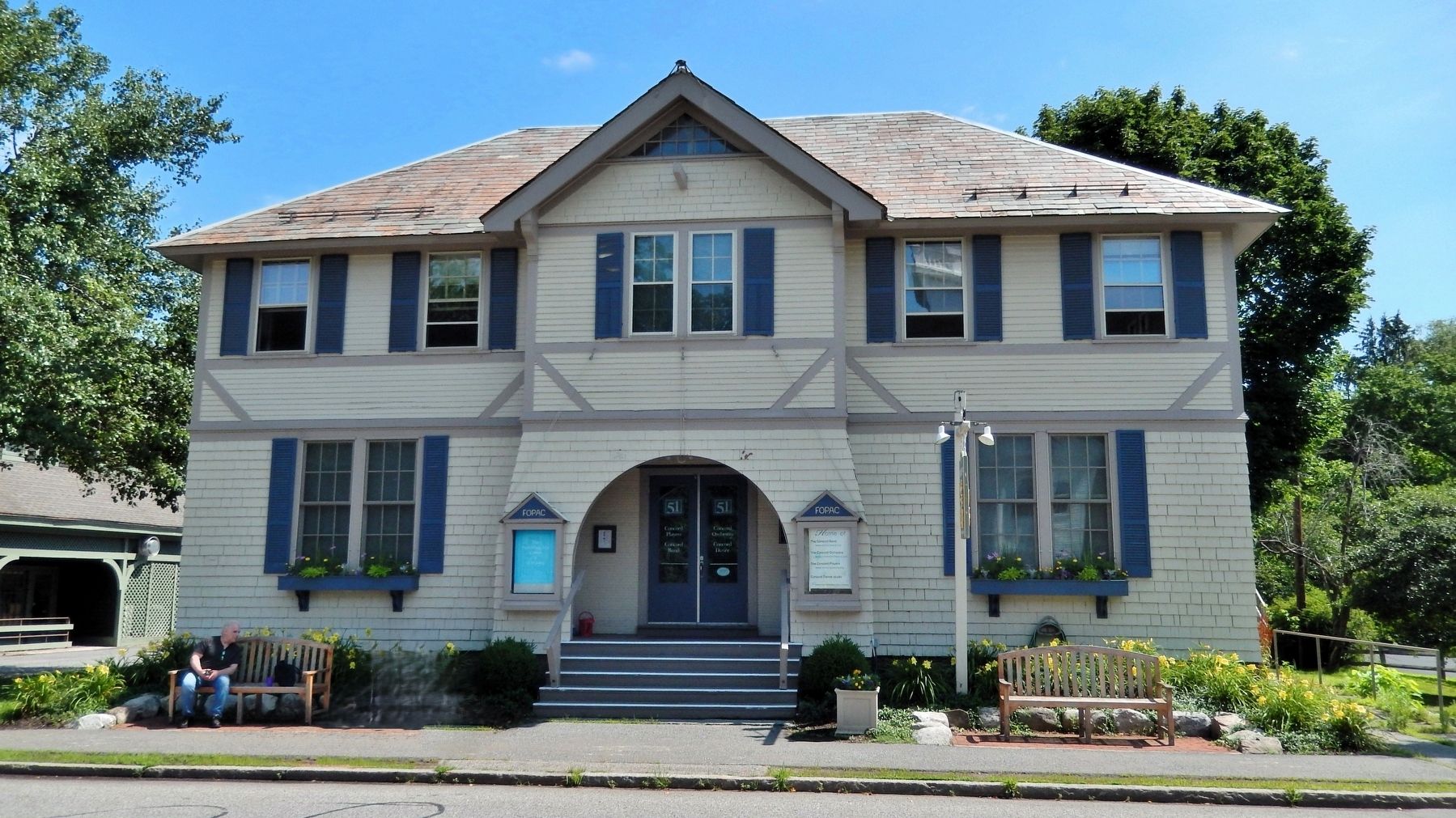
April 19, 1975The 1887 headhouse, 51 feet wide and 26 feet deep, is a two-story, hip-roofed building. The symmetrically arranged facade is articulated by a broad, shallow center pavilion which rises to a gabled dormer. At first-story level, the pavilion incorporates a broad round-arched opening which shelters the recessed center entry, lending a hint of the Romanesque Revival to this otherwise Queen Anne building. The headhouse is clad in wood shingle at the first story and wood clapboard at the second, enhanced with horizontal and diagonal boarding (also called “stick work” or half-timbering), a feature that was popular with the Queen Anne style of the 1880s. The walls inside the entrance arch are lined with horizontally mounted tongue-and-groove boards.
The Concord Armory is significant as a rare and well-preserved wood-frame late 19th century town armory converted in the early 20th century to a regional theater. The building represents several chapters in the history of Concord's commercial and institutional downtown. Built in 1887 and 1888 as the armory and headquarters for the town's military company, the Concord Artillery, the building was the main venue in Concord for local military activity and the associated social events that were an important aspect of life in many New England towns in the years between the Civil War and the turn of the 20th century.
After World War I it was renamed the Concord Veterans Building, and for decades it was the headquarters of the local veterans' organizations and the Red Cross. A highly adaptable structure, the building also evolved in the 20th century into Concord center's primary entertainment and performing arts facility. Public function that continued through the years of the Great Depression, when the town also held its Town Meetings in the building.
The armory is also significant as a rare and well-preserved example of a late 19th century wood-frame armory in an eclectic Queen Anne style, and as an illustration of the work of three notable architects. The building was designed by John Chapman, a local resident whose mark is left on Concord m two extant churches and in a handful of handsome houses he designed or renovated in the 1880s in the Queen Anne, Shingle, and early Colonial Revival styles. The 1922 stage added to the east end of the former drill shed was designed by architect Clarence Blackall, who is best known for the fourteen Boston theaters he designed, including the Wilbur, Colonial, and Metropolitan (Wang) Theaters. The scene dock east of the stage was added in 1927 to a design by another Concord architect, Harry Little, who added this humble structure to the long list of prominent buildings he designed over the course of a career that included the Trinitarian Church directly across Walden Street, the Concord Museum (NR), the transformation of the Concord Free Public Library on Main Street and the Middlesex County Courthouse on Monument Square (NR), as well as a major portion of the National Cathedral in Washington.

Also see . . . Concord Armory (Wikipedia).
Excerpt: The Concord Armory is an historic former armory at 51 Walden Street in Concord, Massachusetts. It now serves as the Performing Arts Center at 51 Walden, which is operated by the Friends of Performing Arts in Concord (FOPAC). The armory was built in 1887 and added to the National Register of Historic Places in 2007, as a rare well-preserved example of a wood-frame municipal armory.(Submitted on July 2, 2026, by Cosmos Mariner of Cape Canaveral, Florida.)The armory was built in several stages, between 1887 and 1927. The front portion, or headhouse, was built in 1887, and the drill shed added in 1888. In 1896 the drill shed was lengthened. When the building was converted for use by veterans organizations and the Concord Players in the 1920s, the area housing the stage was added. In 1927 the stage area was extended to the rear to provide additional space for scenery. The building interior was extensively altered in the 1970s when FOPAC took over the property.
Historical uses of the building during the 20th century include the screening of films by the Red Cross in the 1920s, and for annual town meetings between 1933 and 1946. It was also used to house town offices, and to provide space for a youth center. Due to its deteriorating condition, the building was several times considered for demolition in the 1950s and 1960s, but public outcry was successful in preventing that fate. FOPAC was formed in 1972 to convert the building into a dedicated performing arts space.
Credits. This page was last revised on July 2, 2026. It was originally submitted on July 1, 2026, by Cosmos Mariner of Cape Canaveral, Florida. This page has been viewed 12 times since then. Photos: 1, 2, 3, 4. submitted on July 2, 2026, by Cosmos Mariner of Cape Canaveral, Florida.
