
Chelmsford in Essex, England, United Kingdom — Northwestern Europe (the British Isles)
Frederic Chancellor
Photographed by Ray Gurganus, April 18, 2026
1. Frederic Chancellor Marker
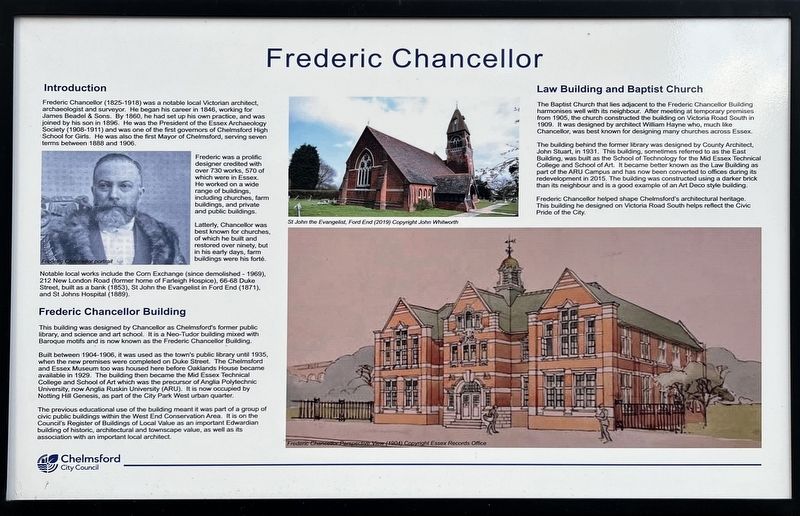
Frederic Chancellor (1825-1918) was a notable local Victorian architect archaeologist and surveyor. He began his career in 1846, working for James Beadel & Sons. By 1860, he had set up his own practice, and was joined by his son in 1896. He was the President of the Essex Archaeology Society (1908-1911) and was one of the first governors of Chelmsford High School for Girls. He was also the first Mayor of Chelmsford, serving seven terms between 1888 and 1906.
Frederic was a prolific designer credited with over 730 works, 570 of which were in Essex. He worked on a wide range of buildings. including churches, farm buildings, and private and public buildings.
Frederic Chancellor Latterly, Chancellor was best known for churches, of which he built and restored over ninety, but in his early days, farm buildings were his forté.
Notable local works include the Corn Exchange (since demolished-1969). 212 New London Road (former home of Farleigh Hospice), 66-68 Duke Street, built as a bank (1853), St John the Evangelist in Ford End (1871). and St Johns Hospital (1889).
Frederic Chancellor Building
This building was designed by Chancellor as Chelmsford's former public library, and science and art school. It is a Neo-Tudor building mixed with Baroque motifs and is now known
this page online
Built between 1904-1906, it was used as the town's public library until 1935. when the new premises were completed on Duke Street. The Chelmsford and Essex Museum too was housed here before Oaklands House became available in 1929. The building then became the Mid Essex Technical College and School of Art which was the precursor of Anglia Polytechnic University, now Anglia Ruskin University (ARU). It is now occupied by Notting Hill Genesis, as part of the City Park West urban quarter.
The previous educational use of the building meant it was part of a group of civic public buildings within the West End Conservation Area. It is on the Council's Register of Buildings of Local Value as an important Edwardian building of historic, architectural and townscape value, as well as its association with an important local architect.
Law Building and Baptist Church
The Baptist Church that lies adjacent to the Frederic Chancellor Building harmonises well with its neighbour. After meeting at temporary premises from 1905, the church constructed the building on Victoria Road South in 1909. It was designed by architect William Hayne who, much le Chancellor, was best known for designing many churches across Essex.
The building behind the former library was designed by County Architect John Stuart, in 1931. This building, sometimes referred to as the East Building, was built as the School of Technology for the Mid Essex Technical College and School of Art. It became better known as the Law Building as part of the ARU Campus and has now been converted to offices during its redevelopment in 2015. The building was constructed using a darker brick than its neighbour and is a good example of an Art Deco style building.
Frederic Chancellor helped shape Chelmsford's architectural heritage. This building he designed on Victoria Road South helps reflect the Civic Pride of the City.
Erected by Chelmsford City Council.
Topics. This historical marker is listed in these topic lists: Architecture • Education • Religion & Religious Structures. A significant historical year for this entry is 1846.
Location. 51° 44.092′ N, 0° 28.145′ E. Marker is in Chelmsford, England, in Essex. It is at the intersection of Business Springs Road and Victoria Road South, on the left when traveling east on Business Springs Road. Touch for map. Marker is at or near this postal address: Business Springs, Chelmsford, England CM1 1LU, United Kingdom. Touch for directions.

Regionally, this marker is in the Greater South East. Globally, it is on the Atlantic Ocean, in the North Atlantic Region, in Europe, in Atlantic Europe, on one of the British Isles, in the Western World, and in the Anglosphere. Historically, it finds itself in what was once the Roman Empire.
Other nearby markers. At least 8 other markers are within 19 kilometers of this marker, measured as the crow flies: Frank Whitmore Green (about 210 meters away, measured in a direct line); Guglielmo Marconi 1874-1937 (approx. 0.3 kilometers away); Dr Benjamin Pugh (1715-1798) (approx. 0.4 kilometers away); The Old County Gaol in Moulsham (approx. half a kilometer away); Stone Bridge (approx. half a kilometer away); The Parish Church of St Mary the Virgin, Shenfield (approx. 15.5 kilometers away); Castle Hill Farm/Railway Station (approx. 18.6 kilometers away); Rayleigh Mount (approx. 18.7 kilometers away). Touch for a list and map of all markers in Chelmsford.
Credits. This page was last revised on July 2, 2026. It was originally submitted on July 2, 2026, by Ray Gurganus of Washington, District of Columbia. This page has been viewed 8 times since then. Photo 1. submitted on July 2, 2026, by Ray Gurganus of Washington, District of Columbia. • Andrew Ruppenstein was the editor who published this page.
