
Chelmsford in Essex, England, United Kingdom — Northwestern Europe (the British Isles)
Stone Bridge
Photographed by Ray Gurganus, April 16, 2026
1. Stone Bridge Marker
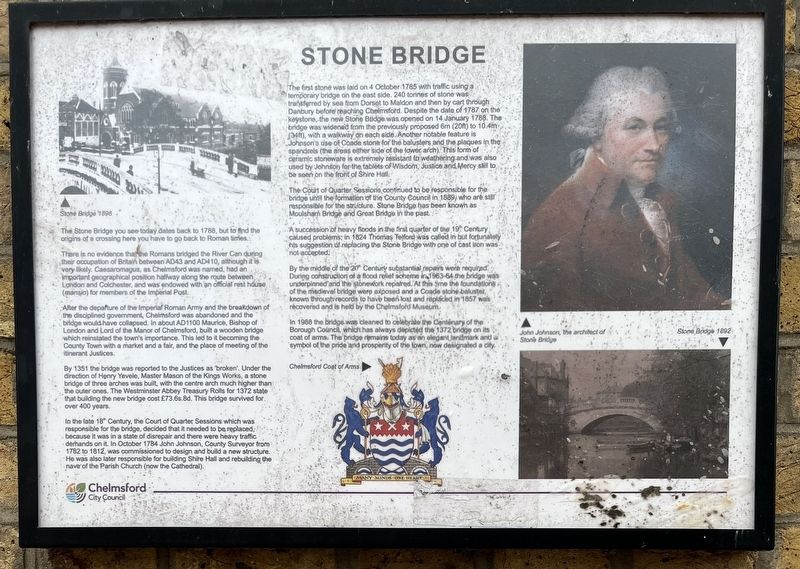
There is no evidence that the Romans bridged the River Can during their occupation of Britain between AD43 and AD410, although it is very likely. Caesaromagus, as Chelmsford was named, had an important geographical position halfway along the route between London and Colchester, and was endowed with an official rest house (mansio) for members of the Imperial Post.
After the departure of the Imperial Roman Army and the breakdown of the disciplined government, Chelmsford was abandoned and the bridge would have collapsed. In about AD1100 Maurice, Bishop of London and Lord of the Manor of Chelmsford, built a wooden bridge which reinstated the town's importance. This led to it becoming the County Town with a market and a fair, and the place of meeting of the itinerant Justices.
By 1351 the bridge was reported to the Justices as broken. Under the direction of Henry Yevele, Master Mason of the Kings Works, a stone bridge of three arches was built, with the centre arch much higher than the outer ones. The Westminster Abbey Treasury Rolls for 1372 state that building the new bridge cost £73.6s.8d. This bridge survived for over 400 years.
In the late 18th Century, the Court
this page online
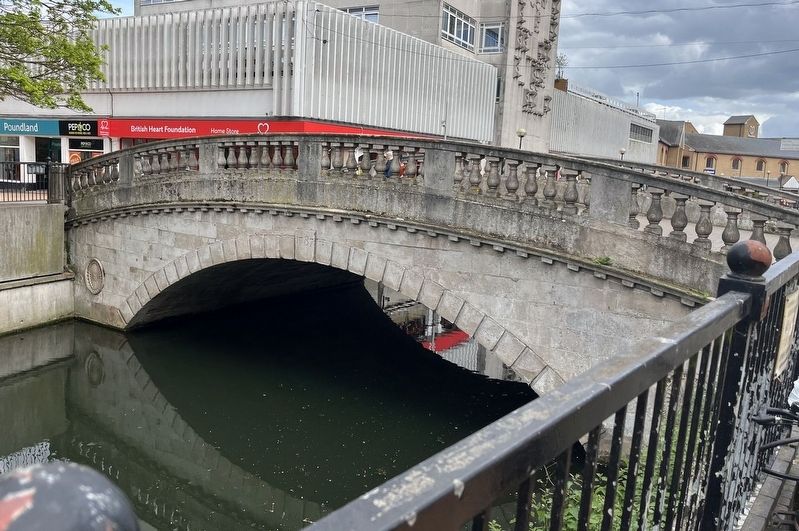
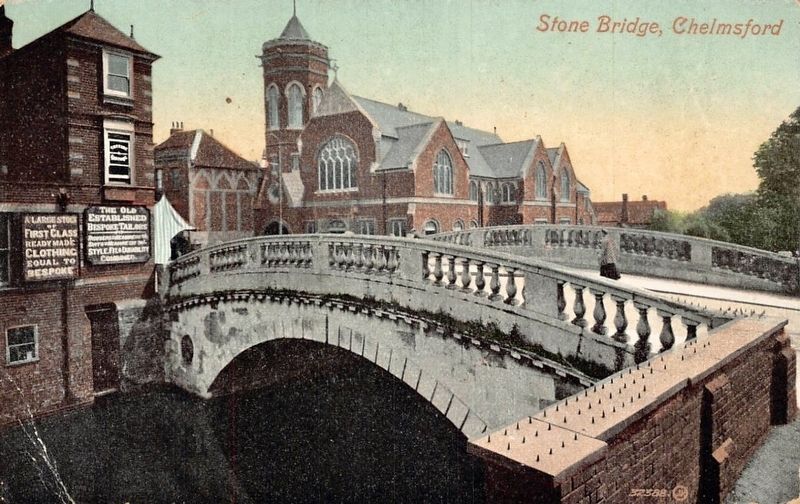
The first stone was laid on 4 October 1785 with traffic using a temporary bridge on the east side. 240 tonnes of stone was transferred by sea from Dorset to Maldon and then by cart through Danbury before teaching Chelmsford. Despite the date of 1787 on the keystone, the new Stone Badge was opened on 14 January 1788. The bridge was wide widened from the previously proposed 6m (20ft) to 10.4m (34ft), with a walkway on each side. Another notable feature is Johnson's use of Coade stone for the balusters and the plaques in the spandrels (the areas either side of the lower arch). This form of ceramic stoneware is extremely resistant to weathering and was also used by Johnson for the tablets of Wisdom, Justion and Mercy still to be seen on the front of Shire Hall.
The Court of Quarter Sessions continued to be responsible for the bridge until the formation of the County Council in 1889, who are still responsible for the structure. Stone Bridge has been
Photographed by Ray Gurganus, April 16, 2026
2. Stone Bridge
A succession of heavy floods in the first quarter of the 19 Century caused problems: in 1824 Thomas Telford was called in but fortunately his suggestion of replacing the Stone Bridge with one of cast iron was not accepted.
By the middle of the 21 Century substantial repairs were required. During construction of a flood relief scheme in 1963-64 the bridge was underpinned and the stonework repaired. At this time the foundations of the medieval bridge were exposed and a Coade stone baluster known through records to have been lost and replaced in 1857 was recovered and is held by the Chelmsford Museum.
In 1968 the bridge was cleaned to celebrate the Centenary of the Borough Council, which has always depicted the 1372 bridge on its coat of arms. The bridge remains today as an elegant landmark and a symbol of the pride and prosperity of the town, now designated a city.
Erected by Chelmsford City Council.
Topics. This historical marker is listed in this topic list: Bridges & Viaducts.
Location. 51° 43.886′ N, 0° 28.47′ E. Marker is in Chelmsford, England, in Essex. It is at the intersection of Barrack Square and Moulsham Street, on the right when traveling east on Barrack
Photographed by John Valentine and Sons Co., circa 1910
3. Stone Bridge, Chelmsford

Regionally, this marker is in the Greater South East. Globally, it is on the Atlantic Ocean, in the North Atlantic Region, in Europe, in Atlantic Europe, on one of the British Isles, in the Western World, and in the Anglosphere. Historically, it finds itself in what was once the Roman Empire.
Other nearby markers. At least 8 other markers are within 19 kilometers of this marker, measured as the crow flies: The Old County Gaol in Moulsham (here, next to this marker); Dr Benjamin Pugh (1715-1798) (about 180 meters away, measured in a direct line); Guglielmo Marconi 1874-1937 (approx. 0.3 kilometers away); Frederic Chancellor (approx. half a kilometer away); Frank Whitmore Green (approx. 0.7 kilometers away); The Parish Church of St Mary the Virgin, Shenfield (approx. 15.5 kilometers away); Castle Hill Farm/Railway Station (approx. 18 kilometers away); Rayleigh Mount (approx. 18.2 kilometers away). Touch for a list and map of all markers in Chelmsford.
Credits. This page was last revised on July 2, 2026. It was originally submitted on July 2, 2026, by Ray Gurganus of Washington, District of Columbia. This page has been viewed 7 times since then. Photos: 1, 2. submitted on July 2, 2026, by Ray Gurganus of Washington, District of Columbia. 3. submitted on July 2, 2026. • Andrew Ruppenstein was the editor who published this page.
