Riverside in Riverside County, California — The American West (Pacific Coastal)
County of Riverside Historical Marker No. 024

Photographed by Volt Craft, July 1, 2026
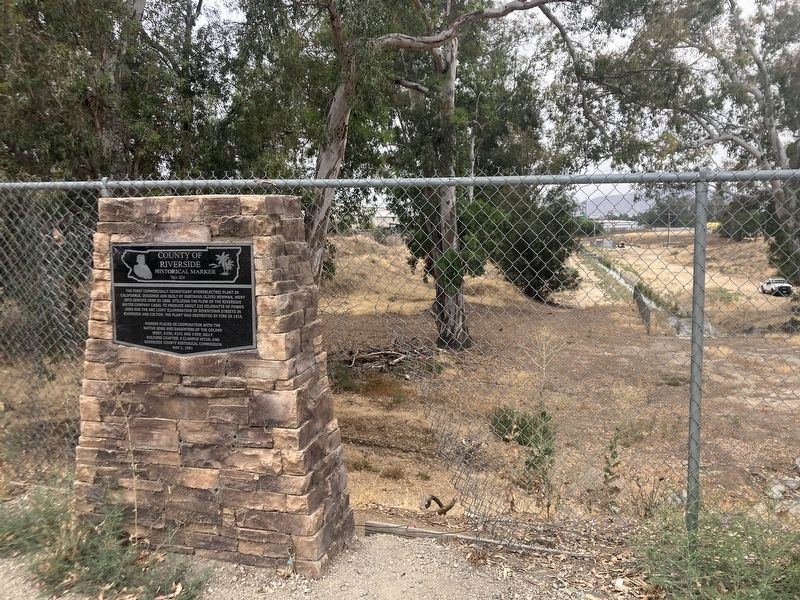
1. County of Riverside Historical Marker No. 024 Marker
The first commercially significant hydroelectric plant in California, designed and built by Gustavus Olivio Newman, went into service here in 1888. Utilizing the flow of the Riverside Water Company canal to produce about 225 kilowatts of power used for the arc light illumination of downtown streets in Riverside and Colton. The plant was destroyed by fire in 1915.
Erected 1991 by Native Sons and Daughters of rthe Golden West, #296, #241 and #299; Billy Holcomb Chapter, E Clampus Vitus; and Riverside County Historical Commission. (Marker Number 024.)
Topics. This historical marker is listed in this topic list: Landmarks. A significant historical year for this entry is 1888.
Location. 34° 0.702′ N, 117° 20.403′ W. Marker is in Riverside, California, in Riverside County. It is on Iowa Avenue south of Spring Street, on the right when traveling south. Touch for map. Marker is at or near this postal address: 491 Iowa Ave, Riverside CA 92507, United States of America. Touch for directions.

Regionally, this marker is in Greater Los Angeles, in the Inland Empire, and in the Peninsular Ranges. It is also in the American
this page online
Other nearby markers. At least 8 other markers are within 3 miles of this marker, measured as the crow flies: Highgrove Hydroelectric Plant (here, next to this marker); Trujillo Adobe (approx. 0.8 miles away); Rotary Centennial Grove (approx. 2.2 miles away); Fairmount Park Bandshell (approx. 2.3 miles away); William Collier House (approx. 2.3 miles away); John J. Hewitt House (approx. 2.3 miles away); Mitchell House (approx. 2.4 miles away); Agua Mansa Cemetery (approx. 2.4 miles away). Touch for a list and map of all markers in Riverside.
Also see . . . Landmarks of the City of Riverside #109. Highgrove Drop and Upper Riverside Canal (Iowa Avenue and Spring Street) The canal is strongly associated with the early development of Riverside and the citrus industry. Furthermore, the Highgrove Drop is also associated with the first commercially significant hydroelectric
Photographed by Volt Craft, July 1, 2026
2. County of Riverside Historical Marker No. 024 Marker
Additional keywords. Hydroelectric plant
Credits. This page was last revised on July 6, 2026. It was originally submitted on July 2, 2026, by Volt Craft of Riverside, California. This page has been viewed 21 times since then. Last updated on July 2, 2026, by Volt Craft of Riverside, California. Photos: 1, 2. submitted on July 2, 2026, by Volt Craft of Riverside, California. • Devry Becker Jones was the editor who published this page.
