Near Cedar Vale in Cowley County, Kansas — The American Midwest (Upper Plains)
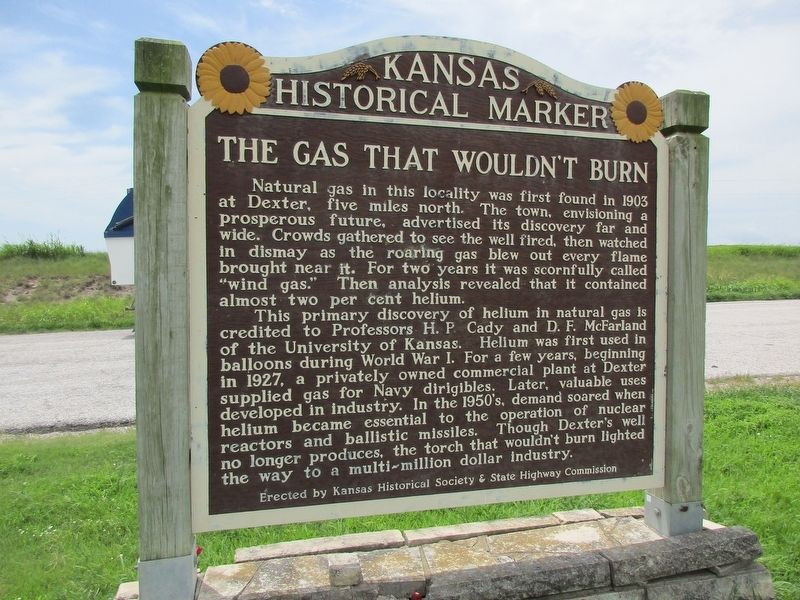
The Gas That Wouldn't Burn
Photographed by Jeff Leichsenring, July 2, 2026
1. The Gas That Wouldn't Burn Marker
Natural gas in this locality was first found in 1903 at Dexter, five miles north. The town, envisioning a prosperous future, advertised its discovery far and wide. Crowds gathered to see the well fired, then watched in dismay as the roaring gas blew out every flame brought near it. For two years it was scornfully called "wind gas". Then analysis revealed that it contained almost two per cent helium.
This primary discovery of helium in natural gas is credited to Professors H. P. Cady and D. F. McFarland of the University of Kansas. Helium was first used in balloons during World War I. For a few years, beginning in 1927, a privately owned commercial plant at Dexter supplied gas for Navy dirigibles. Later valuable uses developed in industry. In the 1950's, demand soared when helium became essential to the operation of nuclear reactors and ballistic missiles. Though Dexter's well no longer produces, the torch that wouldn't burn lighted the way to a multi-million dollar industry.
Erected by Kansas Historical Society. (Marker Number 59.)
Topics and series. This historical marker is listed in these topic lists:
this page online
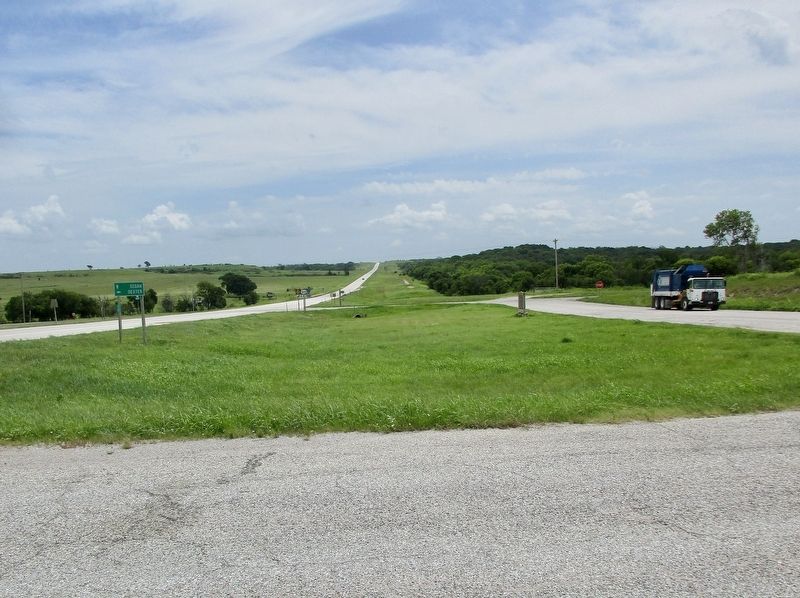
Location. 37° 6.642′ N, 96° 42.947′ W. Marker is near Cedar Vale, Kansas, in Cowley County. It is at the intersection of U.S. 166 and Kansas Highway 15, on the right when traveling east on U.S. 166. Roadside turnout, 12 miles west of Cedar Vale at K-15 north bound junction. Touch for map. Marker is in this post office area: Cedar Vale KS 67024, United States of America. Touch for directions.

Regionally, this marker is in Eastern Kansas and in Greater Wichita. It is also in the American Midwest, in the Corn Belt, on the prairies, and on the Southern Plains. Globally, it is in North America, the Western Hemisphere, the Western World, and the Anglosphere. Historically, it finds itself in what was once New Spain and also the Louisiana Purchase.
Also see . . . Helium production in the United States (Wikipedia). History:
In 1903, an oil exploration well at Dexter, Kansas, produced a gas that would not burn. Kansas state geologist Erasmus Haworth took samples(Submitted on July 19, 2026.)of the gas back to the University of Kansas at Lawrence where chemists Hamilton Cady and David McFarland discovered that gas contained 1.84 percent helium. This led to further discoveries of helium-bearing natural gas in Kansas.Photographed by Jeff Leichsenring, July 2, 20262. The Gas That Wouldn't Burn Marker
Credits. This page was last revised on July 19, 2026. It was originally submitted on July 3, 2026, by Jeff Leichsenring of Garland, Texas. This page has been viewed 52 times since then. Photos: 1, 2. submitted on July 3, 2026, by Jeff Leichsenring of Garland, Texas. • Andrew Ruppenstein was the editor who published this page.
