William H. Wright Building Art Deco Sculpture
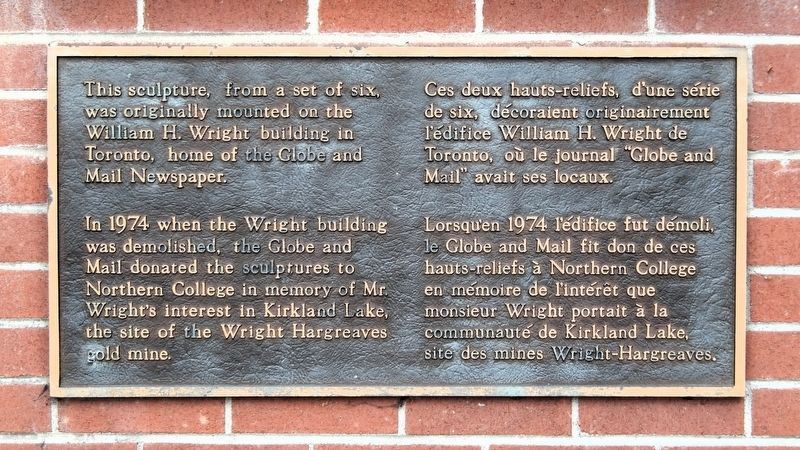

In 1974 when the Wright building was demolished, the Globe and Mail donated the sculptures to Northern College in memory of Mr. Wright’s interest in Kirkland Lake, the site of the Wright Hargreaves gold mine.
Lorsqu’en 1974 l’édifice fut démoli, le Globe and Mail fit don de ces hauts-reliefs à Northern College en mémoire de l’intérêt que monsieur Wright portait à la communauté de Kirkland Lake, site des mines Wright Hargreaves.
Topics. This historical marker is listed in these topic lists: Arts, Letters, Music • Charity & Public Work • Communications • Industry & Commerce. A significant historical year for this entry is 1974.
Location. 47° 27.168′ N, 79° 38.376′ W. Marker is in Temiskaming Shores, Ontario, in Timiskaming District. It is in Haileybury. It can be reached from Latchford
this page online

Regionally, this marker is in Northeastern Ontario and specifically in Northern Ontario. It is also in Central Canada. Globally, it is in North America, the Great North Woods, the Western Hemisphere, the Western World, and the Anglosphere. Historically, it finds itself in what was once a British colony, the Viceroyalty of New France, the Haudenosaunee (Iroquois) Confederacy, and Rupert’s Land.
Other nearby markers. At least 8 other markers are within walking distance of this marker: School of Mines and RockWalk Park / L'École des Mines et le Parc RockWalk (here, next to this marker); The Inukshuk (within shouting distance of this marker); Living Underground at Coober Pedy (about 90 meters away, measured in a direct line); Calcite Breccia (about 90 meters away); Millionaires Row / Le Rang des Millionaires

Related markers. Click here for a list of markers that are related to this marker.
Also see . . . William Henry Wright (1876-1951) (Wikipedia).
Excerpt: A Canadian prospector. In 1911, he discovered the Kirkland Lake Break, which hosted seven gold-producing mines. He used the proceeds from his gold finds to launch a national newspaper in Canada, The Globe and Mail.(Submitted on July 5, 2026, by Cosmos Mariner of Cape Canaveral, Florida.)Wright was born in Sleaford, Lincolnshire, England. In 1907, Wright moved to Canada joining his sister, Frances Wright, and her husband, Edward Hargreaves. Wright and Hargreaves worked at a variety of odd jobs before attempting prospecting. They started in Cobalt, then went on to Porcupine, and finally to Kirkland Lake. One evening in July 1911, Hargreaves became lost while hunting for rabbits. He fired a shot to attract the Wrights' attention. Wright walked
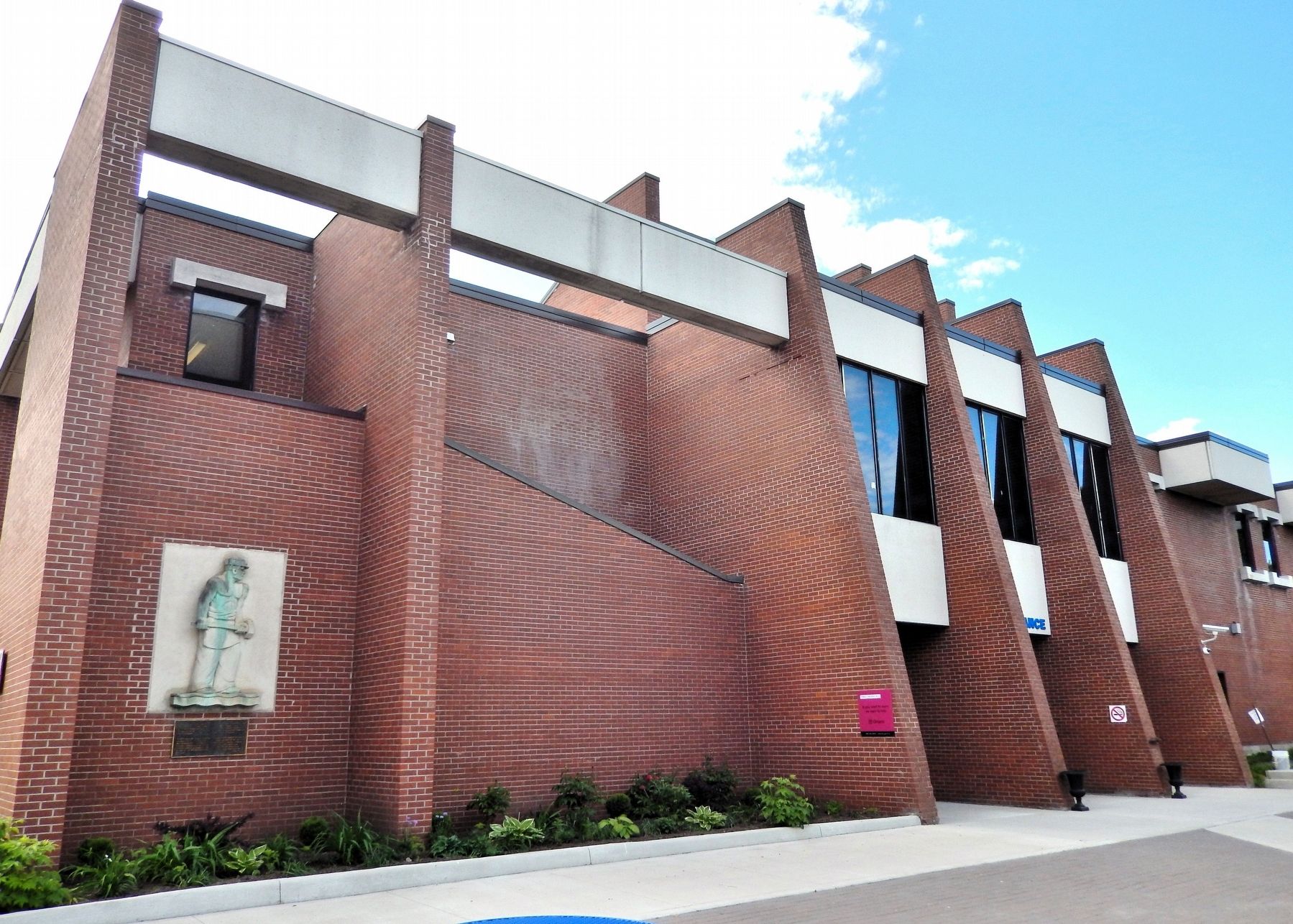
towards Hargreaves and stumbled across a quartz outcrop. It was almost dusk, but he could see free gold in reddish feldspar porphyry. The next day, they staked three claims, two of which turned out to be directly on the fault line of the area. The ground staked by Wright and Hargreaves eventually became three mines: Sylvanite, Lakeshore and Wright-Hargreaves. The gold extracted from these three mines totaled 13.5 million ounces.Photographed by Cosmos Mariner, June 2, 20223. Northern College Haileybury CampusThe marker and sculpture are on the southeast corner of the Northern College Haileybury Campus building, facing east.In 1936, Wright was approached by George McCullagh with the idea of acquiring two Toronto newspapers, The Globe and The Mail and Empire, and merging them. Wright went along with the plan and founded The Globe and Mail, which became Canada's national newspaper. Until it moved to its current location in the early 1970s, The Globe and Mail was published in the art deco William H. Wright Building at 140 King St. W. in Toronto's financial district, since demolished.
Credits. This page was last revised on July 5, 2026. It was originally submitted on July 4, 2026, by Cosmos Mariner of Cape Canaveral, Florida. This page has been viewed 13 times since then. Photos: 1, 2, 3. submitted on July 5, 2026, by Cosmos Mariner of Cape Canaveral, Florida.
