Sudbury in Suffolk, England, United Kingdom — Northwestern Europe (the British Isles)
A Short History of Beautiful Sudbury
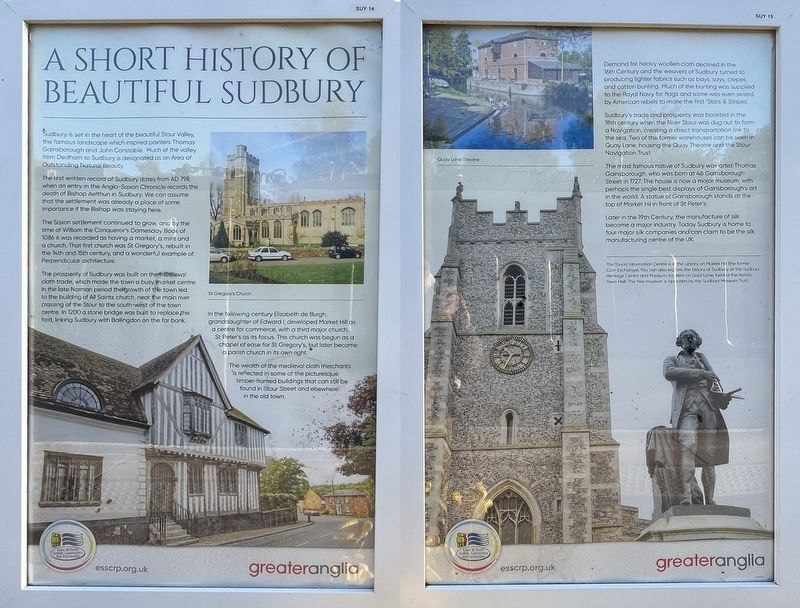
Photographed by Ray Gurganus, April 18, 2026
1. A Short History of Beautiful Sudbury Marker
The first written record of Sudbury dates from AD 798 when an entry in the Anglo-Saxon Chronicle records the death of Bishop Aelthun in Sudbury. We can assume that the settlement was already a place of some importance if the Bishop was staying here.
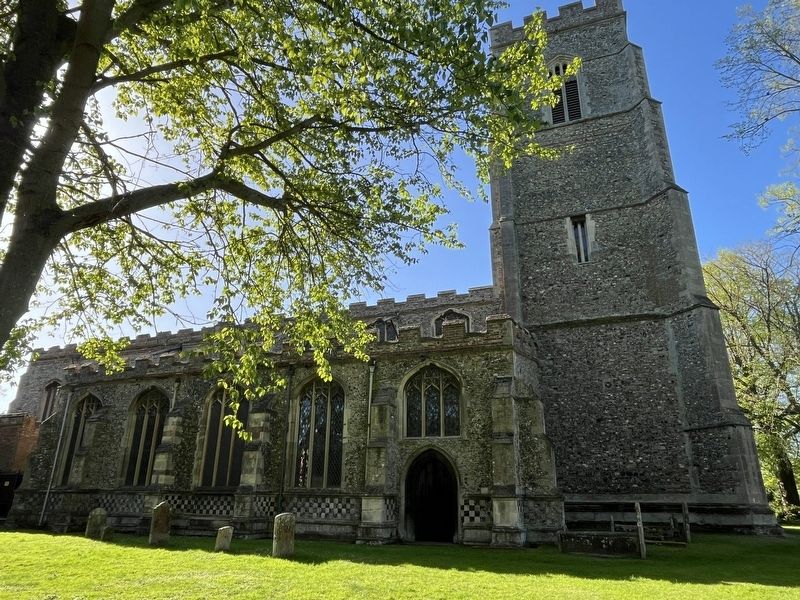
The Saxon settlement continued to grow and by the time of William the Conqueror's Domesday Book of 1086 it was recorded as having a market, a mint and a church. That first church was St Gregory's, rebuilt in the 14th and 15th century, and a wonderful example of Perpendicular architecture.
The property of Sudbury was built on the medieval cloth trade, which mode the town a busy market centre. In the late Norman period the growth of the town led to the building of All Saints church, near the main river crossing of the Stour to the south-west of the town centre. In 1200 a stone bridge was built to replace the ford, linking Sudbury
this page online
In the following century Elizabeth de Burgh, grand daughter of Edward I developed Market Hill as a centre for commerce, with a third major church St Peters as its focus. This church was begun as a chapel of ease for St Gregory's, but later became a parish church in its own right.
The wealth of the medieval cloth merchants is reflected in some of the picturesque timber-framed buildings that can still be found in Stour Street and elsewhere in the old town.
Demand for heavy wooden cloth declined in the 16th Century and the weavers of Sudbury turned to producing lighter fabrics such as bays, says, crepes and cotton bunting. Much of the bunting was supplied to the Royal Navy for flags and some was even seized by American rebels to make the first 'Stars & Stripes'.
Sudbury's trade and prosperity was boosted in the 18th century when the River Stour was dug out to form a Navigation, creating a direct transportation link so the sea Two of the former warehouses can be seen in Quay Lane, housing the Quay Theatre and the Stour Navigation Trust.
The most famous native of Sudbury was artist Thomas Gainsborough,
Photographed by Ray Gurganus, April 18, 2026
2. St Gregory's Church
Later in the 19th Century, the manufacture of silk become a major industry. Today Sudbury is home to four major silk companies and can claim to be the silk manufacturing centre of the UK.
Erected by Greater Anglia.
Topics. This historical marker is listed in these topic lists: Industry & Commerce • Religion & Religious Structures • Settlements & Settlers.
Location. 52° 2.179′ N, 0° 44.137′ E. Marker is in Sudbury, England, in Suffolk. It can be reached from Cornard Road. On the train station platform. Touch for map. Marker is at or near this postal address: 32 Cornard Road, Sudbury, England CO10 2RD, United Kingdom. Touch for directions.

Regionally, this marker is in England’s East Anglia. Globally, it is on the Atlantic Ocean, in the North Atlantic Region, in Europe, in Atlantic Europe, on one of the British Isles, in the Western World, and in the Anglosphere. Historically, it finds itself in what was once the Roman Empire.
Other nearby markers. At least 8 other markers are within 21 kilometers of this marker, measured as the crow flies: Sudbury Station (about 90 meters away, measured in a direct line); Dodie Smith (1896-1990) (approx. 0.4 kilometers away); The Lady Elizabeth (approx. 0.4 kilometers away); Sudbury - the Arrival of Silk Manufacturing (approx. 0.6 kilometers away); Sudbury and the Woollen Cloth Industry (approx. 0.6 kilometers away); Thomas Gainsborough (approx. 7.6 kilometers away); The History of Chappel and Wakes Colne (approx. 12.4 kilometers away); Priory Street Bastion 5 (approx. 20.2 kilometers away). Touch for a list and map of all markers in Sudbury.
Credits. This page was last revised on July 10, 2026. It was originally submitted on July 5, 2026, by Ray Gurganus of Washington, District of Columbia. This page has been viewed 12 times since then. Photos: 1, 2. submitted on July 5, 2026, by Ray Gurganus of Washington, District of Columbia. • Andrew Ruppenstein was the editor who published this page.
