
Ipswich in Suffolk, England, United Kingdom — Northwestern Europe (the British Isles)
Gipeswic
An Anglo-Saxon Port and Town
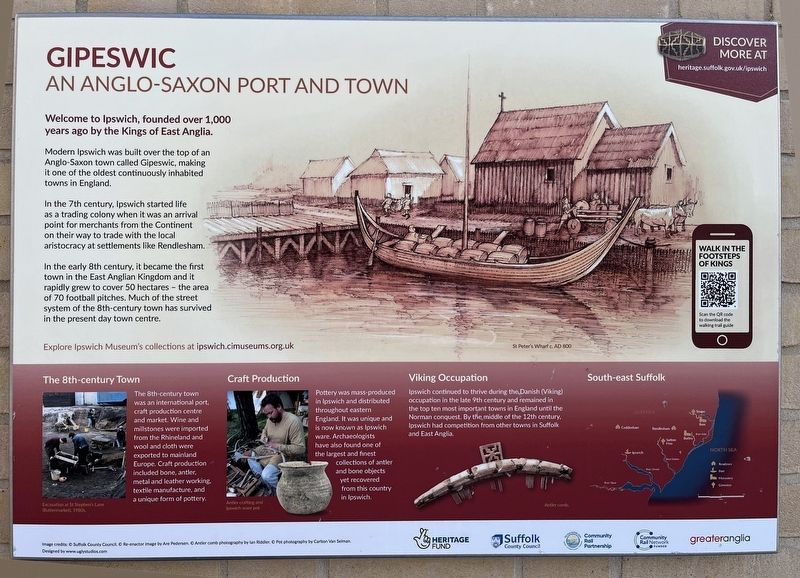
Photographed by Ray Gurganus, April 19, 2026
1. Gipeswic Marker
Modern Ipswich was built over the top of an Anglo-Saxon town called Gipeswic, making it one of the oldest continuously inhabited towns in England.
In the 7th century, Ipswich started life as a trading colony when it was an arrival point for merchants from the Continent on their way to trade with the local aristocracy at settlements like Rendlesham.
In the early 8th century, it became the first town in the East Anglian Kingdom and it rapidly grew to cover 50 hectares - the area of 70 football pitches. Much of the street system of the 8th-century town has survived in the present day town centre.
The 8th-century Town
The 8th-century town was an international port craft production centre and market. Wine and millstones were imported from the Rhineland and wool and cloth were exported to mainland Europe. Craft production included bone, antler. metal and leather working textile manufacture, and a unique form of pottery.
Craft Production
Pottery was mass-produced in Ipswich and distributed throughout eastern England. It was unique and
this page online
Viking Occupation
Ipswich continued to thrive during the Danish (Viking) occupation in the late 9th century and remained in the top ten most important towns in England until the Norman conquest. By the middle of the 12th century, Ipswich had competition from other towns in Suffolk and East Anglia.
Erected by Suffolk County Council.
Topics. This historical marker is listed in this topic list: Settlements & Settlers.
Location. 52° 3.035′ N, 1° 8.62′ E. Marker is in Ipswich, England, in Suffolk. It can be reached from Station Yard. On the train station platform. Touch for map. Marker is at or near this postal address: 29 Station Yard, Ipswich, England IP2 9AB, United Kingdom. Touch for directions.

Regionally, this marker is in England’s East Anglia. Globally, it is on the Atlantic Ocean, in the North Atlantic Region, in Europe, in Atlantic Europe, on one of the British Isles, in the Western World, and in the Anglosphere. Historically, it finds itself in what was once the Roman Empire.
Other nearby markers. At least 8 other markers are within 13 kilometers of this marker, measured as the crow flies: Ipswich (a few steps from this marker); Mary Whitmore, MBE (approx. one kilometer away); Ipswich Almshouses (approx. 1.1 kilometers away); Ipswich Blackfriars (approx. 1.1 kilometers away); Dr. Kurt Erich Glauber (approx. 2.5 kilometers away); Mistley Towers (approx. 12.5 kilometers away); Woodbridge (approx. 12.6 kilometers away); Isaac Johnson (approx. 12.6 kilometers away). Touch for a list and map of all markers in Ipswich.
Credits. This page was last revised on July 9, 2026. It was originally submitted on July 5, 2026, by Ray Gurganus of Washington, District of Columbia. This page has been viewed 13 times since then. Photo 1. submitted on July 5, 2026, by Ray Gurganus of Washington, District of Columbia. • Andrew Ruppenstein was the editor who published this page.
