Kylekiproe in Portlaoise in County Laois, Leinster, Ireland — Mid-East (and Dublin)
Portlaoise Heritage Trail
⎯⎯⎯
Slí Oidhreachta Port Laoise
Photographed by Ian Lefkowitz, May 17, 2026
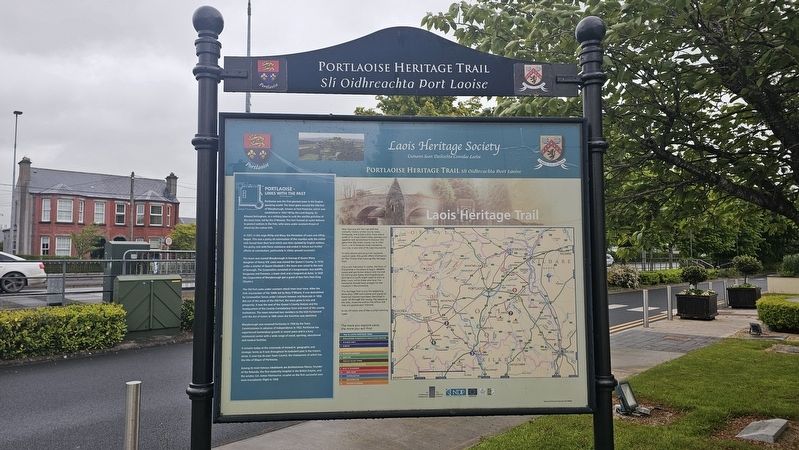
1. Portlaoise Heritage Trail / Slí Oidhreachta Port Laoise Marker
Portlaoise — Links with the Past
Old Fort of Maryborough
Portlaoise was the first planted town in the English speaking world. The town grew around the Old Fort of Maryborough, known as Fort Protector, which was established in 1547/’48 by the Lord Deputy, Sir Edward Bellingham, as a military base to curb the warlike activities of the local clans, led by the O’Moores. The Fort formed an outer defence to protect settlers in the Pale, who were under constant threat of attack by the native Irish.
In 1557, in the reign Philip and Mary, the Plantation of Laois and Offaly began. This was a policy of colonisation of the counties with the native Irish forced from their land which was then claimed by English settlers. The policy met with fierce resistance and ended in failure but further efforts at colonisation, particularly in Ulster, proved successful.
The town was named Maryborough in honour of Queen Mary, daughter of Henry VIII. Laois was named the Queen’s County. In 1570, under a charter of Queen Elizabeth I, the town was raised to the rank of borough. The Corporation consisted of a burgomaster, two bailiffs, burgesses
this page online
The Old Fort came under constant attack from local clans. After the Irish insurrection of the 1640s led by Rory O’Moore, it was demolished by Cromwellian forces under Colonels Hewson and Reycolds in 1650. But out of the ashes of the Old Fort, the town grew in size and prosperity. It was the seat of the Queen’s County Assizes and the headquarters of the County Constabulary force and most of the county institutions. The town returned two members to the Irish Parliament until the Act of Union in 1800 when the franchise was abolished.
Maryborough was renamed Portlaoise in 1920 by the Town Commissioners in advance of Independence in 1922. Portlaoise has experienced tremendous growth in recent years and is a busy commercial centre with a wide range of social, sporting, educational and medical facilities.
It remains today at the crossroads of Ireland in geographic and strategic terms as it was throughout its turbulent past in the historic sense. It now has its own Town Council, the chairperson of which has the
Photographed by Ian Lefkowitz, May 17, 2026
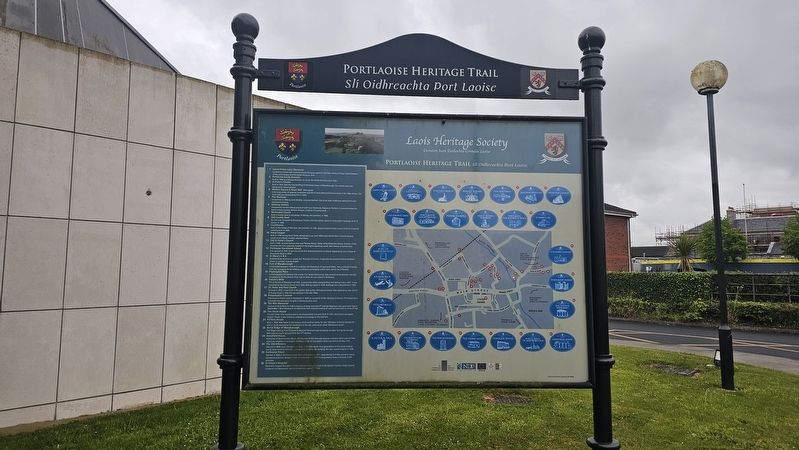
2. Portlaoise Heritage Trail / Slí Oidhreachta Port Laoise Marker
Among its most famous inhabitants are Bartholomew Mosse, founder of the Rotunda, the first maternity hospital in the British Empire, and the aviator, Col. James Fitzmaurice, co-pilot on the first successful east-west transatlantic flight in 1928.
Laois Heritage Trail
Now that you are familiar with the colourful history of the county town, Portlaoise, and know a little more about some of its more historic sites, perhaps your appetite will be whetted to discover the gems that the wider county has to offer. Laois, one of Ireland’s most interesting counties, is also one of its least discovered.
To help visitors and long-time residents explore Laois, this guide offers information on the 13 sites that make up the Heritage Trail.
If you are interested in castles, the Rock of Dunamaise is the place to begin. Wildlife lovers and sportsmen should visit the Irish Fly Fishing and Game Shooting Museum. Architecture buffs might want to start at Emo Court, while those who love fine handwork should head straight for the museum in Mountmellick.
This Heritage Trail is only the beginning. More than 1000 monuments and places of
Photographed by Ian Lefkowitz, May 17, 2026
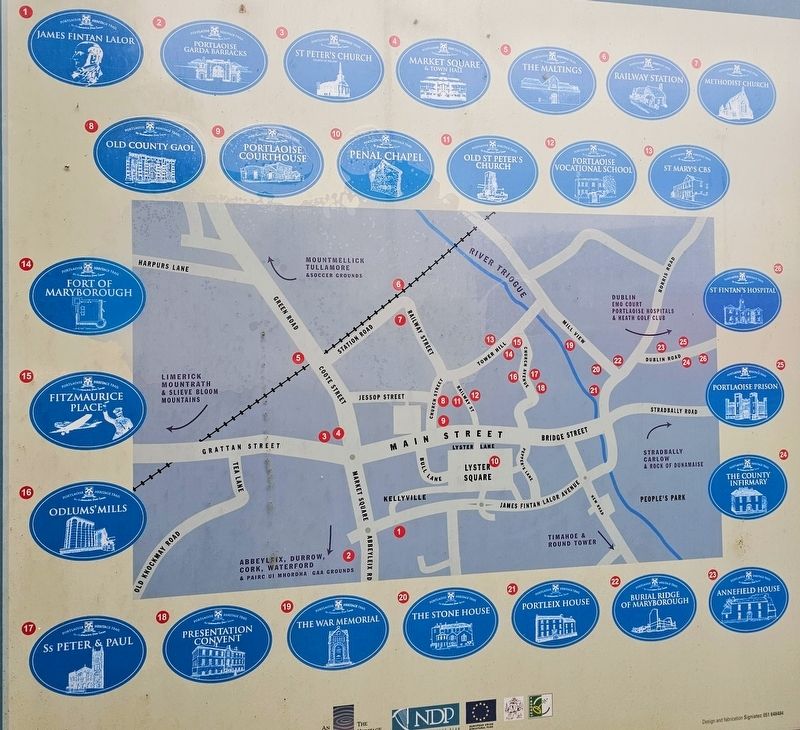
3. Portlaoise Heritage Trail Map
A closeup of the heritage trail map.
So set off down one of the county’s winding roads.
The more you explore Laois, the more you will find.
Key to Laois Heritage Trail
1. Donaghmore Workhouse & Agricultural Museum • 2. Aghaboe Abbey • 3. Durrow • 4. The Irish Fly Fishing and Game Shooting Museum • 5. Heywood Gardens • 6. Abbeyleix • 7. Timahoe Round Tower • 8. Stradbally Steam Museum • 9. Rock of Dunamaise • 10. Emo Court • 11. Portarlington • 12. Mountmellick • 13. The Poet’s Cottage
(Side Two)
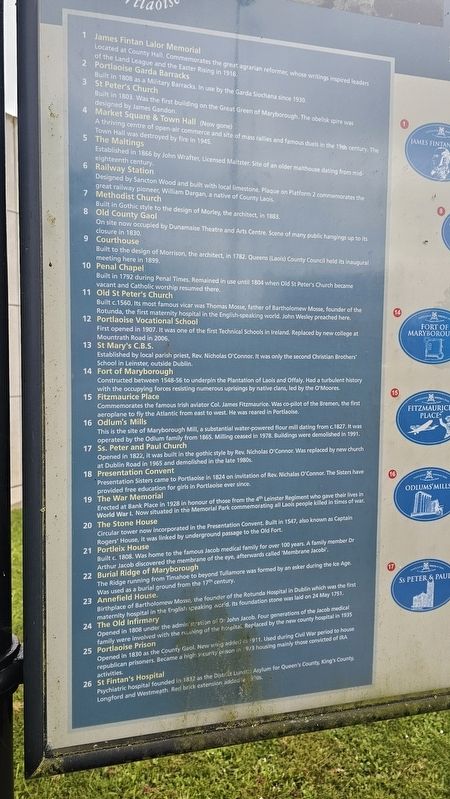
1 James Fintan Lalor Memorial
Located at County Hall. Commemorates the great agrarian reformer, whose writings inspired leaders of the Land League and the Easter Rising in 1916.
2 Portlaoise Garda Barracks
Built in 1808 as a Military Barracks. In use by the Garda Síochána since 1930.
3 St Peter’s Church
Built in 1803. Was the first building on the Great Green of Maryborough. The obelisk spire was designed by James Gandon.
4 Market Square & Town Hall (Now gone)
A thriving centre of open-air commerce and site of mass rallies and famous
Photographed by Ian Lefkowitz, May 17, 2026
4. Portlaoise Heritage Trail Legend
A close-up of the text included in the legend.
5 The Maltings
Established in 1866 by John Wrafter, Licensed Maltster. Site of an older malthouse dating from mid-eighteenth century.
6 Railway Station
Designed by Sancton Wood and built with local limestone. Plaque on Platform 2 commemorates the great railway pioneer, William Dargan, a native of County Laois.
7 Methodist Church
Built in Gothic style to the design of Morley, the architect, in 1883.
8 Old County Gaol
On site now occupied by Dunamaise Theatre and Arts Centre. Scene of many public hangings up to its closure in 1830.
9 Courthouse
Built to the design of Morrison, the architect, in 1782. Queens (Laois) County Council held its inaugural meeting here in 1899.
10 Penal Chapel
Built in 1792 during Penal Times. Remained in use until 1804 when Old St Peter’s Church became vacant and Catholic worship resumed there.
11 Old St Peter’s Church
Built c.1560. Its most famous vicar was Thomas Mosse, father of Bartholomew Mosse, founder of the Rotunda, the first maternity hospital in the English-speaking world. John Wesley preached here.
12 Portlaoise Vocational School
First opened in 1907. It was one of the first Technical Schools in Ireland. Replaced by new college at Mountrath Road in 2006.
13 St Mary’s C.B.S.
Established by local parish priest, Rev. Nicholas O’Connor. It was only the second Christian Brothers’ School in Leinster, outside Dublin.
14 Fort of Maryborough
Constructed between 1548–56 to underpin the Plantation of Laois and Offaly. Had a turbulent history with the occupying forces resisting numerous uprisings by native clans, led by the O’Moores.
15 Fitzmaurice Place
Commemorates the famous Irish aviator Col. James Fitzmaurice. Was co-pilot of the Bremen, the first aeroplane to fly the Atlantic from east to west. He was reared in Portlaoise.
16 Odlum’s Mills
This
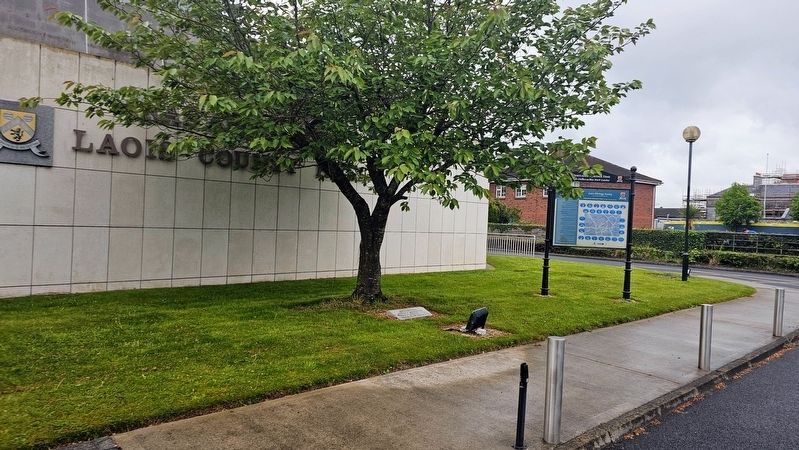
Photographed by Ian Lefkowitz, May 17, 2026
5. Portlaoise Heritage Trail Marker
The marker is located outside the Laois County Council building.
17 Ss. Peter and Paul Church
Opened in 1822, it was built in the gothic style by Rev. Nicholas O’Connor. Was replaced by new church at Dublin Road in 1965 and demolished in the late 1980s.
18 Presentation Convent
Presentation Sisters came to Portlaoise in 1824 on invitation of Rev. Nicholas O’Connor. The Sisters have provided free education for girls in Portlaoise ever since.
19 The War Memorial
Erected at Bank Place in 1928 in honour of those from the 4th Leinster Regiment who gave their lives in World War I. Now situated in the Memorial Park commemorating all Laois people killed in times of war.
20 The Stone House
Circular tower now incorporated in the Presentation Convent. Built in 1547, also known as Captain Rogers’ House, it was linked by underground passage to the Old Fort.
21 Portleix House
Built c. 1808. Was home to the famous Jacob medical family for over 100 years. A family member Dr Arthur Jacob discovered the membrane of the eye, afterwards called ‘Membrane Jacobi’.
22 Burial Ridge of Maryborough
The Ridge running from Timahoe to beyond Tullamore was formed by an esker during the Ice Age. Was used as a burial ground from the 17th century.
23 Annefield House
Birthplace of Bartholomew Mosse, the founder of the Rotunda Hospital in Dublin which was the first maternity hospital in the English-speaking world. Its foundation stone was laid on 24 May 1751.
24 The Old Infirmary
Opened in 1808 under the administration of Dr John Jacob. Four generations of the Jacob medical family were involved with the running of the hospital. Replaced by the new county hospital in 1935.
25 Portlaoise Prison
Opened in 1830 as the County Gaol. New wing added in 1911. Used during Civil War period to house republican prisoners. Became a high security prison in 1973 housing mainly those convicted of IRA activities.
26 St Fintan’s Hospital
Psychiatric hospital founded in 1832 as the District Lunatic Asylum for Queen’s County, King’s County, Longford and Westmeath. Red brick extension added in 1900s.
Erected by Laois Heritage Society.
Topics. This historical marker is listed in this topic list: Notable Places. A significant historical date for this entry is May 24, 1751.
Location. 53° 1.931′ N, 7° 18.092′ W. Marker is in Portlaoise, Leinster, in County Laois. It is in Kylekiproe. It is at the intersection of James Fintan Lalor Avenue and Abbeyleix Road, on the left when traveling west on James Fintan Lalor Avenue. Touch for map. Marker is at or near this postal address: 1 James Fintan Lalor Avenue, Portlaoise, Leinster, Ireland. Touch for directions.

Regionally, it is on the Atlantic Ocean, in the North Atlantic Region, in Europe, on the Island of Ireland, on the Celtic Fringe, in the European Union, in Atlantic Europe, on one of the British Isles, in the Western World, and in the Anglosphere.
Other nearby markers. At least 8 other markers are within walking distance of this marker: James Fintan Lalor (a few steps from this marker); Main Street / Príomhshráid (about 180 meters away, measured in a direct line); St Peter's Church (about 210 meters away); Portlaoise Courthouse (approx. 0.2 kilometers away); Old County Gaol (approx. 0.3 kilometers away); Old St Peter’s Church (approx. 0.3 kilometers away); Portlaoise Vocational School (approx. 0.4 kilometers away); Dún Phort Laoise / The Fort of Portlaoise (approx. 0.4 kilometers away). Touch for a list and map of all markers in Portlaoise.
Also see . . . Portlaoise Heritage Trail Leaflet (.pdf). (Submitted on July 5, 2026, by Ian Lefkowitz of New York, New York.)
Credits. This page was last revised on July 8, 2026. It was originally submitted on July 5, 2026, by Ian Lefkowitz of New York, New York. This page has been viewed 16 times since then. Photos: 1, 2, 3, 4, 5. submitted on July 5, 2026, by Ian Lefkowitz of New York, New York. • Andrew Ruppenstein was the editor who published this page.
