The Hattiesburg Train Depot
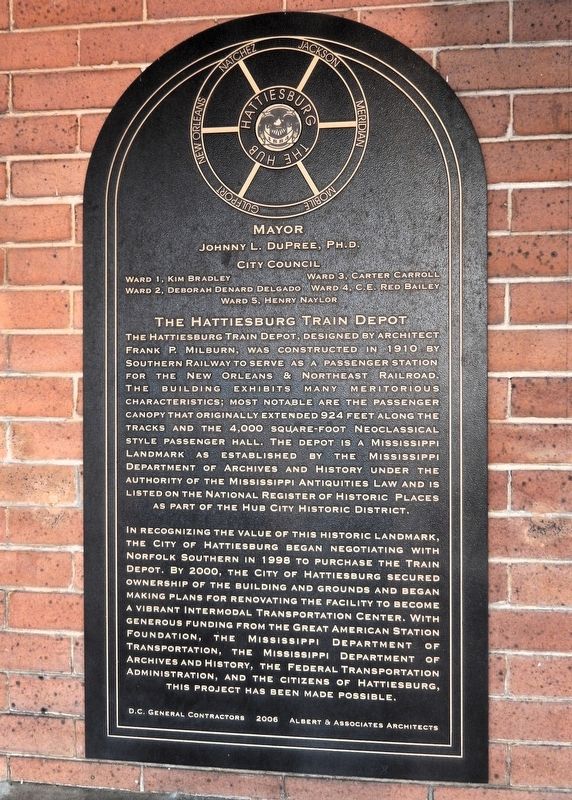
The Hub
• New Orleans • Natchez • Jackson • Meridian • Mobile • Gulfport •
Mayor
Johnny L. Dupree, Ph.D.
City Council
Ward 1, Kim Bradley • Ward 2, Deborah Denard Delgado • Ward 3, Carter Carroll •
Ward 4, C.E. Red Bailey • Ward 5, Henry Naylor
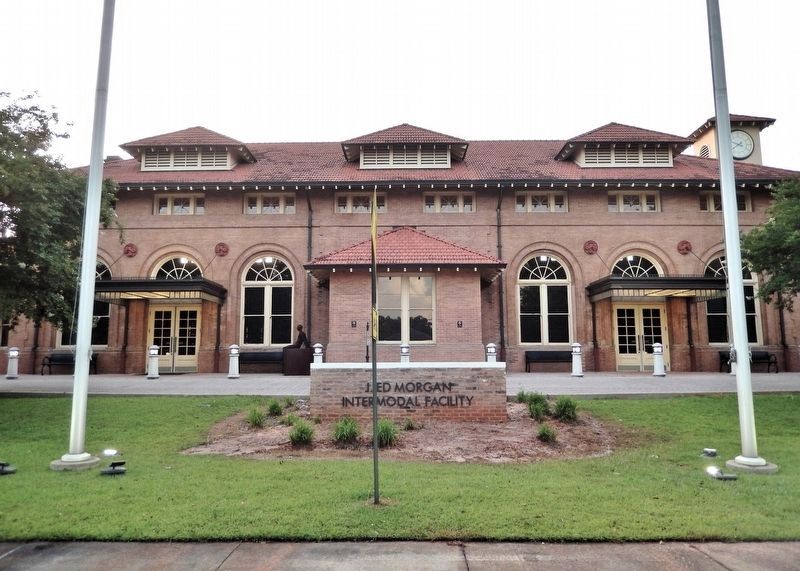
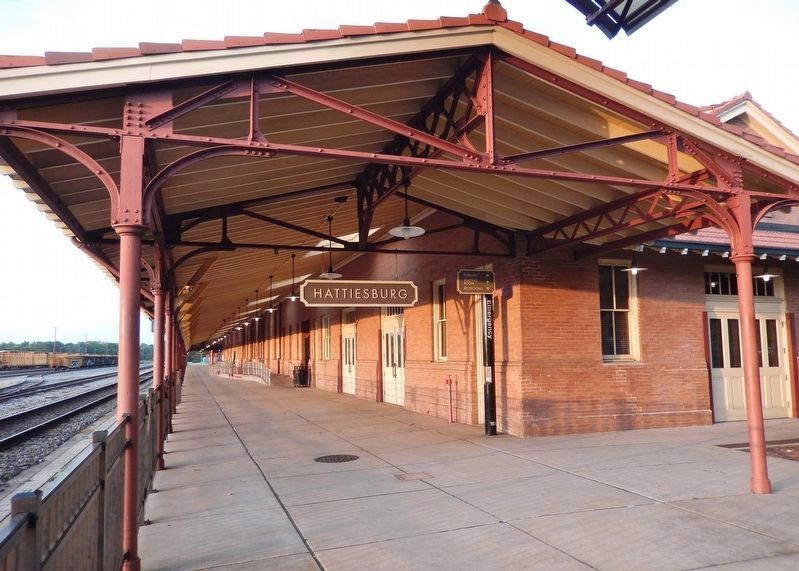
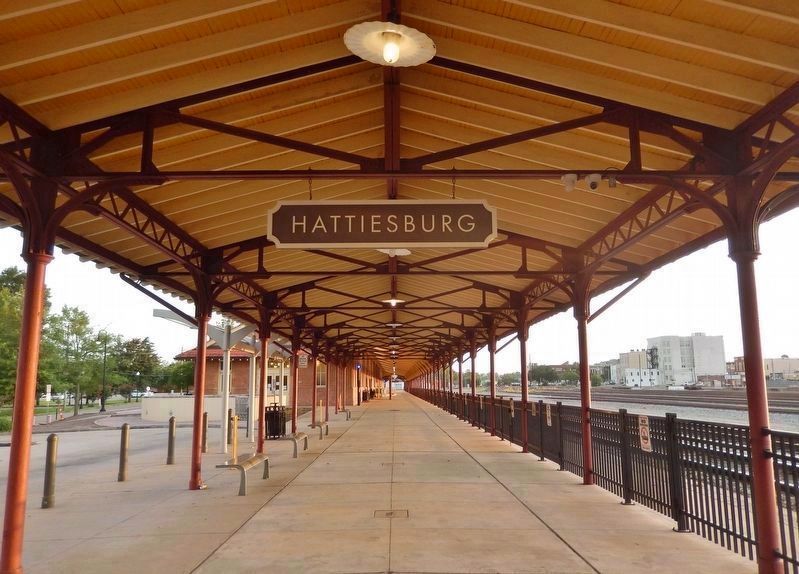
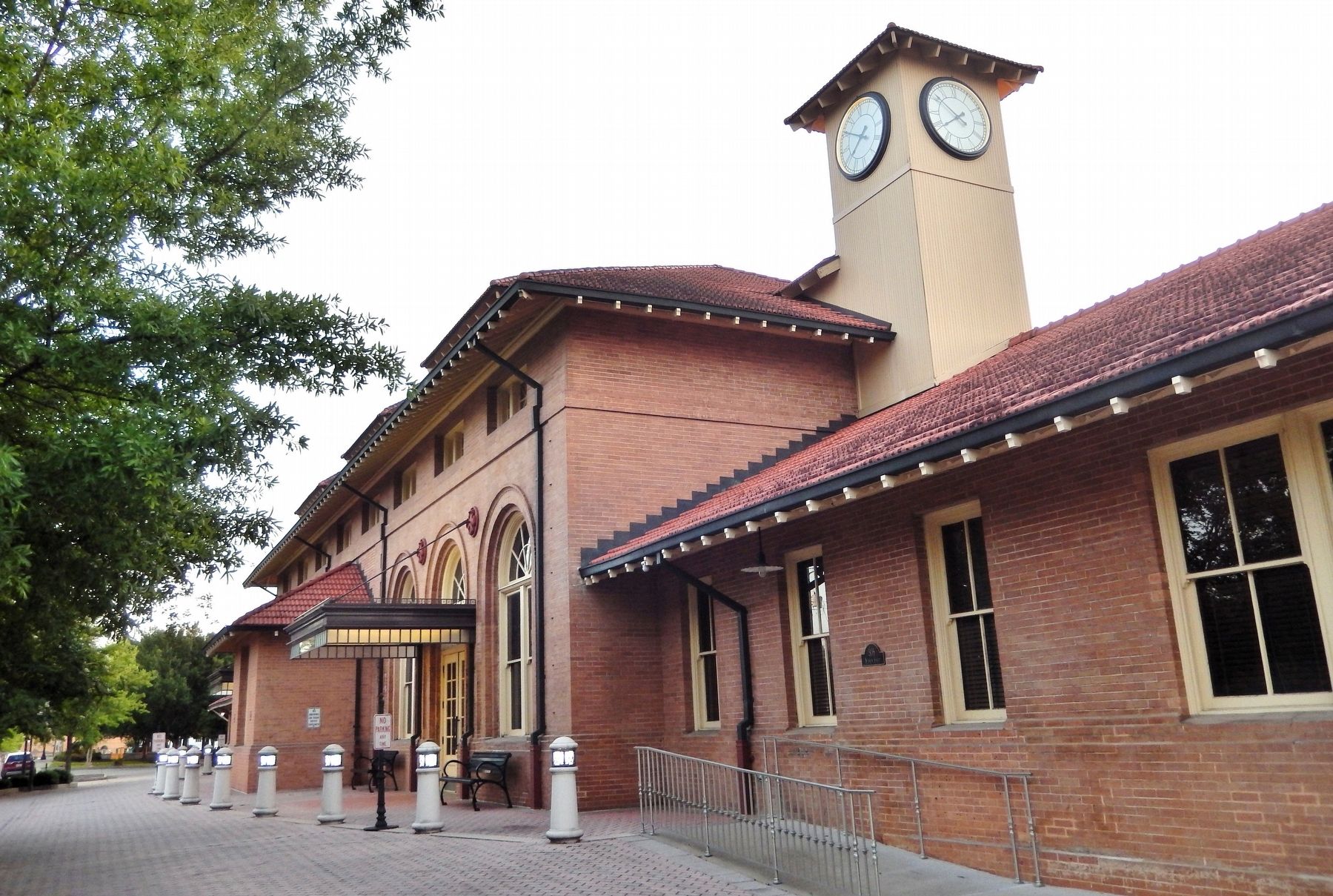
The Hattiesburg Train Depot, designed by architect Frank P. Milburn, was constructed in 1910 by Southern Railway to serve as a passenger station for the New Orleans & Northeast Railroad. The building exhibits many meritorious characteristics; most notable are the passenger canopy that originally extended 924 feet along the tracks and the 4,000 square–foot Neoclassical style passenger hall. The depot is a Mississippi Landmark as established by the Mississippi Department of Archives and History under the authority of the Mississippi Antiquities Law and is listed on the National Register of Historic Places as part of the Hub City Historic District.
In recognizing the value of this historic landmark, the City of Hattiesburg began negotiating with Norfolk Southern in 1998 to purchase the train depot. By 2000, the City of Hattiesburg secured ownership of the building and grounds and
this page online
D.C. General Contractors 2006 Albert & Associates Architects
Erected by City of Hattiesburg.
Topics and series. This historical marker is listed in these topic lists: Architecture • Industry & Commerce • Notable Buildings • Railroads & Streetcars. In addition, it is included in the National Register of Historic Places (NRHP) series list. A significant historical year for this entry is 1910.
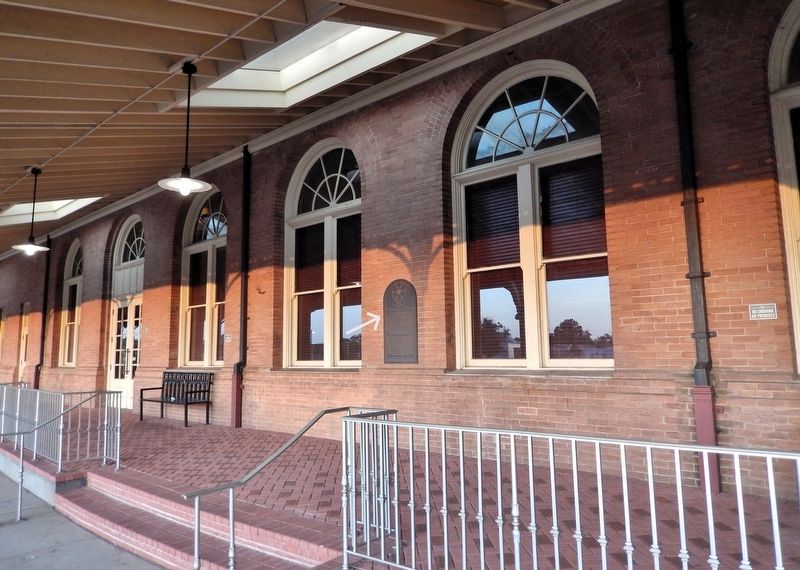
Location. 31° 19.627′ N, 89° 17.189′ W. Marker is in Hattiesburg, Mississippi, in Forrest County. It can be reached from the intersection of Newman Street and River Avenue. The marker is mounted roughly at the center of the northwest or "track side" of the station. Touch for map. Marker is at or near this postal address: 308 Newman Street, Hattiesburg MS

Regionally, this marker is in Mississippi’s Pine Belt. It is also in the American South, specifically in the Deep South, and in the Piney Woods. Globally, it is in North America, a Gulf of Mexico state, the Western Hemisphere, the Western World, and the Anglosphere. Historically, it finds itself in what was once New Spain, the territory of the Mississippian Culture, one of the Confederate States of America, and the Antebellum South.
Other nearby markers. At least 8 other markers are within walking distance of this marker: Pittman Park (approx. 0.2 miles away); Saenger Theatre (approx. ¼ mile away); Vernon Ferdinand Dahmer, Sr. (approx. ¼ mile away); William Harris Hardy (approx. 0.3 miles away); Old Federal Building (approx. 0.3 miles away); Forrest County Confederate Monument (approx. 0.3 miles away); a different marker also named William Harris Hardy (approx. 0.3 miles away); Hattiesburg (approx. 0.4 miles away). Touch for a list and map of all markers in Hattiesburg.
Regarding The Hattiesburg Train Depot. Contributing property, Hub City Historic District,
From the National Register Nomination prepared by Jody Cook, 4/30/1980:
The Hub City Historic District reflects Hattiesburg’s evolution from depot stop to regional center of southeast Mississippi. Architecturally and historically, the city's most significant era lasted from the 1890s until 1930, and the district retains its historical associations and variety of building styles representative of this period.
Surveyors for the New Orleans and Northeastern Railroad located a depot site south of the Leaf and Bowie River confluence, a location known as Twin Forks and later as Gordon's Station. Under the influence of William H. Hardy, founder of the New Orleans and Northeastern Railroad, the new town was named Hattiesburg, in honor of Hardy's wife Hattie.
Hattiesburg experienced a slow but continuous growth following the New Orleans and Northeastern's arrival in 1883 and incorporated in 1884. At this time, the town had no manufacturing plants; farming, cattle raising, trapping and logging were the principal occupations. The boom period for Hattiesburg began in the 1890s with the realizationthat southeast Mississippi had a major natural resource to be exploited. It was the existence of an extensive timber market that initiated the construction of the New Orleans and Northeastern Railroad, one of the State's first locally controlled lines, built to serve local needs.Photographed by Cosmos Mariner, June 20, 20254. Hattiesburg Train Depot: Great HallNow an elegant events venue available for rentals.
By 1912, Hattiesburg, the “metropolis of South Mississippi,” boasted Mississippi's largest machine works, two railroad shops, two foundries, two steam laundries and a variety of smaller industries. With the completion of the Gulf and Ship Island Railroad in 1897, Hattiesburg finally had a direct link with a deep-water port. Efforts began as early as the 1850s to construct a railroad north from the Mississippi Coast but were thwarted by numerous problems. Captain William H. Hardy revived the project in 1886, but the Gulf and Ship Island's completion was primarily achieved by Captain Joseph R. Jones. Gulfport had been chosen as the Gulf Coast's most suitable location to unite the Piney Woods with deep water, and by 1911 was shipping more yellow pine than any port in the world.
Hattiesburg became the producing area's transportation and distribution center aroundwhich revolved the nation's softwood lumber industry. From the Hub City, rail routes penetrating the major timber producing areas were the Mobile, Jackson and Kansas City (1903), later Bonhomie and Hattiesburg Southern, and the Mississippi Central (1906).Photographed by Cosmos Mariner, June 20, 20255. Hattiesburg Train Depot: south end of the platform
Also see . . .
1. Hattiesburg, MS (HBG) (The Great American Stations).
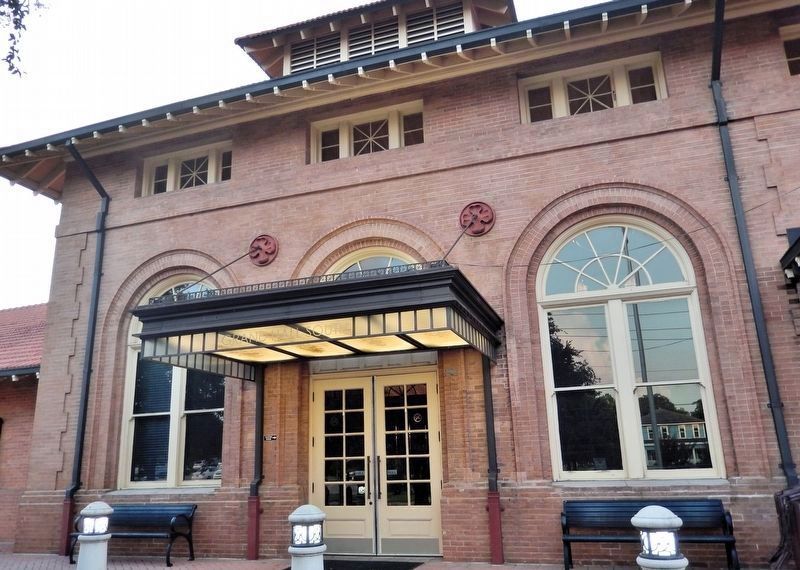
Excerpt: Named "Hub City" for its location at the crossing of rail lines, Hattiesburg boomed as the center of the local lumber industry. The historic 1910 depot underwent a full rehabilitation in the early 2000s.(Submitted on July 7, 2026, by Cosmos Mariner of Cape Canaveral, Florida.)The 14,000-square-foot brick Hattiesburg depot was completed in 1910 by the Southern Railway. One of the larger and more elaborate surviving passenger depots in Mississippi, the station has been in continuous use since it first opened. It was built in an Italian Renaissance style with large round-arched windows and a hipped roof clad in clay tile and tin, and it was noted for its 924-foot-long canopy, which was partially removed in 1958. The depot is located in the Newman-Buschman Railroad Historic District, the city’s oldest neighborhood and once the site of the Newman Lumber Company.
Photographed by Cosmos Mariner, June 20, 20256. Hattiesburg Train Depot: 924-foot Passenger CanopyThe massive depot is so far from this (north) end of the platform that it appears tiny in the distant left background!Phase I consisted of restoration of the clay roof tiles, dormers and skylights. Phase II focused on interior restoration of the ornamental plaster, original flooring and other historic features while making the building more accessible. Phase III included extending the platform canopy to its original 924-foot length, adding additional parking and landscaping, and realigning the local traffic patterns surrounding the depot to help repurpose it as an intermodal transportation center. Special attention was given to the Grand Hall, a double-height room lined with pilasters topped with Corinthian capitals. This beautiful space was converted into an events venue that’s available for rentals throughout the year. The restored building was rededicated on April 21, 2007, celebrated with a black-tie gala event the night before. The rehabilitation work cost $10 million and took five years to complete.
2. Hattiesburg Train Depot (VisitHattiesburg.Org).
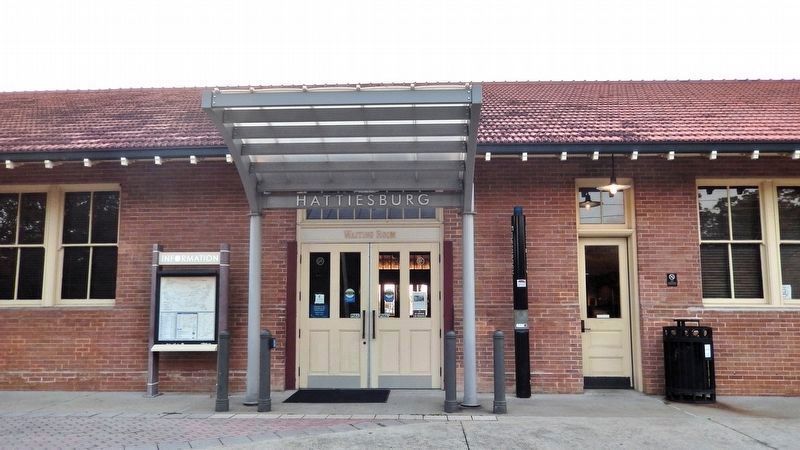
Excerpt: The Hattiesburg Train Depot is an icon for Hattiesburg, the Hub City Today, the train depot(Submitted on July 7, 2026, by Cosmos Mariner of Cape Canaveral, Florida.)remains one of the most unique sites to hold events. In 1910, Southern Railway Company constructed its Hattiesburg Depot in the Italian Renaissance style capped with a clay tile roof. Its 14,000 square-foot interior includes a 4,000 square-foot passenger waiting room. The loading platform was nearly three city block long and was covered by a 924-foot-long canopy. It was the largest and most architecturally significant of the city’s three passenger depots and would remain in continuous use from that point on. The restored Hattiesburg Depot was rededicated in April 2007 to function as an intermodal transportation center for rail, bus and taxi service.Photographed by Cosmos Mariner, June 20, 20257. Hattiesburg Train Depot: Active Amtrack Passenger Terminal
Credits. This page was last revised on July 7, 2026. It was originally submitted on July 6, 2026, by Cosmos Mariner of Cape Canaveral, Florida. This page has been viewed 15 times since then. Photos: 1, 2, 3, 4, 5, 6, 7, 8. submitted on July 7, 2026, by Cosmos Mariner of Cape Canaveral, Florida.
