De Cocksdorp in Texel, North Holland, Netherlands — Northwestern Europe
RK kerk
⎯⎯⎯
Roman Catholic Church

Photographed by Andrew Ruppenstein, June 1, 2026
1. RK kerk / Roman Catholic Church Marker
Note that: 1) The small text in the upper left is repeated on all 12+ similar markers in De Cocksdorp as it is, effectively, the origin story of the area, and 2) the URL provided on the marker seemingly does not work.

In de periode dat Eierland werd aangelegd, rond 1835, had de RK kerkgemeenschap in De Cocksdorp én in de polder 70 leden. Dat jaar gaf de regering toestemming tot de bouw van een RK kerk en schonk een subsidie van 4.000 gulden, maar de leden hadden onvoldoende eigen middelen. Daardoor kon de bouw pas beginnen in 1876.
De polder Eierland is in 1835 ontstaan na bedijking van het Buitenveld, een kwelder oostelijk gelegen van de Zanddijk.
Deze stuifdijk werd ca. 1630 met gebruik van gevlochten matten van rijshout aangelegd tussen de duinen van de Koog en het voormalig eilandje Eyerland.
Deze zanddijk en de polder boven de Ruigendijk bepaalden de vorm yan Texel.
Roman Catholic Church
Around 1835, when the Eierland polder was being created, the Roman Catholic community in De Cocksdorp and the polder itself comprised 70 members. That year, the government authorized the construction of a Roman Catholic church and provided a subsidy of 4,000 guilders, but the members lacked sufficient funds of their own. Consequently, construction could not begin until 1876.
The Eierland
this page online
This sand dike was constructed around 1630—using woven brushwood mats—between the dunes of De Koog and the former small island of Eyerland.
This sand dike and the polder situated above the Ruigendijk determined the shape of Texel.
Topics. This historical marker is listed in this topic list: Religion & Religious Structures. A significant historical year for this entry is 1835.
Location. 53° 9.29′ N, 4° 52.179′ E. Marker is in De Cocksdorp, Noord-Holland (North Holland), in Texel. It is at the intersection of Molenlaan and Klimpstraat, on the right when traveling south on Molenlaan. Touch for map. Marker is at or near this postal address: Molenlaan 4, De Cocksdorp, Noord-Holland 1795 AM, Netherlands. Touch for directions.

Regionally, this marker is on the German Wadden Sea. Globally, it is in Europe, the European Union, Atlantic Europe, the Benelux Low Countries, the Schengen Area, Western Europe, and the Western World. Historically, it finds itself in what was once the Holy Roman Empire.
Other nearby markers. At
Photographed by Andrew Ruppenstein, June 1, 2026
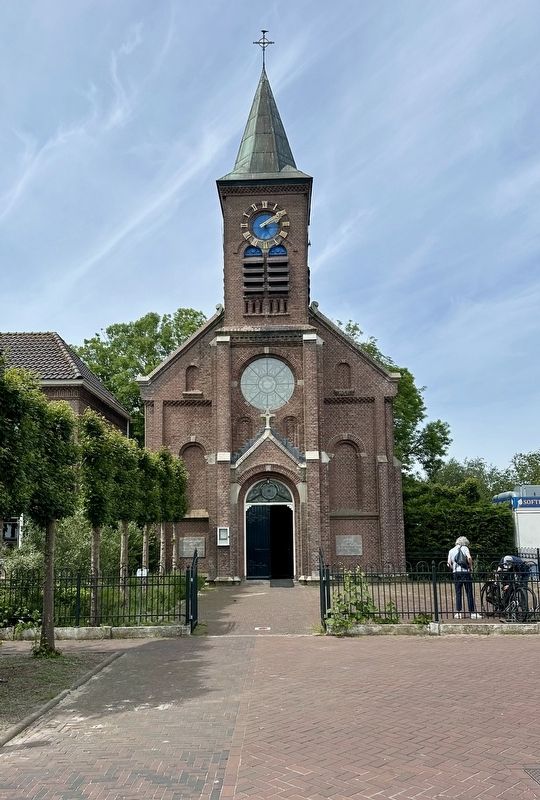
2. RK kerk / Roman Catholic Church and marker
The marker is visible here behind the fence, to the left of the gate.
Also see . . . Francisca Romanakerk (Wikipedia, in Dutch). Excerpt (in translation:)
The Francisca Romana Church is a 19th-century Roman Catholic church in De Cocksdorp on Texel, belonging to the Diocese of Haarlem-Amsterdam.(Submitted on July 7, 2026.)
The architect of the new church was G. Bijvoets from Amsterdam. On October 26, 1875, the contract was awarded to builder Leendert van der Ploeg Johzn. from Zierikzee for 20,980 guilders. Construction began in late March 1876. The parish priest overseeing the project was Joannes Antonius Scholte. The foundation stone was laid on July 18, 1876, by Dean A.G. Schweitzer, who subsequently blessed the church on August 7, 1877. The church was dedicated to Francisca Romana—a choice based on the name of the wife of Nicolas Joseph de Cock, one of the initiators of the Eierland polder project; her name was Francisca Theresia Isabella.
During the Georgian Uprising, the church—like the rectory—was severely damaged on April 8, 1945; repair costs amounted to 46,249 guilders. On March 22, 2002, the parish of De Cocksdorp was merged with those of Den Burg and Oudeschild to form the new Roman Catholic Parish of Texel.
Photographed by Andrew Ruppenstein, June 1, 2026
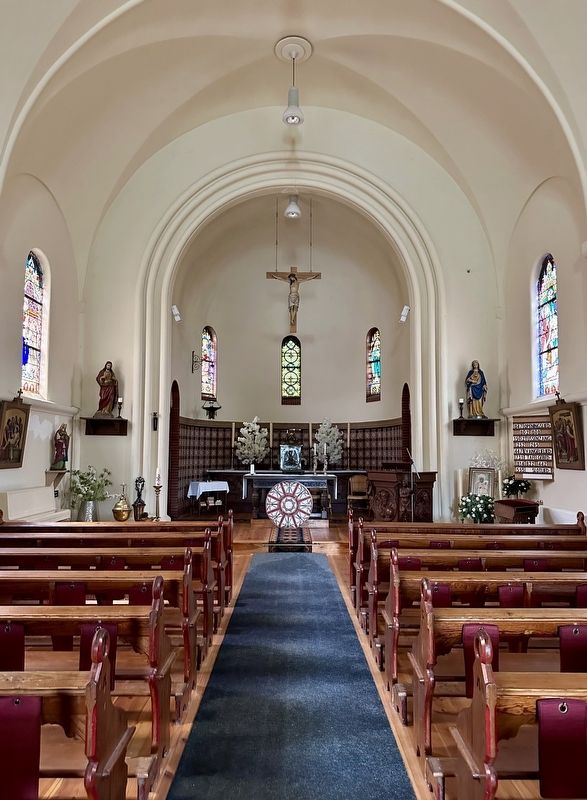
3. RK kerk / Roman Catholic Church - interior
courtesy Noord-Hollands Archief, circa 1910
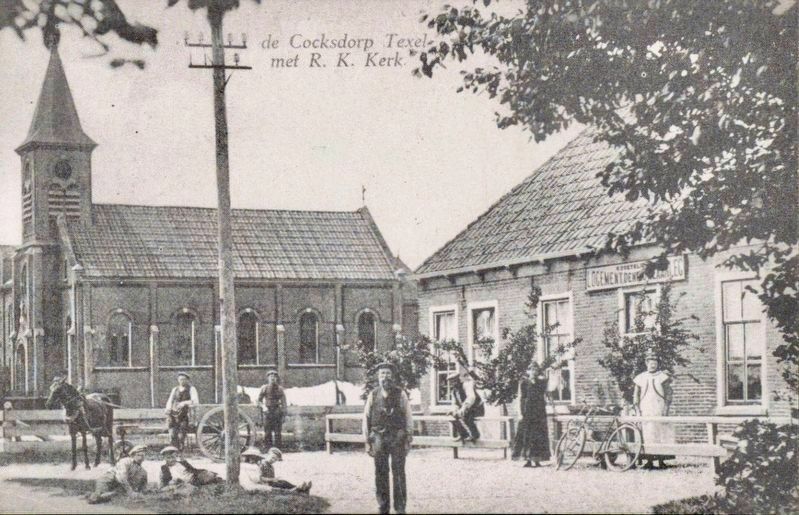
4. De Cocksdorp, Texel, with RK Kerk / Roman Catholic Church
Credits. This page was last revised on July 7, 2026. It was originally submitted on July 7, 2026, by Andrew Ruppenstein of Lamorinda, California. This page has been viewed 14 times since then. Photos: 1, 2, 3, 4. submitted on July 7, 2026, by Andrew Ruppenstein of Lamorinda, California.
