Mountain Creek in Dallas in Dallas County, Texas — The American South (West South Central)
Jangjin (Chosin) Reservoir Battle
27 Nov. 1950 – 10 Dec. 1950

Photographed by James Hulse, July 3, 2026
1. Jangjin (Chosin) Reservoir Battle Marker
This monument is dedicated to the United Nations forces that participated in one of the most epic battles in history. If this battle had been lost, the Republic of Korea would have been doomed to Communist rule.
Chinese leadership believed if their forces could annihilate the 1st Marine Division, elements of the 7th U.S. Army Division, and 41 Independent Commando, British Royal Marines, which were deployed around the Jangjin (Chosin) Reservoir, the United Nations would abandon the fight for the freedom of Korea.
When the battle started, U.N. forces were scattered over a distance of some 40 miles with major concentrations at five locations: east of Jangjin (Chosin), Yudam-ni, Toktong Pass, Hagaru-ri, and Koto-ri. Major support was at Hamhung, 78 miles away from the forward-most units. Two major factors helped determine the outcome. First was the around-the-clock U.N. air support provided from distant air bases and Navy carriers in unprecedented bad weather. More importantly, the courage, steadfastness, and determination displayed by the embattled U.N. ground forces won the day.
Seventeen Medals of Honor were earned
this page online
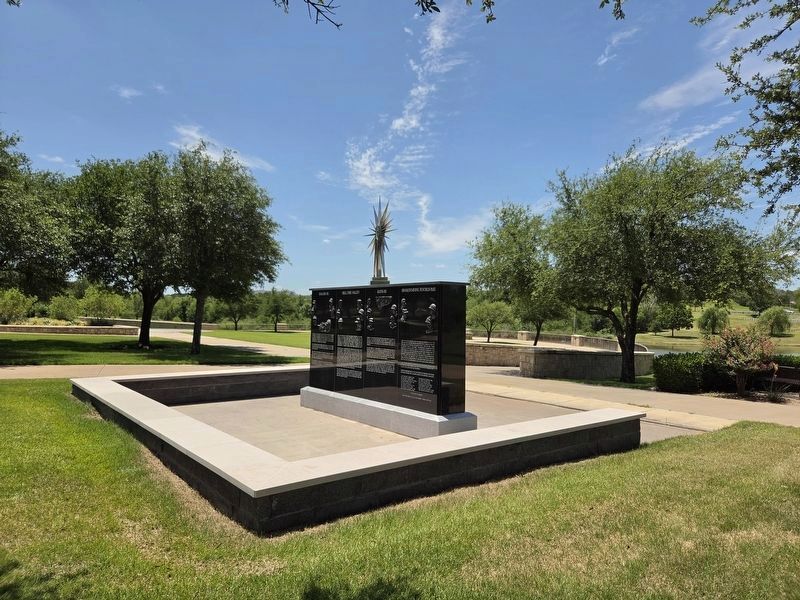
The Star of Koto-ri tops the monument. Many Marines believe the star indicated divine intervention, and it became the logo of the survivors of the battle who call themselves "The Chosin Few."
"We few, we Chosin few, we eternal band of brothers."
East of Jangjin (Chosin)
On the night of 27 November 1950, on the eastern shore of the Jangjin (Chosin) Reservoir, units of the 31st Regimental Combat Team (RCT-31), consisting of elements of the 31st and 32nd Regiments of the 7th Infantry Division of the U.S. Army, were attacked by an estimated 20,000 Chinese. RCT-31 had two infantry battalions available and about 800 Korean military attached (KATUSA), as well as artillery, tanks, mortars, and anti-aircraft vehicles. These forces were deployed over a distance of about 10 miles and were consolidating when their regimental commander was killed.
LTC Don Faith, USA, took command and, on 1 December, reorganized the unit as a truck

Photographed by James Hulse, July 3, 2026
2. Jangjin (Chosin) Reservoir Battle Marker - Reverse Side
The Star of Koto-ri is located on the top the monument.
Yudam-ni
At Yudam-ni on the night of 27 November 1950, the temperature dropped to 30 degrees below zero. The 5th and 7th Marines of the 1st Marine Division were suddenly surrounded and repeatedly attacked by nearly four Chinese divisions.
The fight at Yudam-ni continued until 1 December when the Marines were ordered to break out by attacking 14 miles south to Hagaru-ri. In this effort, the famous Marine saying of "Every Man a Rifleman" was proven. Every Marine, from every military occupational specialty, fought through numerous Chinese roadblocks and assaulted over enemy-held hills.
After continuous fighting from Yudam-ni to Hagaru-ri, though battered and bloody, all who could walk formed up and marched into Hagaru-ri, singing The Marines' Hymn on 4 December.
Toktong Pass
Recognizing the
Photographed by James Hulse, July 3, 2026
3. Jangjin (Chosin) Reservoir Battle Marker
The view of the reverse side looking towards the southwest.
It was here that the Tootsie Roll event occurred. When running short of mortar ammunition, a resupply was requested by sending the codeword "Tootsie Rolls." Forces in the rear misinterpreted the request and air-dropped actual Tootsie Roll candy instead of ammunition. The mistake was quickly corrected, but in the meantime the candy provided a welcome boost to morale and energy.
Fox Company tenaciously held their hill and secured the pass until they were relieved by the 7th Marines during the breakout from Yudam-ni to Hagaru-ri.
Hagaru-ri
Upon arrival at Hagaru-ri with his 1st Marine Division headquarters and supporting units, Major General O. P. Smith immediately ordered construction of an airstrip, which was built
Photographed by James Hulse, July 3, 2026
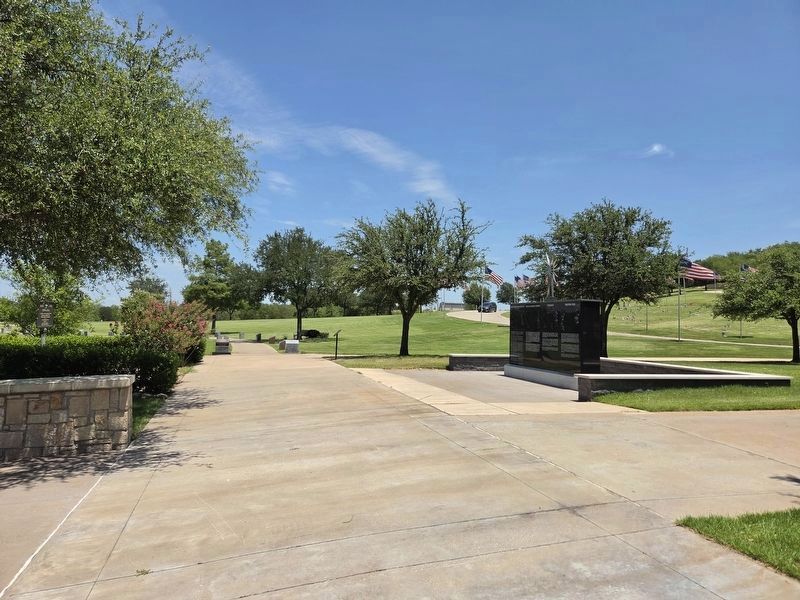
4. Jangjin (Chosin) Reservoir Battle Marker
The view of the front of the memorial looking towards the northeast.
This airstrip enabled more than 4,000 casualties to be evacuated by air and permitted 537 replacements and nearly 400 tons of supplies and ammunition to be flown into Hagaru-ri.
The key to the successful defense of Hagaru-ri and the force breakout was the commanding terrain called "East Hill." The fight for its control began on 29 November 1950 and was continual and vicious until it was finally secured for the breakout.
By 6 December, U.N. forces were reorganized and began the difficult and costly fight from Hagaru-ri down "Hell Fire Valley" to Koto-ri.
Hell Fire Valley
On 29 November 1950, the vital Marine position at Hagaru-ri was in danger of being overrun by the Chinese. Reinforcements, including about 900 men supported by 29 tanks and 141 vehicles, were ordered to fight through to Hagaru-ri from Koto-ri at all costs. The organization was designated Task Force Drysdale, named for the British Royal Marine colonel who commanded the force.
Chinese forces continuously fired on the task force as it fought toward Hagaru-ri. At a place that became known as "Hell Fire Valley" because of the heavy losses of men and vehicles, the Chinese attacks cut the convoy into several sections. After a day of hard fighting, George Company of the 1st Marines, about 200 Royal Marine Commandos, and 16 Marine tanks made it through to Hagaru-ri just in time to reinforce the defensive lines against repeated Chinese attacks. Several groups of Marines and soldiers in "Hell Fire Valley" were subsequently surrounded and captured; others made their way back to Koto-ri.
On 6 December, when the U.N. forces returned to "Hell Fire Valley" in the advance to Koto-ri, the Chinese attempted again to block the road. The U.N. forces overcame all resistance through skillful use of supporting arms and infantry assault tactics.
Koto-ri
From 28 November 1950 to the final breakout, elements of the 1st Marine Division and the U.S. Army's 7th Infantry Division at Koto-ri were surrounded, vastly outnumbered, and repeatedly assaulted by Chinese forces.
By the night of 7 December, U.N. units from Hagaru-ri had fought their way through to Koto-ri, and all units were preparing to begin the breakout to the sea. Clear weather was necessary so that Marine and Navy fighter planes could cover the breakout, but blinding snowstorms threatened to ground them.
On the night before the breakout, a single star was seen over Koto-ri through the falling snow, and the sky began to clear. The fighter planes returned at dawn. The vital treadway bridge sections were successfully air-dropped, and the breakout through the Hwangch'o-ryong (Funchilin Pass) began. This shining star quickly became known as "The Star of Koto-ri."
Hwangch'o-ryong (Funchilin Pass)
The final major obstacle to the successful fight to the sea was the destroyed bridge over a deep gorge at Hwangch'o-ryong (Funchilin Pass).
For the first time in history, the U.S. Air Force air-dropped a heavy bridge, which was installed by Army and Marine engineers protected by continuous close air support, infantry from the withdrawing force, and a company of Marines who had fought over the hills from Chinhung-ni.
Without the bridge, the entire U.N. force and the thousands of North Korean refugees following them to freedom might have been killed or captured.
The entire Jangjin (Chosin) Reservoir Battle resulted in the evacuation of military personnel and 98,000 North Korean refugees to South Korea.
These warriors received the Medal of Honor for their actions during the Jangjin (Chosin) Reservoir Campaign:
Capt. William E. Barber, USMC • *PFC William B. Baugh, USMC • Pvt. Hector A. Cafferata, Jr., USMCR • Lt. Col. Raymond G. Davis, USMC • *Lt. Col. Don C. Faith, Jr., USA • Lt. J.G. Thomas J. Hudner, Jr., USN • Sgt. James E. Johnson, USMC • SSgt. Robert S. Kennemore, USMC • *1st Lt. Frank N. Mitchell, USMC • Maj. Reginald R. Myers, USMC • *Lt. Col. John U. D. Page, USA • *Cpl. Lee H. Phillips, USMC • *Sgt. James I. Poynter, USMCR • *2nd Lt. Robert D. Reem, USMC • Capt. Carl L. Sitter, USMC • *SSgt. William G. Windrich, USMC • SSgt. Archie Van Winkle, USMC
*Posthumously Awarded
Not One Gave Up • All Gave Some • Some Gave All
Topics. This memorial is listed in this topic list: War, Korean. A significant historical date for this entry is November 27, 1950.
Location. 32° 42.993′ N, 96° 56.138′ W. Memorial is in Dallas, Texas, in Dallas County. It is in Mountain Creek. It is at the intersection of Patriot Avenue and Lone Star Circle, on the right when traveling south on Patriot Avenue. The marker is located in the eastern section of the Dallas-Fort Worth National Cemetery along the Memorial Path. Touch for map. Memorial is at or near this postal address: 2000 Patriot Ave, Dallas TX 75211, United States of America. Touch for directions.

Regionally, this memorial is in the Prairies & Lakes Region. Globally, it is in North America, a Gulf of Mexico state, the Western Hemisphere, the Western World, and the Anglosphere. Historically, it finds itself in what was once New Spain, the Republic of Texas, one of the Confederate States of America, and the Antebellum South.
Other nearby markers. At least 8 other markers are within walking distance of this marker: Dallas/Fort Worth National Cemetery (a few steps from this marker); Eternal Patrol (a few steps from this marker); Texas National Cemetery Foundation (a few steps from this marker); Big D Detachment (a few steps from this marker); First Marine Division (within shouting distance of this marker); Freedom Is Not Free (within shouting distance of this marker); Third Marine Division (within shouting distance of this marker); Veterans of Underage Military Service (within shouting distance of this marker). Touch for a list and map of all markers in Dallas.
Credits. This page was last revised on July 9, 2026. It was originally submitted on July 9, 2026, by James Hulse of Medina, Texas. This page has been viewed 15 times since then. Photos: 1, 2, 3, 4. submitted on July 9, 2026, by James Hulse of Medina, Texas.
