Bluefield in Mercer County, West Virginia — The American South (Appalachia)
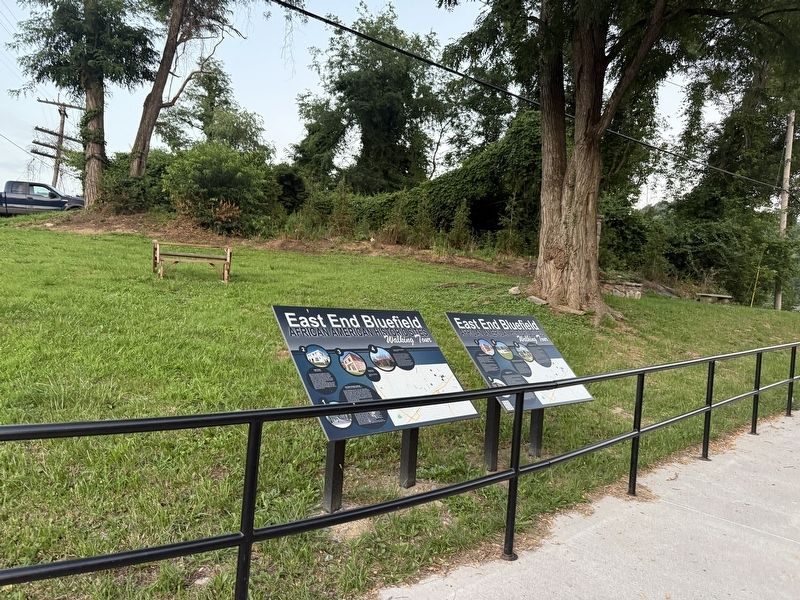
East End Bluefield African American Historic Sites
Walking Tour
![East End Bluefield African American Historic Sites Marker [Left side] image. Click for full size.](Photos9/956/Photo956759.jpg?79202663000PM "East End Bluefield African American Historic Sites Marker [Left side]. Click for full size.")
Photographed by Devry Becker Jones (CC0), July 3, 2026
1. East End Bluefield African American Historic Sites Marker [Left side]
❶ Grant Street Bridge (replaced)
Grant Street over Norfolk Southern Railyard
The Grant Street Bridge was built in 1941 by the Virginia Bridge Company of Roanoke Virginia. It is a two-span, riveted-plate Warren through truss bridge. The overall length of the structure was 320 feet with an overall width of 20 feet, excluding the pedestrian walkway along the northeast elevation. The structure consisted of trusses that were connected by riveted floor beams, sway struts, and upper and lower laterals. It had a metal grid deck, and the pedestrian walkway with wooden floor beams. The bridge was supported at each end by stone and concrete abutments and intermittently by two reinforced concrete open-bent type piers.
The bridge carried Grant Street over the Norfolk Southern railyard, connecting the residential neighborhood known as the East End to the north of the railyard to the downtown commercial center of Bluefield located to the south of the railyard.
The first bridge in this location was built around 1903. That bridge collapsed under the weight of an overloaded truck in September of 1940, leading to a protracted
this page online
Due to structural deficiencies, the bridge was closed to all traffic in 2019 and replaced by the West Virginia Division of Highways in 2022.
❷ Hotel Thelma
1509 Logan Street
Hotel Thelma is located on the northwestern corner of Wayne and Logan Streets in Bluefield. The two-story building of concrete block with glass
![East End Bluefield African American Historic Sites Marker [Right side] image. Click for full size.](Photos9/956/Photo956761.jpg?79202663100PM "East End Bluefield African American Historic Sites Marker [Right side]. Click for full size.")
Photographed by Devry Becker Jones (CC0), July 3, 2026
2. East End Bluefield African American Historic Sites Marker [Right side]
❸ Traveler's Inn
147 Wayne Street
Traveler's Inn is located on Wayne Street next to Hotel Thelma.
❹ Hancock Elementary School
209 Henry Street
Hancock Elementary School was built in 1925. The one-story school is built of yellow brick and the building had five classrooms. The school is on a slightly less than one acre lot and is surrounded by a partially paved schoolyard. Although integration became the law of the land when the Supreme Court decided Brown Vs. the Board of Education in 1954, the integration
Photographed by Devry Becker Jones (CC0), July 3, 2026
3. East End Bluefield African American Historic Sites Marker
❺ Alpha Phi Alpha Fraternity House
300 Sussex Street
The Alpha Phi Alpha House was built in 1907 by M. H. Pettigo for Charles Hancock, an early industrialist in Bluefield. Hancock owned the Bluefield Hardware Store, which supplied wholesale hardware to mines. The house is an American Four-Square plan in the Neoclassical Revival style. Built with imported and local building materials, it is among the most prominent in the East End neighborhood. The house sits on a hill overlooking the Norfolk & Western Railyard and wrap-around front porch. The first floor of the house contains an entrance hall, great room, study, living room, dining room, and kitchen, while the upper floors contain six bedrooms.
In 1962, the Hancock House was purchased by Bluefield State College chapter of the Alpha Phi Alpha fraternity. Following the purchase and dedication in 1963, the house was used asa residence for undergraduate Alpha Phi Alpha fraternity brothers and as a hall for balls, parties, musical performances and other university and community events.
In 1966, Duke Ellington gave a private concert at the house following a performance at Bluefield State College.
The Alpha Phi Alpha Fraternity House was listed in the National Register of Historic Places in 1989 under the identification number NR#: 89001783.
Note: The Alpha Phi Alpha house is now in private ownership. Please observe the house only from Henry Street or Sussex Street and do not trespass on the property.
❻ Hardy Street Recreation Center (demolished)
Hardy Street between Fairfax Street and Floyd Street
The Hardy Street Recreation Center opened in June of 1952. It was a two-story concrete block building located on a flat lot on Hardy Street. A basketball court, baseball diamond, wading pool, and playground were also located on the site. Programming included dance classes, sports, crafting, and holiday parties. The center was also used for receptions, birthday parties, civic club meetings, and other community events.
Although at first a product of the "separate but equal" era in Bluefield, the Hardy Street Recreation Center was a beloved community gathering space with activities for children and teenagers. It operated throughout the 1990s but fell into disrepair in the 2000s. After several attempts to renovate the building, it was demolished by the City of Bluefield. The site remains as the Hardy Street Park with playgorund equipment and lawns.
❼ Park Central High School
102 Park Street
Park Central High School was built in 1949 and opened to its first class in September of the same year. Set upon half a city block in the North Side neighborhood of Bluefield. Park Central served African American students in 10th, 11th, and 12th grades. The two-story, red brick building was constructed in the International style.
It contains thirteen classrooms, a cafeteria able to accommodate 300 students, a library, and various administrative offices. In 1957, a massive, vaulted auditorium and gym was added to the east elevation of the building.
In 1968, the Mercer County School Board voted to close Park Central High School and students were transferred to Bluefield High located across the railyard in the city's downtown. The class of 1969 was the last to graduate at the school.
The school was sold in 1985 to the Greater Mount Zion Pentecostal Church, who are the current owners. A vestiblue entry was added to the south elevation, but the building retains the layout and exterior finishing present when it was built. Alumni of Park Central High are among the Church Elders and the building is lovingly maintained.
❽ Bluefield State College
219 Rock Street
Industrialization in southern West Virginia brought an influx of African American families to the region in the 1890s. To attract and retain the workforce needed in the mining and railroad industries, state politicians courted these families with promises of improved education opportunities.
Originally called the Bluefield Colored Institute, Bluefield State College was founded in 1895 and the first classes were held in 18897. As the college grew in size, influence, and capacity, the name was changed in 1929 to Bluefield Institute and in 1931 to Bluefield State Teachers College.
In the mid-20th century, Bluefield State was the cultural and intellectual center of the Black community in southern West Virginia. Noted intellectuals such as the poet Langston Hughes came to lecture, and musical stars such as Duke Ellingotn, Fats Waller, and Dizzy Gillespie performed at the college auditorium.
Up until the 1960s, the college was led by African American presidents, first Professor Hamilton Hatter, then RogerPage Sims, who led the college from 1906 to 1936. Sims led the expansion of the campus and initiated new programs of study, more than doubling enrollment over his tenure. Henry Lake Dickason became president upon Sims's retirement in 1936 and led the school through continued expansion over 16 years. It was during this period that several buildings were designed by Alex Mahood, notable West Virginia architect, were erected on campus. The last Black president of the college was Leroy Allen, who led the school between 1958 to 1965.
Following desegregation in the 1960s, Wendell Hardaway, who was white, was appointed president. The school shifted away from its roots as a Historically Black college and began enrolling commuter students from the southern West Virginia region, leading to an increasingly white student body. Hardaway closed the college's dormitories in 1968 following a bombing at the physical education building. Closure of the dormitories disrupted the education and community of the mostly Black residential students, effectively bringing the historical era of the college to a close. In the 21st century, Bluefield State College serves a diverse student body and reopened renovated and newly built dormitories in 2021.
Topics and series. This historical marker is listed in these topic lists: Bridges & Viaducts • Education • Industry & Commerce • Settlements & Settlers. In addition, it is included in the African Methodist Episcopal Zion (AME Zion) Church, and the Historically Black Colleges and Universities series lists. A significant historical month for this entry is March 1941.
Location. 37° 16.368′ N, 81° 13.06′ W. Marker is in Bluefield, West Virginia, in Mercer County. It is at the intersection of Grant Street and Wayne Street, on the right when traveling north on Grant Street. Touch for map. Marker is at or near this postal address: 1005 Wayne St, Bluefield WV 24701, United States of America. Touch for directions.

Regionally, this marker is in the Southern Coalfields. It is also in the American South, specifically in the Upper South, in Appalachia, and specifically in Southern Appalachia. Globally, it is in North America, the Western Hemisphere, the Western World, and the Anglosphere. Historically, it finds itself in what was once the territory of the Mississippian Culture.
Other nearby markers. At least 8 other markers are within walking distance of this marker: Hotel Thelma (about 500 feet away, measured in a direct line); Coal Heritage Trail (approx. ¼ mile away); Gateway to the "Billion Dollar Coalfield" (approx. ¼ mile away); Railroads: Prelude Prelude to Prosperity (approx. ¼ mile away); Bluefield Rail Yards (approx. ¼ mile away); Where the Chicory Blooms (approx. ¼ mile away); West Virginia's Most Diverse City (approx. ¼ mile away); Legends and Landmarks (approx. ¼ mile away). Touch for a list and map of all markers in Bluefield.
Additional commentary.
1. About Bluefield State University
As of 2026, Bluefield State University is one of three Historically Black Colleges and Universities (HBCUs) in the United States that is also a Predominantly White Institution (PWI). The other two schools are West Virginia State University (Institute, West Virginia) and Shelton State Community College (Tuscaloosa, Alabama).
— Submitted July 9, 2026, by Devry Becker Jones of Washington, District of Columbia.
Credits. This page was last revised on July 9, 2026. It was originally submitted on July 9, 2026, by Devry Becker Jones of Washington, District of Columbia. This page has been viewed 17 times since then. Photos: 1, 2, 3. submitted on July 9, 2026, by Devry Becker Jones of Washington, District of Columbia.
