Sudbury in Suffolk, England, United Kingdom — Northwestern Europe (the British Isles)
Sudbury and the Woollen Cloth Industry
Photographed by Ray Gurganus, April 18, 2026
1. Sudbury and the Woollen Cloth Industry Marker
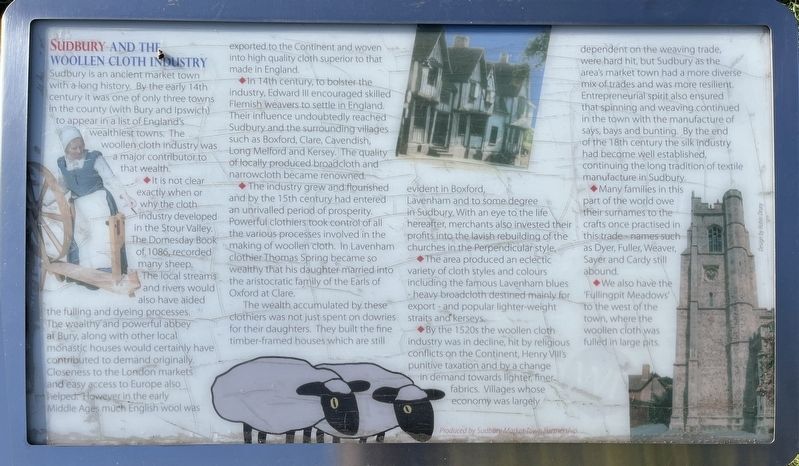
It is not clear exactly when or why the cloth industry developed in the Stour Valley. The Domesday Book of 1086, recorded many sheep. The local streams and rivers would also have aided the fulling and dyeing processes. The wealthy and powerful abbey at Bury, along with other local monastic houses would certainly have contributed to demand originally. Closeness to the London markets and easy access to Europe also helped. However in the early Middle Ages much English wool was exported to the Continent and woven into high quality cloth superior to that made in England.
In 14th century, to bolster the Industry, Edward III encouraged skilled Flemish weavers to settle in England. Their influence undoubtedly reached Sudbury and the surrounding villages: such as Boxford, Clare, Cavendish, Long Melford and Kersey. The quality of locally produced broadcloth and narrowcloth
this page online
The industry grew and flourished and by the 15th century had entered an unrivalled period of prosperity. Powerful clothiers took control of all the various processes involved in the making of woollen cloth. In Lavenham clothier Thomas Spring became so wealthy that his daughter married into the aristocratic family of the Earls of Oxford at Clare.
The wealth accumulated by these clothiers was not just spent on dowries for their daughters. They built the fine timber-framed houses which are still evident in Boxford, Lavenham and to some degree in Sudbury. With an eye to the life hereafter, merchants also invested their profits into the lavish rebuilding of the churches in the Perpendicular style.
The area produced an eclectic variety of cloth styles and colours including the famous Lavenham blues heavy broadcloth destined mainly for export and popular lighter-weight straits and kerseys.
By the 1520s the woollen cloth industry was in decline, hit by religious conflicts on the Continent, Henry Vill's punitive taxation and by a change in demand towards lighter, finer fabrics. Villages whose economy was largely
Photographed by Ray Gurganus, April 18, 2026
2. Sudbury and the Woollen Cloth Industry Marker
Many families in this part of the world owe their surnames to the crafts once practised in this trade - names such as Dyer, Fuller, Weaver, Sayer and Cardy still abound.
We also have the 'Fullingpit Meadows' to the west of the town, where the woollen cloth was fulled in large pits.
Erected by Sudbury Market Town Partnership.
Topics. This historical marker is listed in this topic list: Industry & Commerce.
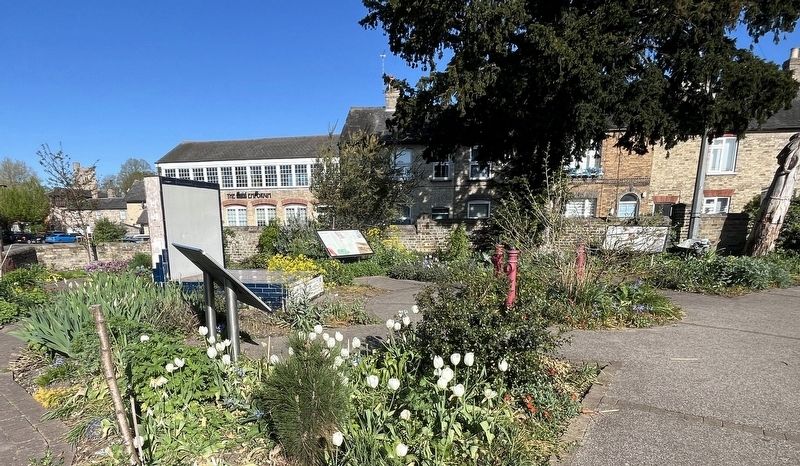
Location. 52° 2.386′ N, 0° 43.772′ E. Marker is in Sudbury, England, in Suffolk. It is at the intersection of Gaol Lane and Siam Place, on the right when traveling west on Gaol Lane. In Weavers Piece Gardens. Touch for map. Marker is at or near this postal address: 47 Gaol Lane, Sudbury, England CO10 1RF, United Kingdom. Touch for directions.

Regionally, this marker is in England’s East Anglia. Globally, it is on the Atlantic Ocean, in the North Atlantic Region, in Europe, in Atlantic Europe, on one of the British Isles, in the Western World, and in the Anglosphere. Historically, it finds itself in what was once the Roman Empire.
Other nearby markers. At least 8 other markers are within 21 kilometers of this marker, measured as the crow flies: Sudbury - the Arrival of Silk Manufacturing (here, next to this marker); The Lady Elizabeth (about 150 meters away, measured in a direct line); Dodie Smith (1896-1990) (about 180 meters away); Sudbury Station (approx. half a kilometer away); A Short History of Beautiful Sudbury (approx. 0.6 kilometers away); Thomas Gainsborough (approx. 8.1 kilometers away); The History of Chappel and Wakes Colne (approx. 12.9 kilometers away); Priory Street Bastion 5 (approx. 20.7 kilometers away). Touch for a list and map of all markers in Sudbury.
Credits. This page was last revised on July 10, 2026. It was originally submitted on July 9, 2026, by Ray Gurganus of Washington, District of Columbia. This page has been viewed 22 times since then. Photos: 1, 2. submitted on July 9, 2026, by Ray Gurganus of Washington, District of Columbia. • Andrew Ruppenstein was the editor who published this page.
