Cedar Hill in Selkirk in Albany County, New York — The American Northeast (Mid-Atlantic)
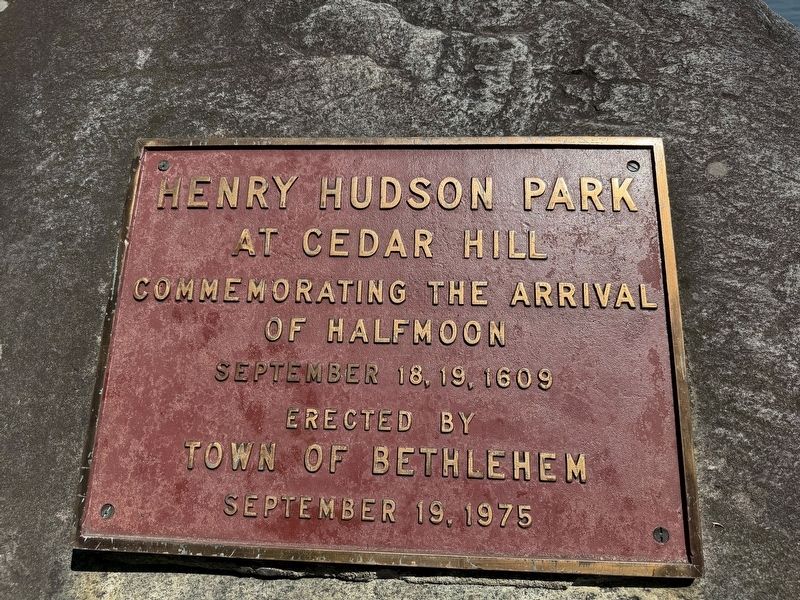
Henry Hudson Park at Cedar Hill
Photographed by Trudi Jacobson, July 8, 2026
1. Henry Hudson Park at Cedar Hill Marker
September 18, 19, 1609
Erected 1975 by Town of Bethlehem.
Topics. This historical marker is listed in this topic list: Exploration. A significant historical date for this entry is September 18, 1609.
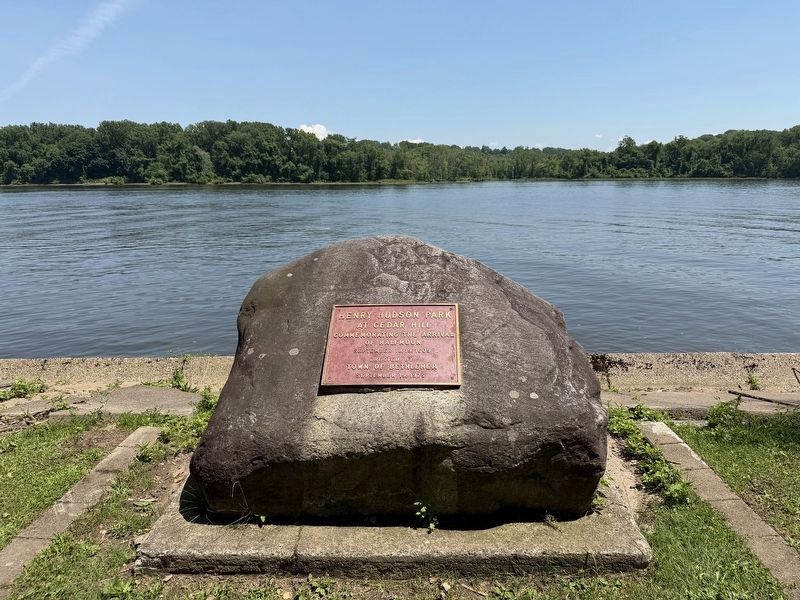
Location. 42° 32.677′ N, 73° 45.543′ W. Marker is in Selkirk, New York, in Albany County. It is in Cedar Hill. It is on Lyons Road one mile east of River Road (New York State Route 144), on the left when traveling south. The plaque is mounted to a rock next to the flagpole, by the river. Touch for map. Marker is at or near this postal address: 157 Lyons Road, Selkirk NY 12158, United States of America. Touch for directions.

Regionally, this marker is in Upstate New York, in the Capital District, and in the Albany Metropolitan Area. It is also in the American Northeast and in the Mid-Atlantic. Globally, it is in North America, the Western Hemisphere, the Western World, and the Anglosphere. Historically, it finds itself in what was once New Netherland and also one of the original Thirteen Colonies.
Other nearby markers. At least 8 other markers are within 3 miles of this marker, measured
this page online
Related markers. Click here for a list of markers that are related to this marker.
Also see . . . Henry Hudson (Wikipedia). Excerpt concerning the 1609 expedition:
…Hudson sailed into the Upper New York Bay on 11 September, and the following day encountered a large group of 28 Lenape canoes occupied by Lenape Natives, from whom he bought oysters and beans. He then began a journey up what is now known as the Hudson River. Over the next ten days his ship ascended the river, reaching a point near Stuyvesant Landing (Old Kinderhook). There the ship's boat with five crew members ventured to the vicinity of present-day Albany.(Submitted on July 10, 2026.)
On 23 September, Hudson decidedto return to Europe.…Photographed by Trudi Jacobson, July 8, 20262. Henry Hudson Park at Cedar Hill Marker with the Hudson River in the Background
While exploring the Hudson River, Hudson had traded with several native groups, mainly obtaining furs. His voyage established Dutch claims to the region and to the fur trade that prospered there when a trading post was established at Albany in 1614. New Amsterdam on Manhattan Island became the capital of New Netherland in 1625.
Credits. This page was last revised on July 10, 2026. It was originally submitted on July 9, 2026, by Trudi Jacobson of Slingerlands, New York. This page has been viewed 27 times since then. Last updated on July 10, 2026, by Trudi Jacobson of Slingerlands, New York. Photos: 1. submitted on July 9, 2026, by Trudi Jacobson of Slingerlands, New York. 2. submitted on July 10, 2026, by Trudi Jacobson of Slingerlands, New York. • Devry Becker Jones was the editor who published this page.
